SEO
Zero-Click Search: An SEO Strategy for the No-Click Era

For years SEO success meant clicks. That assumption is breaking. With AI Overviews and rich answer features, a large and growing share of searches are resolved without anyone leaving the results page. SparkToro's 2026 analysis put US zero-click searches around 68%. Treating this as a disaster leads to bad decisions; treating it as a shift you can plan for leads to better ones. This article lays out a practical strategy for the no-click era.
Quick answer
Zero-click search is when a query is answered on the results page, through AI Overviews, featured snippets or knowledge panels, so the user never clicks a link. A reported majority of searches now end this way. The strategy is not to fight it but to adapt: win visibility inside the answer, prioritise queries where a click still has value, and capture demand through brand, not just traffic. Measure success by visibility and conversions, not clicks alone.
Key takeaways
- Zero-click is now the majority of searches and is unlikely to reverse.
- Win visibility inside the answer for queries that no longer click.
- Prioritise commercial and complex intent where clicks still convert.
- Capture demand through brand, and build owned channels you control.
- Measure visibility, branded demand and conversions, not clicks alone.
Why zero-click is rising
Search engines increasingly answer the question directly to keep users satisfied and on the page. AI Overviews synthesise an answer from multiple sources; featured snippets lift a passage; knowledge panels show facts. For simple informational and factual queries, the user often has what they need without clicking. This is unlikely to reverse, so strategy has to account for it.
What zero-click does not mean
It does not mean SEO is dead or that traffic disappears. It means the value of a search shifts. Visibility inside the answer still builds awareness and trust. Commercial and complex queries still drive clicks, because people want to compare, buy or go deep. The job is to protect and grow value where it still exists and to earn visibility where the click is gone.
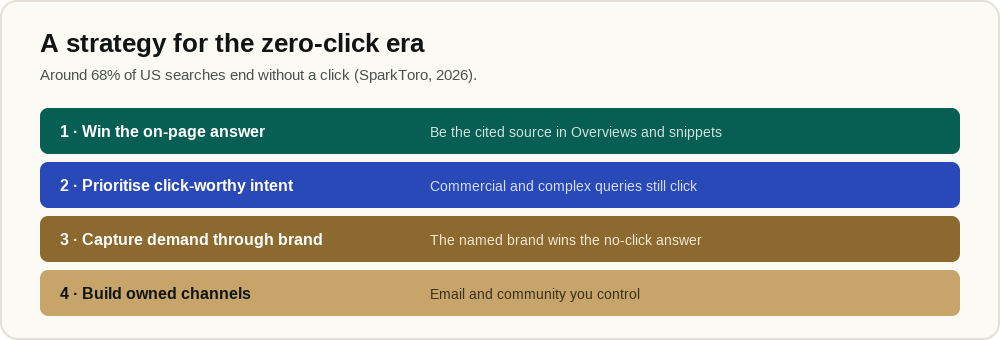
The strategy, in four moves
1. Win the on-page answer
For queries you cannot keep as clicks, aim to be the cited source in the Overview or snippet. Lead with a direct answer, structure the page clearly, and strengthen the authority that gets you selected. Being the quoted brand is the new "ranking" for these queries.
2. Prioritise click-worthy intent
Shift effort toward queries where a click still matters: commercial comparisons, buying decisions, tools, and complex how-to that cannot be fully answered in a snippet. These resist zero-click and still convert.
3. Capture demand through brand
When the answer appears without a click, the brand named in it wins. Invest in being that brand: consistent naming, genuine authority, and content worth remembering. Branded search and direct visits become key signals of success.
4. Build owned channels
Reduce dependence on borrowed reach. Email capture, a genuine community, and distribution on channels you control turn fleeting visibility into durable relationships that no algorithm change can erase.
How to measure in the no-click era
Clicks alone understate your performance. Track impressions and visibility for target queries, whether you are cited in answers, branded search and direct traffic, and ultimately conversions and revenue. A page that loses clicks but lifts brand awareness and assisted conversions may be winning, not losing.
Common mistakes
- Panicking and chasing only high-volume informational terms that no longer click.
- Judging every page by clicks, ignoring visibility and assisted value.
- Ignoring commercial and complex queries where clicks remain strong.
- Neglecting brand and owned channels, leaving you fully exposed to answer features.
FAQ
Frequently asked questions
Not necessarily. It changes where value sits. You lose some informational clicks but can win visibility and brand awareness, and commercial clicks often remain strong.
Focus on queries that still click, commercial and complex ones, and convert the awareness from answer features into branded search, direct visits and owned-channel signups.
No, but be strategic. Informational content builds authority and can win answer citations; just do not expect the click volumes of the past, and pair it with click-worthy commercial content.
Report visibility and citation presence, branded search, direct traffic, and assisted conversions, not clicks in isolation. Tie SEO to business outcomes.
The trend points that way as AI answers expand. Planning for it now, by winning answers and building brand, is more durable than resisting it.
Similar posts
AI Search & GEO
Generative Engine Optimization (GEO): The Complete Playbook for Getting Cited by AI
A practitioner's guide to GEO: how to get your brand cited by ChatGPT, Google AI Overviews and Perplexity. What works, what you cannot control, and a 30-day plan.
6 min read
SEO
Will AI Search Kill SEO? An Honest Answer
No, AI will not kill SEO, but it is changing it. What actually changes, what stays the same, why SEO skills transfer to GEO and AEO, and how to adapt without panic.
3 min read
AI Search & GEO
How to Appear in Google AI Overviews
How to improve your chances of being cited in Google AI Overviews: rank for the query, answer it cleanly, and strengthen E-E-A-T. What you can and cannot control.
5 min read
Related services