AI Search & GEO
How to Appear in Google AI Overviews

Google AI Overviews summarise an answer at the top of many results pages and link to a few supporting sources. For informational queries in particular, they can sit above the traditional links and capture the attention that once went to the top result. Brands want to be one of the cited sources, because it keeps them visible even when the user does not scroll. This article explains, honestly, what influences inclusion and how to improve your chances without chasing tricks.
Quick answer
To appear in Google AI Overviews, earn strong conventional search visibility and make your content easy for Google to extract. Overviews are generated from the web Google already indexes and tends to draw on pages that rank well, answer the query directly, and demonstrate experience and trust. You cannot force inclusion, but ranking on page one, answering the exact question clearly, and strengthening E-E-A-T are the levers that matter most.
Key takeaways
- Overviews draw on pages that already rank and answer the query cleanly.
- Win conventional ranking first; it is the entry requirement.
- Lead with a direct answer, mirror the question in headings, and cover follow-ups.
- Experience and trust signals strongly influence source selection.
- You can improve candidacy but cannot guarantee inclusion or wording.
How AI Overviews pick sources
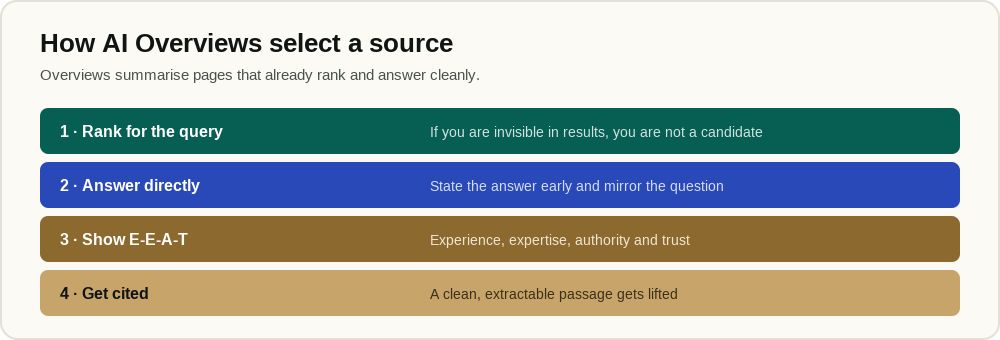
Overviews are built from Google's existing index and ranking systems, then summarised by a model. In practice the cited pages are usually ones that already perform well for the query and that answer it cleanly. So the work is twofold: rank for the query in the normal way, and format the page so the specific answer is easy to lift.
Rank for the query first
If you are not visible in conventional results for a query, you are unlikely to feature in its Overview. That means the usual priorities apply: match search intent, cover the topic thoroughly, earn authority, and keep the page technically sound. Overviews reward the same quality that ranking rewards, then add an extraction step on top.
Answer the exact question, early and clearly
Overviews lift concise, direct answers. Help Google find yours.
- State the answer to the query in the first paragraph, in a self-contained way.
- Use headings that mirror the question and its common variations.
- Break complex answers into short steps or a simple table.
- Keep each section focused so the relevant passage is unambiguous.
Strengthen experience and trust
Google has emphasised experience, expertise, authoritativeness and trust for years, and these matter for being chosen as a source. Show first-hand experience, name credible authors, cite and align with reliable information, and keep your facts consistent. Thin or contradictory content is a weak candidate.
Cover the follow-up questions
Overviews often address a cluster of related sub-questions. A page that answers the main query and its natural follow-ups, with an FAQ and supporting sections, gives Google more surface to draw from. Link to deeper pages on each sub-topic so the cluster reinforces itself.
Technical and structured-data basics
Make sure the page is crawlable and renderable, with key content in the HTML. Add relevant structured data, such as FAQ or how-to where appropriate, to help Google understand the page. Structured data supports comprehension; it does not buy inclusion.
What you cannot control
You cannot guarantee an Overview will appear for a query, that you will be cited, or how you will be summarised. Overviews vary by query, location and time, and Google adjusts when and how they show. Aim to be a strong candidate across many queries rather than fixating on one.
How to measure
Track rankings and impressions for your target queries in Search Console, watch for queries where Overviews appear and whether your clicks change, and periodically check a set of real questions to see whether you are cited. Expect click patterns to shift as Overviews expand, and judge success across the topic, not a single term.
FAQ
Frequently asked questions
There is no sign-up or submission form. You appear mainly by ranking for the query and answering it clearly on a page that shows real expertise. Put a direct answer near the top, back claims with specifics, keep the page indexable, and add accurate structured data. Results vary, so track appearances in Search Console rather than assuming.
Start with the queries that already bring you impressions, and make sure each page answers its question in the first few lines with evidence. Then strengthen the author and organisation signals on the page, link related guides together, and check progress over several weeks. Showing up is a function of relevance and trust, not a trick.
They sit above or among them for many queries, but traditional links remain. Being cited in an Overview is additional visibility, not a separate system.
Controls over how Google uses your content evolve, but opting out of Overviews can also affect normal visibility. Check current Google documentation before changing anything.
Overviews can answer the question on the page, reducing clicks for some informational queries. Focus on queries where a click still has value and on being the cited source.
It helps Google understand your page but does not guarantee inclusion. Treat it as support for clear, accurate content.
They are related but not identical. Both reward clear, direct answers, but Overviews are AI-generated summaries that may combine several sources.
Similar posts
AI Search & GEO
Generative Engine Optimization (GEO): The Complete Playbook for Getting Cited by AI
A practitioner's guide to GEO: how to get your brand cited by ChatGPT, Google AI Overviews and Perplexity. What works, what you cannot control, and a 30-day plan.
6 min read
AI Search & GEO
How to Get Your Brand Cited by ChatGPT
How to improve your odds of being cited by ChatGPT: retrievable pages, answer-ready content, consistent branding and real authority. Honest about what you cannot control.
4 min read
AI Search & GEO
How to Get Cited by Perplexity
Perplexity retrieves and cites live sources. Learn how to be discoverable, relevant, quotable and credible so it chooses your page, and how to audit your citations.
3 min read
Related services