AI Search & GEO
Generative Engine Optimization (GEO): The Complete Playbook for Getting Cited by AI

Search is shifting from a list of links to a synthesised answer. A large share of searches now end without a click, and AI systems increasingly answer the question on the spot, citing a handful of sources rather than sending everyone to ten blue links. For brands, the question is changing from "where do we rank" to "are we the source the AI quotes". This playbook explains what GEO is, how it relates to SEO and AEO, what actually influences AI citations, and a practical way to start. It is written for operators who want durable results, not quick hacks, because the engines change often and shortcuts age badly.
Quick answer
Generative Engine Optimization (GEO) is the practice of getting your brand and content referenced inside AI-generated answers from tools like ChatGPT, Google AI Overviews, Perplexity and Copilot. It does not replace SEO. It builds on the same foundations, accessible pages, clear facts and genuine authority, and adds a focus on being quoted rather than only ranked. No method guarantees inclusion, because the engines decide what to surface, but you can measurably improve your odds.
Key takeaways
- GEO is getting cited inside AI answers; it extends SEO rather than replacing it.
- You cannot guarantee inclusion, but retrievable, parseable, trustworthy content measurably improves your odds.
- Optimise across engines, not just Google, because discovery is now fragmented.
- Lead with a quotable answer, state facts plainly, and make authorship and expertise clear.
- Off-site authority and original assets still do the heavy lifting.
- Measure with a basket of imperfect signals and a manual prompt scorecard.
What GEO is, and is not
GEO is the discipline of earning mentions and citations in generative AI answers. It is not a separate website you build, a single setting you switch on, or a guaranteed placement you can buy. Think of it as the natural extension of good SEO into a world where the "result" is often a paragraph written by a model rather than a link you click.
It overlaps heavily with two neighbours. SEO makes your pages discoverable and trustworthy to search engines. AEO, answer engine optimization, structures your content so a machine can extract a clean, correct answer. GEO is the broader goal: being the source that generative systems choose to represent a topic. In practice you do all three at once.
Why GEO matters now
Three shifts make this urgent. First, answers are replacing clicks, so visibility increasingly means being inside the answer, not under it. Second, discovery is spreading across engines, Google AI Overviews, ChatGPT, Perplexity, Copilot and others, so optimising for one is no longer enough. Third, AI systems lean on sources that are clear, consistent and credible, which rewards brands that invest in genuine expertise and punishes thin, contradictory content.
How AI engines choose what to cite
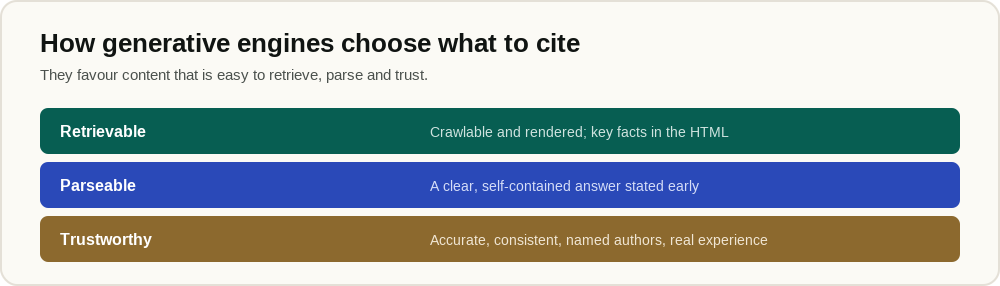
No one outside the labs has the exact formula, and it differs by engine. But the observable pattern is consistent. Generative systems favour content that is easy to retrieve, easy to parse, and safe to trust.
That is why GEO and strong fundamentals are the same project. A model cannot cite what it cannot read, and it is reluctant to cite what it cannot verify.
- Retrievable: the page can be crawled and rendered, important facts are in the HTML rather than hidden behind interactions, and the site is referenced elsewhere.
- Parseable: the answer to a likely question is stated plainly, early, and in a self-contained way, so a model can lift it without guessing.
- Trustworthy: the claims are accurate and consistent with the wider web, the author and brand are identifiable, and the content shows real experience.
The GEO foundations
Be genuinely discoverable
Make sure your important pages can be crawled and rendered, use clean internal links, valid status codes, canonical URLs and accurate sitemaps. If key information only appears after a click or script that a crawler may not execute, treat it as invisible. Technical access does not guarantee citations, but inaccessible pages cannot be cited at all.
State facts plainly and early
Lead with a direct, quotable answer. Use clear question-style headings, keep one idea per section, and write short declarative sentences for the facts that matter. This "answer-ready" structure is what lets a model extract your point cleanly instead of paraphrasing a competitor.
Build real expertise and entity clarity
Use consistent names for your organisation, products and the people behind the content. Show first-hand experience, name your authors, and keep claims accurate. Over time this builds an "entity" the engines associate with your topic, which is what makes you a default source rather than an occasional one.
Earn authority off-site
Citations in AI answers correlate with being referenced across the wider web. Original data, useful tools, genuine PR and real relationships still matter, arguably more than ever, because they are hard to fake and easy for a model to corroborate.
A sensible measurement approach
You cannot manage what you do not watch, but AI visibility is harder to measure than rankings. Combine a few imperfect signals rather than trusting one number: track whether your brand appears in AI answers for a defined set of prompts, watch referral traffic from AI tools where it is reported, monitor branded search and direct demand, and keep a simple log of manual checks across engines. Treat these as directional, not precise.
Common mistakes
- Treating GEO as a trick rather than an extension of quality and authority.
- Optimising for one engine and ignoring the others.
- Hiding key facts behind scripts, tabs or images with no text equivalent.
- Publishing thin, undifferentiated content that a model has no reason to prefer.
- Chasing guaranteed placements that no legitimate provider can offer.
A 30-day starting plan
- 01Pick one priority topic and audit whether your best page on it is crawlable, clearly answered early, and consistent with your other pages.
- 02Add a quotable quick answer, question-style headings and an FAQ with schema to that page.
- 03Define 15 to 20 real prompts a buyer would ask an AI about your topic, and record who gets cited today.
- 04Fix the biggest gaps, missing facts, unclear authorship, weak internal links to supporting pages.
- 05Publish or strengthen two supporting articles that answer adjacent questions, and link them together.
- 06Re-check your prompts after a few weeks and keep a simple scorecard.
FAQ
Frequently asked questions
GEO builds on SEO. SEO makes pages discoverable and trusted; GEO focuses on being cited inside AI answers. You do both together, and strong SEO is a prerequisite for GEO.
No. The engines decide what to surface, and anyone promising guaranteed inclusion is overselling. You can improve your odds with clear, accurate, authoritative content, not buy a placement.
Not to start. You need accessible pages, answer-ready content and genuine authority. Dedicated AI-visibility trackers help you measure, but they are optional at the beginning.
Like SEO, it compounds. Fixes to clarity and structure can show up within weeks for some prompts, while authority and entity strength build over months.
It helps machines parse and trust your content, and it supports AEO, but it complements accurate, accessible page content rather than replacing it.
Similar posts
AI Search & GEO
How to Get Your Brand Cited by ChatGPT
How to improve your odds of being cited by ChatGPT: retrievable pages, answer-ready content, consistent branding and real authority. Honest about what you cannot control.
4 min read
AI Search & GEO
How to Appear in Google AI Overviews
How to improve your chances of being cited in Google AI Overviews: rank for the query, answer it cleanly, and strengthen E-E-A-T. What you can and cannot control.
5 min read
AI Search & GEO
GEO vs SEO vs AEO: What's the Difference and How They Work Together
SEO ranks, AEO answers, GEO gets cited by AI. A clear explanation of how the three differ, where they overlap, and one combined workflow that serves all three.
4 min read
Related services