SEO
Will AI Search Kill SEO? An Honest Answer

Every few years something is declared the death of SEO: social, voice, apps, now AI. The reality is always more nuanced. AI search genuinely changes how people find answers and how traffic flows, and anyone who ignores that will struggle. But the claim that optimisation itself is over misreads how these systems work. This article gives an honest, practitioner view of what AI changes, what it does not, and how to adapt without panic.
Quick answer
No, AI search will not kill SEO, but it is changing it significantly. The fundamentals, making content discoverable, relevant, accurate and authoritative, matter as much as ever, because AI answers are built from the web those fundamentals shape. What changes is the goal: alongside ranking and clicks, you now optimise to be the source cited inside AI answers. SEO is evolving into a broader discipline, not disappearing.
Key takeaways
- AI search changes SEO; it does not end it.
- The fundamentals that drive ranking also drive AI citations.
- Optimise to be cited, not only to rank, and measure visibility and brand demand.
- SEO skills transfer directly to GEO and AEO.
- The real risk is thin content and single-engine dependence, not optimisation itself.
What is actually changing
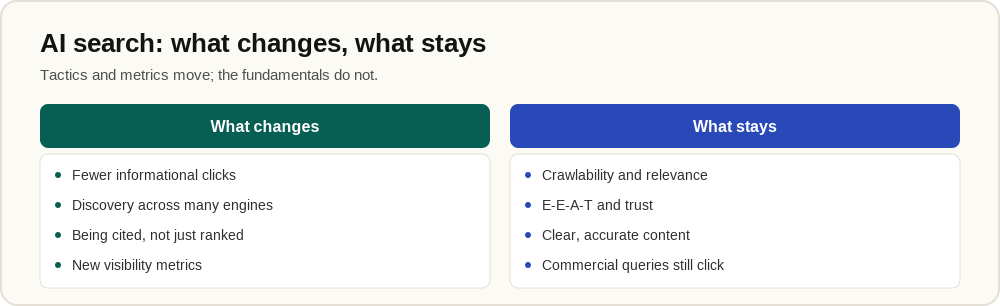
These are real shifts, and they change tactics and reporting meaningfully.
- More answers resolve on the results page, so informational clicks fall.
- Discovery spreads across engines: Google, AI Overviews, ChatGPT, Perplexity, Copilot and more.
- Being cited inside an answer becomes a form of visibility that is not a ranking or a click.
- Measurement shifts from position and clicks toward visibility, citation share and brand demand.
What is not changing
The inputs to success are remarkably stable. The outputs and how you measure them are what moved.
- AI answers are built from the indexed web, so discoverability and crawlability still decide whether you can be used at all.
- Relevance to the question still determines whether you are a candidate.
- Experience, expertise, authority and trust still decide who gets chosen and cited.
- Clear, accurate, well-structured content still wins, now even more, because machines must parse it.
- Commercial and complex queries still drive clicks and conversions.
Why SEO skills transfer directly
Everything that makes a page a good search result, technical health, intent match, depth, authority, clear answers, is exactly what makes it a good AI source. Teams that have done SEO well are well placed to do GEO and AEO, because it is the same craft applied to a new surface. The brands at risk are those that treated SEO as keyword tricks rather than genuine quality and authority.
How to adapt
- 01Keep the foundations strong: crawlability, speed, internal links, accurate sitemaps.
- 02Write answer-ready content: lead with the answer, use clear structure, add FAQs and schema.
- 03Build topic clusters and a recognisable brand entity with named, credible authors.
- 04Invest in off-site authority and original assets that are hard to fake.
- 05Broaden measurement to visibility, citation share and brand demand, not just clicks.
- 06Protect click value where it remains, in commercial and complex queries.
The honest risks
There are real downsides to plan for. Informational click volumes are likely to keep falling. Dependence on a single engine is riskier as discovery fragments. And low-quality, undifferentiated content, including thin AI-generated pages, has less reason to exist when a model can generate the same thing. The response is higher quality, genuine expertise, and broader presence, not abandoning optimisation.
FAQ
Frequently asked questions
No. The skills transfer directly to optimising for AI answers. Practitioners who focus on quality and authority are more valuable, not less.
No. AI answers are built from the indexed web, so the discoverability and trust SEO creates are prerequisites for AI visibility.
It can reduce informational clicks. Commercial and complex queries tend to hold up, and you can offset losses by winning citations and brand demand.
The goal broadens from ranking and clicks to also being the cited source in AI answers, and measurement expands accordingly.
Genuine expertise, clear and accurate content, a strong brand entity, and presence across multiple engines. Quality and authority are the durable moat.
Similar posts
AI Search & GEO
Generative Engine Optimization (GEO): The Complete Playbook for Getting Cited by AI
A practitioner's guide to GEO: how to get your brand cited by ChatGPT, Google AI Overviews and Perplexity. What works, what you cannot control, and a 30-day plan.
6 min read
AI Search & GEO
GEO vs SEO vs AEO: What's the Difference and How They Work Together
SEO ranks, AEO answers, GEO gets cited by AI. A clear explanation of how the three differ, where they overlap, and one combined workflow that serves all three.
4 min read
SEO
Zero-Click Search: An SEO Strategy for the No-Click Era
Most searches now end without a click. A practical strategy: win the on-page answer, prioritise click-worthy intent, capture demand through brand, and build owned channels.
4 min read
Related services