AI Search & GEO
GEO vs SEO vs AEO: What's the Difference and How They Work Together

The acronyms are multiplying, and it is easy to think GEO or AEO replaces SEO. They do not. Each describes a different slice of the same problem: being visible and trusted when people look for answers, whether that is a ranked link, a featured answer, or a citation inside an AI response. This article defines each clearly, shows where they overlap, and gives a simple way to work on all three without duplicating effort.
Quick answer
SEO makes your pages discoverable and trusted so they rank in search. AEO, answer engine optimization, structures your content so a machine can extract a clean, correct answer. GEO, generative engine optimization, aims to get your brand cited inside AI-generated answers across engines like ChatGPT, Perplexity and Google AI Overviews. They are layers of the same goal, being the source people find, not competing strategies. You do all three together.
Key takeaways
- SEO ranks, AEO answers, GEO gets cited; they are layers, not rivals.
- They share inputs: accessible pages, clear answers, real authority.
- The main differences are emphasis and measurement, not technique.
- Judge GEO and AEO by visibility and trust, not clicks alone.
- One combined workflow serves all three without duplicated effort.
Definitions, kept simple
SEO (search engine optimization)
The practice of making pages discoverable, relevant and trustworthy so they rank in search results. It covers technical health, content quality, on-page relevance and off-site authority. It is the foundation everything else builds on.
AEO (answer engine optimization)
The practice of formatting content so an answer engine can extract a concise, correct response. It emphasises direct answers, clear structure, FAQs and structured data. AEO is about answerability: making your point easy to lift.
GEO (generative engine optimization)
The practice of earning citations and mentions inside generative AI answers. It extends SEO and AEO with a focus on being the source a model chooses to represent a topic, across multiple engines, built on clarity, consistency and authority.
How they overlap
The three share most of their inputs. Crawlable, fast, well-structured pages help all three. Clear, accurate, answer-ready content helps all three. Genuine authority and a recognisable brand entity help all three. The differences are mostly in emphasis and in how you measure success.
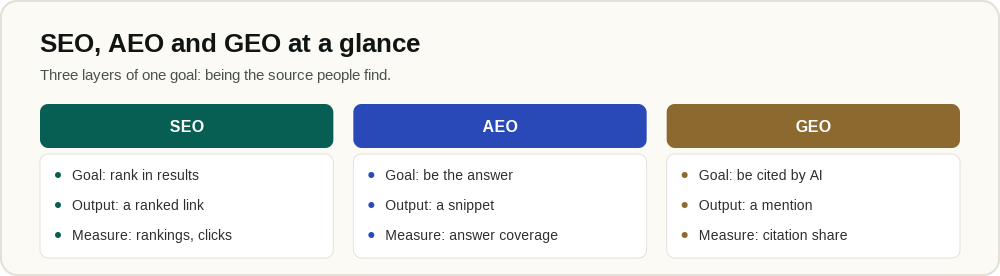
| Dimension | SEO | AEO | GEO |
|---|---|---|---|
| Primary goal | Rank in results | Be the extracted answer | Be cited in AI answers |
| Main output | A ranked link | A snippet or direct answer | A mention inside a generated response |
| Key emphasis | Relevance and authority | Answerability and structure | Clarity, consistency, cross-engine trust |
| How you measure | Rankings, clicks, impressions | Snippet wins, answer coverage | Citation presence and share across engines |
Where they differ in practice
SEO still cares most about ranking position and the click. AEO cares about being the clean answer, even when that reduces clicks. GEO cares about being represented accurately inside an answer you may never get a click from, which is why brand consistency and off-site reputation carry extra weight. The practical implication: do not judge GEO and AEO only by clicks, because their value often shows up as visibility and trust rather than sessions.
A combined workflow
- 01Fix the foundations once: crawlability, speed, internal links, accurate sitemaps. This serves all three.
- 02For each important topic, write a page that ranks (thorough, relevant, authoritative) and answers cleanly (direct answer early, question headings, FAQ, schema).
- 03Build the topic cluster: a hub plus supporting articles, linked together, so you demonstrate depth.
- 04Strengthen the entity: consistent naming, named authors, real experience, and off-site authority.
- 05Measure in layers: rankings and clicks for SEO, answer and snippet coverage for AEO, citation presence across engines for GEO.
Common misunderstandings
- "GEO replaces SEO." It does not; weak SEO makes GEO unlikely.
- "AEO is just FAQs." FAQs help, but AEO is the whole discipline of answerability.
- "These need separate teams or budgets." They are mostly the same work, prioritised differently.
FAQ
Frequently asked questions
No. GEO depends on the discoverability and trust that SEO creates. Dropping SEO undermines GEO.
They are closely related. AEO focuses on extractable answers; GEO focuses on being cited in generative responses. AEO work directly supports GEO.
Usually not. A well-built page that ranks, answers cleanly and comes from a credible brand serves all three. You adjust emphasis, not create three versions.
Start with SEO foundations and answer-ready content, which also seed AEO and GEO. Add dedicated GEO measurement once the basics are solid.
Track whether your brand is cited across a fixed set of prompts and engines, plus branded search and direct demand, rather than relying on click metrics alone.
Similar posts
AI Search & GEO
Generative Engine Optimization (GEO): The Complete Playbook for Getting Cited by AI
A practitioner's guide to GEO: how to get your brand cited by ChatGPT, Google AI Overviews and Perplexity. What works, what you cannot control, and a 30-day plan.
6 min read
AI Search & GEO
What Is Answer Engine Optimization (AEO)?
AEO structures your content so engines can extract a concise, correct answer. Learn the building blocks, why accuracy matters, and how AEO bridges SEO and GEO.
4 min read
SEO
Will AI Search Kill SEO? An Honest Answer
No, AI will not kill SEO, but it is changing it. What actually changes, what stays the same, why SEO skills transfer to GEO and AEO, and how to adapt without panic.
3 min read
Related services