Agentic Commerce
What Is Agentic Commerce?

Agentic commerce is one of those terms that arrived faster than its definition settled. People use it to mean anything from a smarter chatbot to a fully autonomous robot shopper. That vagueness causes both hype and confusion. This piece gives a clear, grounded definition, distinguishes agentic commerce from things it is often confused with, and sets realistic expectations about where it actually is today. The goal is not to predict the future precisely but to give you a solid mental model, so that when a vendor or a headline uses the phrase, you can tell what they really mean and whether it matters for your business.
Quick answer
Agentic commerce is online shopping in which an AI agent acts on a person's behalf, handling research, comparison, recommendation and sometimes the purchase itself. It differs from a normal chatbot because an agent can take steps towards a goal, not just answer questions. It sits on a spectrum from lightly assisting a human decision to, less maturely, completing a transaction autonomously within limits the person has set.
Key takeaways
- Agentic commerce is shopping mediated by an AI agent that acts towards a goal on a person's behalf, not just a chatbot that answers questions.
- The defining feature is action: an agent can research, compare, decide and sometimes purchase, not merely inform.
- It is a spectrum of autonomy: assisting, recommending, and transacting, with most real activity today in the first two bands.
- When an agent mediates, outcomes depend more on your structured data, consistency and trustworthiness than on page design and persuasion.
- It is distinct from on-site personalisation and from fully autonomous web shopping, which remains early.
- Even in its assisting form, it changes discovery, so making products easy for AI systems to read and trust matters now.
A working definition
Agentic commerce is commerce mediated by an AI agent: software that can pursue a goal on a person's behalf by taking a sequence of actions, rather than simply responding to each prompt. In a shopping context, the goal might be "find me a good option for X within these constraints", and the agent works towards it by gathering information, evaluating choices and producing a recommendation or action.
The key word is agent. A system is agentic to the degree that it can act, not just inform. An assistant that answers "what are good options for X" is on the lighter end. One that compares those options against your stated budget and needs is more agentic. One that places the order within limits you set is more agentic still.
What makes it different
Agents act towards goals
A traditional chatbot responds turn by turn. You ask, it answers, and the thread has no particular destination. An agent is organised around a goal and can take intermediate steps to reach it: look something up, compare, decide, proceed. This goal-directedness is what separates agentic commerce from the conversational commerce and chatbots that preceded it, even though they overlap.
The buyer is partly a machine
In conventional ecommerce, every decision is made by a human looking at your pages. In agentic commerce, some of the evaluation is done by a system reading your data and the wider web. That changes what influences the outcome: less your page design and persuasion, more your structured data, your consistency across sources, and your trustworthiness as a machine can assess it.
The spectrum of autonomy
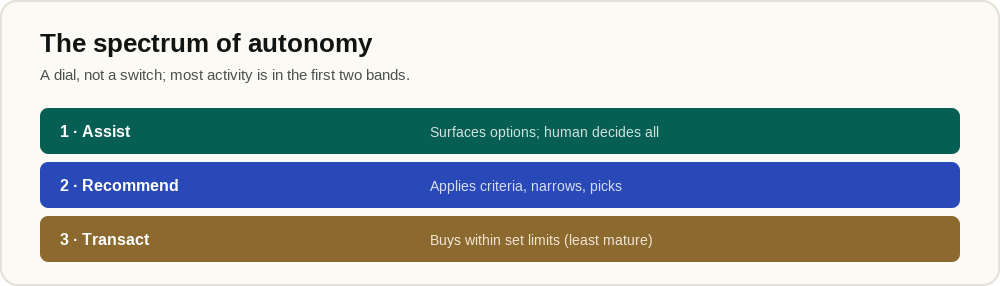
It helps to think of agentic commerce as a dial rather than a switch.
At the low end, the agent assists: it surfaces options and context, and the human makes every real decision. This is common today and genuinely useful.
In the middle, the agent recommends: it applies the person's criteria, narrows a wide field to a shortlist or a specific pick, and explains why. The human still approves, but the agent has done the heavy lifting of evaluation.
At the high end, the agent transacts: it completes a purchase on the person's behalf within boundaries they have defined. This is the least mature part, available today only in specific, controlled integrations rather than freely across the web.
Most of what is called agentic commerce right now lives in the first two bands. Being clear about this prevents both complacency and overreaction.
What it is not
Agentic commerce is not simply a chatbot bolted onto a store, though chatbots can be part of it. It is not the same as AI-powered personalisation or recommendation engines on your own site, though those are related. And it is not, yet, a world where autonomous shoppers roam the open web buying freely with no human in the loop. Keeping these distinctions straight helps you judge claims accurately.
Why it matters even in its early form
Even at the assisting and recommending end, agentic commerce changes how discovery works. When people increasingly begin shopping by asking an assistant rather than browsing, the brands the assistant knows about, understands clearly, and trusts have an advantage, and the ones it cannot parse or corroborate are quietly skipped. That is reason enough to make your products easy for these systems to read and trust now, well before the fully autonomous end of the spectrum arrives.
FAQ
Frequently asked questions
A chatbot responds to each message without a destination. An agent is organised around a goal and can take a sequence of steps to reach it: looking things up, comparing, deciding and sometimes acting. Agentic commerce uses that goal-directed behaviour; a basic chatbot does not.
In limited, controlled situations, yes, but it is not widespread or fully autonomous across the open web. Most agentic shopping today assists or recommends, with a human approving the final purchase. Full autonomous buying within set limits is the least mature part of the spectrum.
They overlap but are not identical. Conversational commerce is shopping through a chat interface. Agentic commerce is shopping where an AI acts towards a goal on your behalf. An agent may use a conversational interface, but what makes it agentic is the ability to act, not the chat format.
No. Even when agents only assist and recommend, they shape which products people discover and consider. Brands that AI systems can read, understand and trust get surfaced; others get skipped. That influence is already meaningful before any autonomous purchasing.
Focus on fundamentals that help regardless of how fast agents mature: accurate structured product data, clean feeds, genuine reviews and consistent information across the web, and an easy checkout. These make your products legible and trustworthy to AI systems while also helping ordinary search and shopping.
Similar posts
Agentic Commerce
The Agentic Commerce Guide: Selling When AI Does the Shopping
A practitioner's guide to agentic commerce: what it is, what is real versus hype, and the no-regret work, structured data, feeds, trust and frictionless buying, that makes a store ready.
7 min read
Agentic Commerce
How to Prepare Your Store for AI Shopping Agents
Preparing for AI shopping agents means making products easy for a machine to find, understand, trust and buy, with structured data, clean feeds and a frictionless checkout. Mostly no-regret work.
6 min read
Agentic Commerce
The Conversational Commerce Playbook
Conversational commerce is selling through chat. Where it helps, the principles that separate useful assistants from annoying ones, and how to measure outcomes rather than chat volume.
5 min read
Related services