Agentic Commerce
How to Prepare Your Store for AI Shopping Agents

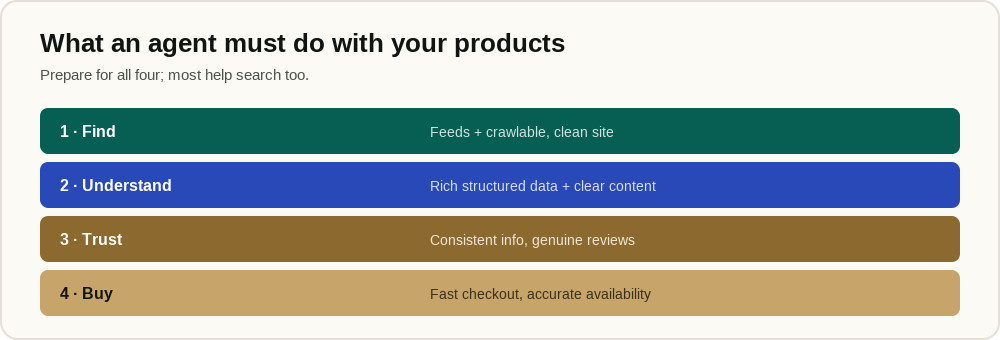
The phrase "prepare your store for AI agents" can sound like it demands a futuristic overhaul. It does not. The reassuring reality is that an AI agent judges your store on much the same qualities that make you findable and trustworthy in ordinary search and shopping, just read by a machine rather than a person. That means preparation is mostly a matter of doing known fundamentals well, with a sharper eye on machine-readability. This is a practical checklist of what actually matters, organised by the four things an agent needs to do with your products: find them, understand them, trust them, and buy them. None of it is wasted effort if agentic shopping grows slowly, because every item also helps today.
Quick answer
Preparing for AI shopping agents means making your products easy for a machine to find, understand, trust and buy. In practice that is accurate structured data and schema, clean and complete product feeds, consistent information across the web, genuine reviews, and a frictionless checkout. Almost all of this also improves ordinary search and conversion, so it is low-risk work worth doing now, whatever the pace of agentic adoption.
Key takeaways
- An AI agent judges your store on the same qualities as ordinary search and shopping, read by a machine: findable, understandable, trustworthy, buyable.
- Make products findable through complete, accurate feeds and a crawlable, cleanly structured site.
- Make them understandable with rich, accurate structured data and schema, the highest-leverage single investment, plus clear, factual content.
- Make them trustworthy through consistent information across sources, genuine reviews and clear policies.
- Make them buyable with a fast checkout, accurate availability and transparent pricing; agentic readiness and conversion hygiene are the same work.
- Keep investing in brand and owned relationships so you are not reduced to a commodity chosen on price alone.
Make your products easy to find
An agent can only consider products it can discover, and it discovers them through structured, machine-readable sources rather than by admiring your homepage.
The foundations are your product feeds and your site's crawlability. A complete, accurate feed in the places agents and AI shopping surfaces draw from is how your catalogue enters their consideration set. On your own site, clean URLs, a solid sitemap, and pages that are accessible without heavy client-side gymnastics all help machines read you. If a product is hard for a crawler or a feed to see, an agent will not weigh it.
Make your products easy to understand
Discovery is not enough; the agent must understand what each product is and whether it fits a need.
Structured product data is the priority
Product schema and clean, complete attributes are how a machine grasps the specifics: what the item is, its price, availability, variants, materials, dimensions, and so on. The richer and more accurate your structured data, the more precisely an agent can match you to a real requirement and the less likely it is to misrepresent or skip you. This is the highest-leverage single investment, and it directly helps traditional search features too.
Write for clarity, not just persuasion
Agents read your descriptions and content to extract facts and judge relevance. Clear, specific, honest product information, real attributes and genuine use cases rather than vague superlatives, is easier for a machine to parse and trust. Content written only to excite a human, thin on actual detail, gives an agent little to work with.
Make your products easy to trust
Given several options, an agent leans towards the one it can corroborate. Trust, as a machine assesses it, comes from consistency and evidence.
Keep your core information, name, details, pricing, policies, consistent across your site, feeds, marketplaces and third-party listings; contradictions make you harder to trust. Cultivate genuine reviews, which are a strong credibility signal. Make your policies, shipping, returns, guarantees, clear and easy to find. Much of this is the same reputation-building that helps a brand get cited in AI answers generally: an agent, like an AI answer, prefers sources it can verify.
Make your products easy to buy
Finally, reduce friction at the point of purchase, because whether the final click is made by a nudged human or, eventually, an agent, obstacles cost you the sale.
A fast, clean checkout, accurate availability, transparent pricing with no nasty surprises, and clear fulfilment information all reduce the reasons to abandon you. Agentic readiness and basic conversion hygiene are, happily, the same work: a checkout that is smooth for people is also less likely to trip up an automated flow.
Do not neglect the brand itself
One strategic caution sits alongside the technical checklist. If you optimise only to be an easy, legible option, you risk becoming a commodity an agent picks purely on price and specs. Keep investing in what makes customers want you specifically: distinctive products, genuine loyalty, owned relationships and first-party data. The strongest position is to be both easy for an agent to recommend and a brand people ask for by name.
FAQ
Frequently asked questions
Get your structured product data and schema accurate and complete. It is how a machine understands what your products are and whether they fit a need, it reduces the chance an agent misrepresents or skips you, and it also improves ordinary search features, so the return is high and the risk low.
Usually not. Most preparation is doing known fundamentals well: clean feeds, good schema, consistent information, genuine reviews and a smooth checkout. These are supported by mainstream ecommerce platforms already. Beware vendors selling an expensive "agentic readiness" product that mostly repackages basics.
No, the opposite. Nearly everything that makes you legible and trustworthy to an agent, structured data, clean feeds, consistent information, a frictionless checkout, also helps traditional search, shopping surfaces and human conversion. That overlap is what makes this low-risk work.
Feeds are a primary way your catalogue reaches the surfaces agents and AI assistants draw on. A complete, richly attributed, accurate feed lets an agent match your products to real needs; a thin or error-prone feed gets passed over. Feed quality is foundational to being considered at all.
You cannot fully control it, but you can resist it by staying a brand people want specifically: distinctive products, a real reason to prefer you, genuine loyalty, and owned customer relationships with first-party data. Be easy for an agent to recommend and strong enough that customers ask for you by name.
Similar posts
Agentic Commerce
The Agentic Commerce Guide: Selling When AI Does the Shopping
A practitioner's guide to agentic commerce: what it is, what is real versus hype, and the no-regret work, structured data, feeds, trust and frictionless buying, that makes a store ready.
7 min read
AI for Ecommerce
Product Feeds for AI Agents and AI Search
A product feed is the machine-readable version of your catalogue and a core discovery asset as AI agents mediate shopping. What makes a good feed, and why machines do not fill gaps.
6 min read
Technical SEO
Structured Data for Agentic Commerce
Structured data tells AI agents what your products are, cost, and whether they can be trusted. Which schema types matter, why accuracy is paramount, and how to keep it synced to reality.
5 min read
Related services