Agentic Commerce
The Agentic Commerce Guide: Selling When AI Does the Shopping

For most of ecommerce history, the shopper has been a person with a browser. They searched, they clicked, they compared tabs, they filled a basket. Agentic commerce describes an emerging change to that assumption: increasingly, an AI assistant sits between the person and the store, doing some of the work the person used to do themselves. Someone asks an assistant to find the best option for their needs, and the assistant researches, narrows the field, and presents a recommendation, sometimes offering to buy. This is early, uneven and easy to overhype. Much of it is still assistants recommending rather than autonomously purchasing, and the behaviour varies by platform and category. But the direction is clear enough that it is worth preparing for deliberately rather than waiting to react. This guide explains what agentic commerce is, what is genuinely happening versus what is speculation, and the practical, no-regret work that makes a brand ready, work that mostly pays off even if the agentic future arrives more slowly than the headlines suggest.
Quick answer
Agentic commerce is the shift from people browsing stores to AI agents and assistants doing parts of the shopping on their behalf: researching, comparing, recommending, and in some cases completing the purchase. Preparing for it is mostly an extension of good practice you should already value: clean structured product data, honest content AI systems can trust, machine-readable feeds, and measurement of AI-driven traffic. You cannot control what an agent recommends, but you can make your brand easy for it to find, understand and trust.
Key takeaways
- Agentic commerce is the shift towards AI agents and assistants doing parts of shopping for people; it is a spectrum from recommending to, eventually, purchasing.
- When an agent mediates, your influence moves from persuading a human on a page to being understood and trusted by a system.
- Be honest about maturity: assistant-led recommendation and AI-assisted shopping are real now; fully autonomous buying across the open web is still emerging.
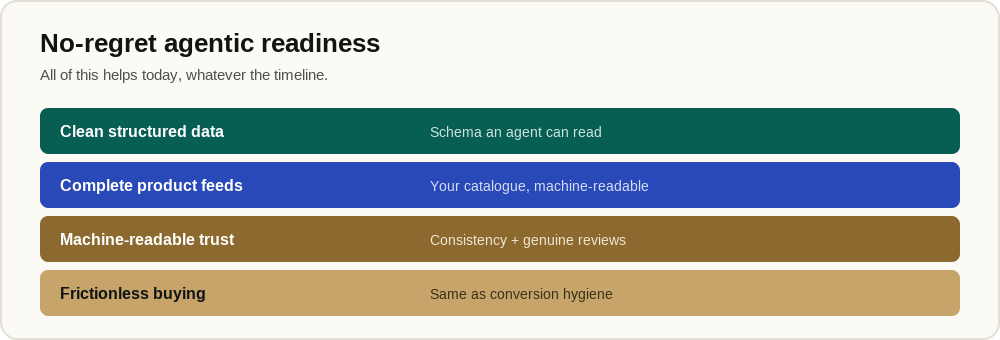
- The preparation is almost all no-regret: clean structured data, complete feeds, machine-readable trust, and frictionless buying all help today regardless of timeline.
- Start measuring AI-driven demand with the imperfect signals available, backed by blended metrics.
- Guard against disintermediation by staying a brand customers ask for by name, with owned relationships and first-party data.
What agentic commerce actually means
Agentic commerce is a spectrum, not a single thing. At the lightest end, an AI assistant answers a shopping question and names some options, much as a knowledgeable friend might. In the middle, it compares products against stated criteria and makes a specific recommendation. At the far end, which is least mature, an agent completes a transaction on the person's behalf within limits they have set.
Alongside this runs conversational commerce: shopping that happens through a chat interface, whether an on-site assistant, a messaging app, or an AI chatbot. The two overlap. What unites them is that a layer of software increasingly mediates between your store and the buyer, and that layer reads, reasons over, and acts on information about your products.
Why it matters for brands
When a person browses your site, your design, merchandising and persuasion do the work. When an agent mediates, much of that is bypassed. The agent does not see your hero banner; it reads your data, your content, and what others say about you. Your influence shifts from persuading a human on a page to being understood and trusted by a system. That is a real change in where marketing effort pays off, and it rewards clarity and structure over spectacle.
What is real now, and what is not
It is worth being honest about maturity, because the gap between demonstrations and everyday reality is wide.
Real now: AI assistants routinely answer shopping questions, summarise options, and point to products and retailers. People increasingly start product research in an AI chat rather than a search box. Structured product data and feeds already drive how products appear in AI-assisted shopping surfaces. Messaging-based and chatbot shopping are established in some markets and categories.
Still emerging: fully autonomous agents that independently choose and buy across the open web with little oversight. In-chat checkout exists in specific, controlled integrations rather than universally. Standards for how agents transact are still forming. Treat any vendor promising a finished agentic future with healthy scepticism, and build for the parts that are real while staying ready for the rest.
The no-regret preparation
The reassuring part of agentic commerce is that preparing for it overlaps almost entirely with things that are already good practice. There are few bets here you would regret if the timeline slips.
Get your structured data right
Agents and AI shopping surfaces rely on machine-readable information: product schema, clean attributes, accurate availability and pricing. The better structured your product data, the more accurately an agent can represent you, and the less likely it is to misstate or skip you. This is the single highest-leverage preparation, and it helps traditional search too.
Keep your product feeds clean and complete
Feeds are how your catalogue reaches many AI-assisted and marketplace surfaces. Complete, accurate, richly attributed feeds let agents match your products to real needs. Thin or messy feeds get passed over. This work pays off across shopping ads, marketplaces and AI surfaces alike.
Earn trust that a machine can read
AI systems weigh signals of credibility: consistent information across the web, genuine reviews, clear policies, and content that demonstrates real expertise. Much of this is the same reputation-building that helps you get cited in AI answers generally. An agent comparing options will lean towards brands it can corroborate and away from those it cannot.
Make buying frictionless
Whether the final step is taken by a person nudged by an assistant or, eventually, by an agent, a clean, fast, well-structured checkout and clear fulfilment information reduce the reasons to drop you. Agentic readiness and basic conversion hygiene are the same work.
Measure AI-driven demand
You cannot manage what you cannot see, and AI channels are partly invisible to conventional analytics. Start paying attention to assistant and chat referrals where they are identifiable, watch for shifts in how people describe finding you, and treat branded demand and direct traffic as partial proxies for AI-influenced discovery. Measurement here is imperfect today, so combine the signals you can see with blended business metrics rather than expecting a clean dashboard.
Do not cede the relationship entirely
A genuine strategic risk of agentic commerce is disintermediation: if an agent becomes the customer's primary interface, the brand can be reduced to a line item chosen on price and specs. The counter is to remain a brand worth asking for by name, through distinctive products, genuine loyalty, owned customer relationships and first-party data. The brands that thrive will be easy for agents to recommend and strong enough that customers still want them specifically.
FAQ
Frequently asked questions
It is shopping where an AI agent or assistant does some of the work a person used to do: researching, comparing, recommending, and sometimes buying, on the person's behalf. It ranges from an assistant suggesting options to, less maturely, an agent completing a purchase within set limits.
Both. People genuinely use AI assistants to research and shortlist products now, and structured data and feeds already shape AI-assisted shopping. Fully autonomous agents buying across the open web are still early and uneven. Prepare for what is real while staying ready for the rest.
Focus on no-regret work: accurate structured product data and schema, clean and complete product feeds, machine-readable trust signals such as consistent information and genuine reviews, and a frictionless checkout. These help traditional search and shopping too, so the downside risk is low.
Not entirely, but they may mediate more of the discovery and comparison that your website used to own. The response is to keep your data and content excellent so agents represent you well, and to stay a brand customers want specifically, rather than a commodity chosen on price alone.
Imperfectly, for now. Track identifiable assistant and chat referrals, watch branded and direct demand as partial proxies, ask customers how they found you, and lean on blended business metrics. Clean per-channel attribution for AI discovery does not fully exist yet, so combine signals rather than trusting one number.
Similar posts
Agentic Commerce
What Is Agentic Commerce?
Agentic commerce is shopping where an AI agent acts on your behalf. What it is, how it differs from a chatbot, the spectrum from assisting to buying, and where it really is today.
6 min read
Agentic Commerce
How to Prepare Your Store for AI Shopping Agents
Preparing for AI shopping agents means making products easy for a machine to find, understand, trust and buy, with structured data, clean feeds and a frictionless checkout. Mostly no-regret work.
6 min read
AI for Ecommerce
Product Feeds for AI Agents and AI Search
A product feed is the machine-readable version of your catalogue and a core discovery asset as AI agents mediate shopping. What makes a good feed, and why machines do not fill gaps.
6 min read
Related services