Agentic Commerce
The Conversational Commerce Playbook

Conversational commerce has been promised for years and delivered unevenly. Early chatbots were often clumsy, and many brands bolted one on because it was fashionable, not because it helped anyone. But the underlying idea is sound and newly practical: a lot of shopping friction is really unanswered questions, and a conversation is a natural way to answer them. Better AI has made conversational interfaces genuinely more capable, and it overlaps with the rise of agentic shopping. This is a practical playbook rather than a hype piece. It covers where conversational commerce actually helps, the principles that separate useful implementations from annoying ones, and how to measure whether it is working.
Quick answer
Conversational commerce is selling through chat: on-site assistants, messaging apps and AI chatbots that let customers get help, ask questions and sometimes buy in a dialogue rather than by navigating pages. Done well, it reduces friction, answers objections at the moment of doubt, and feels like good service. Done badly, it frustrates people with scripted dead ends. The playbook is to solve real customer problems, blend automation with human handoff, and measure outcomes, not chat volume.
Key takeaways
- Conversational commerce is selling and serving through chat, and it earns its place by removing specific friction, not by being fashionable.
- It helps most with purchase-blocking questions, guided discovery in large ranges, buying-adjacent support, and after-hours availability.
- It hurts when it obstructs people who know what they want or replaces a clear page with a scripted maze.
- Blend automation with easy human handoff, be transparent that it is a bot, and keep it fast and low-effort.
- It is converging with agentic commerce: a good on-site assistant is an agent within your store, and the same data and honesty prepare you for external agents.
- Measure outcomes, completed purchases, resolved issues, reduced abandonment, not chat volume.
Where conversational commerce helps
Conversation is not better than a well-designed page for everything. It earns its place in specific moments.
It helps when a customer has a question that stands between them and a purchase: does this fit my situation, which option is right for me, is it in stock, when will it arrive. It helps with guided discovery in ranges that are large or confusing, where a few questions narrow the field faster than filtering. It helps with support that touches buying: order status, returns, exchanges. And it helps after hours, when no human is available but a good automated answer still moves things forward.
It does not help when it gets in the way of people who already know what they want, or when it substitutes a scripted maze for a clear page and a simple checkout. The test is always whether the conversation removes friction or adds it.
Principles of a good implementation
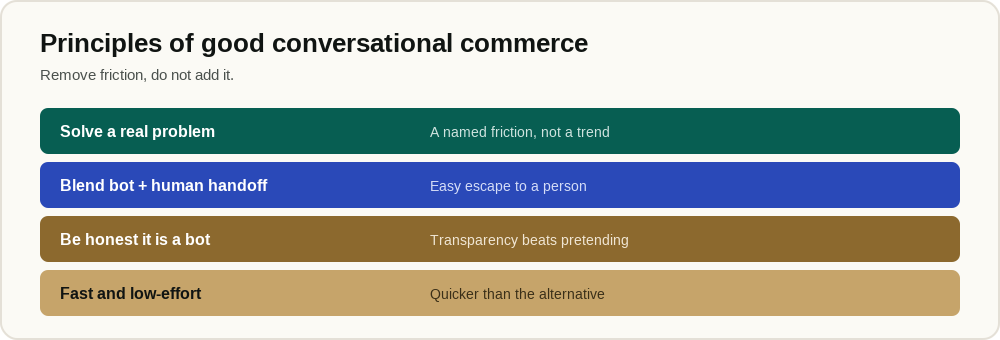
Solve a real problem, not a trend
Start from a specific customer friction you can name, and design the conversational experience to remove it. A chatbot that exists to seem modern, with no clear job, will be ignored or resented. One that reliably answers the three questions that most often stall your buyers will earn its keep.
Blend automation with human handoff
Automation handles volume and availability; humans handle nuance and high stakes. The worst conversational experiences trap people in a bot with no way to reach a person. Design clear, early escape hatches to a human for anything the automation cannot resolve, and treat a smooth handoff as a feature, not a failure.
Be honest that it is a bot
People forgive a bot that is clearly a bot and genuinely helpful. They resent one that pretends to be human and then fails. Set expectations, be transparent, and focus on usefulness rather than on passing for a person.
Keep it fast and low-effort
A conversation should be quicker than the alternative, not a slow interrogation. Ask only what you need, remember context within the session, and get the customer to their answer or their purchase with as few steps as possible.
Conversational commerce and AI agents
Conversational commerce and agentic commerce are converging. A capable conversational assistant on your site is, in effect, an agent working on the customer's behalf within your store: understanding a need, narrowing options, and guiding to purchase. The same qualities that make it good, clear understanding of your catalogue, accurate data, honest guidance, are what make you ready for external agents too. Investing in one supports the other.
Measure outcomes, not chatter
The common mistake is to measure conversational commerce by activity, number of chats, messages handled, when what matters is outcomes. Track whether conversations lead to the result you wanted: completed purchases, resolved issues, reduced abandonment at the point the conversation addresses. Watch customer satisfaction with the experience, and watch for the anti-signal of people trying to escape to a human and failing. A busy bot that does not improve outcomes is a cost, not a win.
FAQ
Frequently asked questions
It is shopping and customer service conducted through a dialogue, via on-site assistants, messaging apps or AI chatbots, rather than by navigating pages. At its best it answers questions at the moment of doubt and guides people to a purchase, feeling like good service rather than an obstacle.
They can, when they remove real friction, such as answering the questions that stall buyers, guiding discovery in large ranges, or helping after hours. They can also hurt sales when they obstruct people or trap them in scripted dead ends. The outcome depends on solving a genuine problem well, not on having a bot at all.
Conversational commerce is defined by the chat interface. Agentic commerce is defined by an AI acting towards a goal on someone's behalf. They overlap: a capable conversational assistant can act agentically within your store. One is about the format, the other about the behaviour.
No. People forgive a clearly labelled bot that is genuinely helpful and resent one that pretends to be human and then fails. Be transparent, set expectations, and focus on usefulness. Always provide an easy path to a real person for anything the automation cannot handle.
By outcomes, not activity. Track completed purchases, resolved issues and reduced abandonment at the points conversations address, plus satisfaction with the experience. A high volume of chats that does not improve these outcomes is a cost rather than a success, and failed attempts to reach a human are a warning sign.
Similar posts
Agentic Commerce
The Agentic Commerce Guide: Selling When AI Does the Shopping
A practitioner's guide to agentic commerce: what it is, what is real versus hype, and the no-regret work, structured data, feeds, trust and frictionless buying, that makes a store ready.
7 min read

Agentic Commerce
AI Chatbots for Ecommerce That Actually Convert
An ecommerce chatbot converts when it removes a specific friction, answers accurately from real data, guides choice and hands off to a human. Why adding AI alone does not make a bot good.
5 min read
Agentic Commerce
How to Prepare Your Store for AI Shopping Agents
Preparing for AI shopping agents means making products easy for a machine to find, understand, trust and buy, with structured data, clean feeds and a frictionless checkout. Mostly no-regret work.
6 min read
Related services