Agentic Commerce
Voice Commerce in 2026: A Realistic View

Voice commerce has been predicted to transform shopping for a long time, and the prediction has repeatedly outrun reality. Voice assistants are everywhere, people use them constantly, and yet buying by voice has stayed a modest slice of ecommerce. That gap between expectation and reality is itself the most useful thing to understand, because it tells you where voice genuinely fits and where it does not. This piece takes a realistic view: what voice commerce is actually good for, why it has not taken over, how it connects to the broader rise of AI assistants, and what, proportionately, a brand should do about it. No hype, and no dismissiveness either, just a sober read of where the channel sits.
Quick answer
Voice commerce, shopping through voice assistants, is real but narrower than years of hype predicted. It works well for simple, familiar, low-consideration purchases and reordering, and poorly for anything that needs visual comparison or careful choice, because a voice interface cannot show options the way a screen can. For brands the sensible posture is to prepare the fundamentals that also serve AI assistants generally, be the trusted, easily named option, and size the investment to voice's genuine, limited role rather than the hype.
Key takeaways
- Voice commerce is real but narrower than the hype: it suits simple, familiar, low-consideration purchases and reordering, not considered visual choice.
- Its limits are structural, a linear, screenless interface cannot support visual comparison, and trust in committing money by voice is lower, so they will not simply disappear.
- Voice works for reordering, low-consideration buys, hands-busy contexts, and as a step in a larger cross-device journey.
- It is best seen as one interface to the broader AI-assistant shift, not a separate revolution.
- Preparation overlaps with general AI-assistant readiness: clean data, accurate information, genuine reputation, and being easy to name unambiguously.
- Size the investment to voice's real, limited role; do the foundational work that serves many channels rather than a disproportionate bespoke voice programme.
Why voice commerce stayed niche
The core limitation is structural, not temporary. A voice interface is linear and invisible: it can speak options one at a time but cannot show a grid of choices the way a screen can. For purchases that need comparison, looking at several products, weighing attributes, judging appearance, this is a poor fit. Humans shop visually for most considered purchases, and voice cannot replicate that.
There is also a trust dimension. Committing money by voice, with no screen to confirm exactly what you are buying, makes people cautious, especially for anything unfamiliar or expensive. These are not bugs to be fixed with better technology; they are properties of the medium.
Where voice commerce works
Voice earns its place in specific situations that play to its strengths rather than its weaknesses.
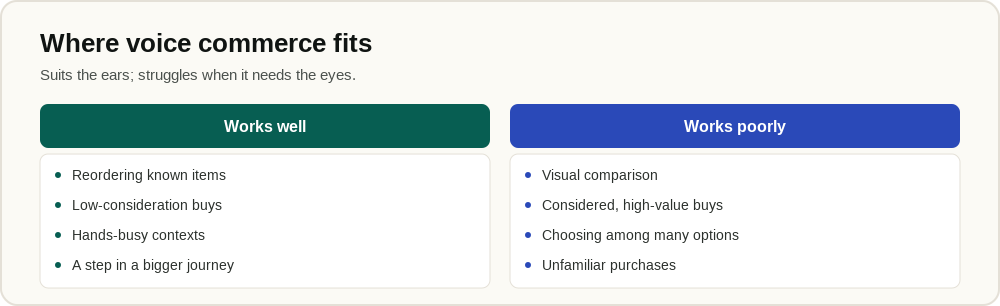
It works for reordering known items: things the person has bought before, where there is nothing to compare and the decision is already made. It works for simple, low-consideration purchases where a single good answer is enough and no visual judgement is needed. It works for hands-busy contexts, cooking, driving, where voice is the convenient interface. And it works as a step in a larger journey, for instance adding something to a list or a basket by voice to complete later on a screen.
The pattern is clear: voice suits low-consideration, familiar, decided purchases, and struggles with everything that needs the eyes.
Voice and the broader AI-assistant shift
Voice commerce is best understood not as its own revolution but as one interface to the wider rise of AI assistants. The same assistants people type to can also be spoken to, and the underlying need, to understand a request and surface a trustworthy answer, is the same whether the channel is voice or text.
This matters for how you prepare. The work that makes you a good answer for an AI assistant generally, clean machine-readable data, consistent and accurate information, genuine reputation, being easily and unambiguously named, is the same work that helps in voice contexts. You do not need a separate voice strategy so much as a solid AI-assistant readiness that voice draws on.
What brands should actually do
Given voice's real but limited role, the right investment is proportionate. Do the foundational AI-readiness work anyway, because it serves many channels. Make sure your brand and products are easy to name and pronounce and unambiguous, since voice relies on being asked for clearly. Keep your product data and availability accurate, so a voice answer is correct. And if reordering is relevant to your category, make being the easy repeat choice a priority, because that is where voice commerce most naturally lives.
What you should not do is pour disproportionate resources into a bespoke voice-commerce programme on the assumption that voice is about to dominate. It has not for years, for structural reasons, and sizing your effort to its genuine role is the disciplined call.
FAQ
Frequently asked questions
It is real but modest, and has stayed a small slice of ecommerce despite years of prediction. It genuinely helps with simple, familiar, decided purchases and reordering, but not with considered buying that needs visual comparison. Its role is useful and specific rather than transformative.
Mainly structural reasons: a voice interface is linear and screenless, so it cannot show options for visual comparison the way most considered shopping needs, and people are cautious committing money without a screen to confirm the purchase. These are properties of the medium, not temporary technical gaps.
Low-consideration, familiar items, especially reorders of things the person has bought before, where there is nothing to compare and the decision is already made. Simple purchases needing a single good answer, and hands-busy contexts like cooking or driving, also suit voice. Considered, visual purchases do not.
Usually not a large bespoke one. Voice is one interface to the broader AI-assistant shift, so the readiness work that helps assistants generally, clean data, accurate information, genuine reputation, being easy to name, also serves voice. Make being the easy repeat choice a priority if reordering fits your category.
Proportionately to its genuine, limited role. Do the foundational AI-assistant readiness that serves many channels anyway, ensure your brand is easy to name and your data accurate, but avoid pouring disproportionate resources into voice on the assumption it is about to dominate, which it has not for years, for structural reasons.
Similar posts
Agentic Commerce
The Agentic Commerce Guide: Selling When AI Does the Shopping
A practitioner's guide to agentic commerce: what it is, what is real versus hype, and the no-regret work, structured data, feeds, trust and frictionless buying, that makes a store ready.
7 min read
Agentic Commerce
The Conversational Commerce Playbook
Conversational commerce is selling through chat. Where it helps, the principles that separate useful assistants from annoying ones, and how to measure outcomes rather than chat volume.
5 min read

Agentic Commerce
ChatGPT Shopping and In-Chat Checkout
People research products in AI assistants, and shopping features are emerging. What is real versus speculative, how to be legible and trusted, and why not to rebuild checkout on speculation.
5 min read
Related services