Measurement
How to Track Your Brand Across AI Engines

You cannot improve what you do not measure, and AI visibility is harder to measure than rankings because answers vary by phrasing, user and time. But you can still build a disciplined, repeatable picture. This article sets out a practical monitoring approach that any brand can run, using a consistent question set, a few supporting signals and a steady cadence, without overclaiming precision the medium does not allow.
Quick answer
Track your brand in AI by running a fixed set of real questions through each engine on a regular schedule and recording whether you are mentioned, how, and alongside which competitors. Combine this prompt-based monitoring with referral traffic from AI sources where it is reported, and with branded search trends. The aim is a simple, repeatable baseline you can compare over time, not a single perfect metric.
Key takeaways
- Measure AI visibility with a fixed question set run on a schedule.
- Record presence, prominence, source links and competitor appearances.
- Support it with AI referral traffic and branded search trends.
- Feed gaps back into content and authority, then re-measure.
- Treat results as directional; read trends over several cycles.
Build a fixed question set
Start with the real questions your customers ask, in the categories where you want to appear: problem questions, comparison questions, recommendation questions and branded questions. Keep the list fixed so results are comparable over time, and version it when you add questions. Twenty to fifty well-chosen questions is plenty to begin.
Run them across engines on a schedule
Put the same questions through the AI engines your audience uses, on a regular cadence, monthly is a sensible default, and record for each: were you mentioned, how prominently, was a source link included, and which competitors appeared. Keep the conditions as consistent as you can, since results naturally vary.
Track the signals that support the picture
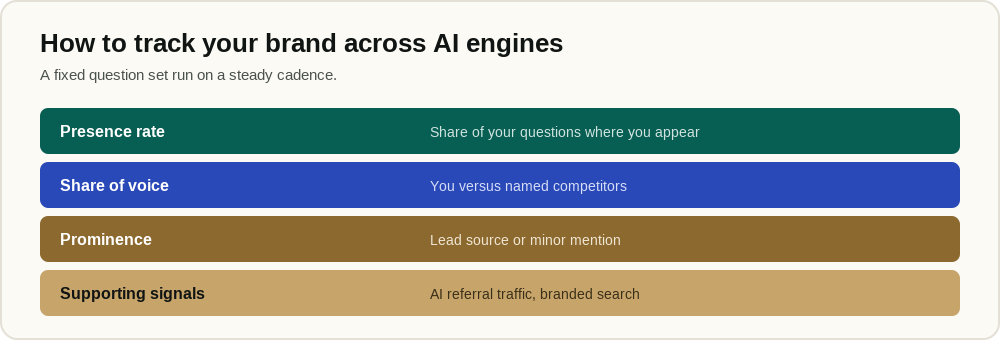
- Presence rate: the share of your questions where you appear.
- Share of voice: your presence versus named competitors.
- Prominence: whether you are the lead source or a minor mention.
- Referral traffic from AI engines, where analytics report it.
- Branded search volume, as a proxy for AI-driven awareness.
Turn findings into action
Where you are absent, check whether you even cover the question, whether your answer is clear, and whether your trust signals are strong. Where competitors lead, study what makes their page easy to cite. Feed the gaps back into your content and authority work, then re-measure next cycle to see whether the gap closed.
Keep it honest
Treat the numbers as directional, not exact. Variation between runs is normal, so look at trends over several cycles rather than reading too much into a single result. Be transparent in reporting about what the method can and cannot show.
Tools and effort
You can run this manually for a small question set, or use emerging AI-visibility monitoring tools to scale it. Whatever you use, the discipline matters more than the tool: the same questions, a steady cadence, and consistent recording.
FAQ
Frequently asked questions
Because AI answers vary by phrasing, user and time, no single score is reliable. A fixed question set tracked over time gives a more honest, comparable picture.
Monthly suits most brands, with a bigger review each quarter. Keep the cadence steady so results are comparable.
Increasingly, yes, where engines pass a referrer, though coverage is incomplete. Use it as one supporting signal, not the whole picture.
Twenty to fifty well-chosen, representative questions are enough to start. Keep the list fixed and version it when you expand.
No. A small set can be tracked manually. Tools help you scale and save time, but the discipline of a consistent method matters most.
Similar posts
AI Search & GEO
Generative Engine Optimization (GEO): The Complete Playbook for Getting Cited by AI
A practitioner's guide to GEO: how to get your brand cited by ChatGPT, Google AI Overviews and Perplexity. What works, what you cannot control, and a 30-day plan.
6 min read
Measurement
How to Measure AI Search Visibility and Citation Share
Measure AI visibility with a fixed prompt set and citation share, plus referral traffic, branded search and sentiment. A practical method you can run without paid tools.
4 min read
AI Search & GEO
How AI Chooses Which Sources to Cite
AI engines retrieve, then prefer clear answers from trusted sources. A high-level look at how citation decisions work, what it means for you, and the honest limits.
3 min read
Related services