Measurement
How to Measure AI Search Visibility and Citation Share

Rankings were easy to measure: a keyword, a position, a trend line. AI visibility is messier. Answers vary by user, phrasing, engine and time, and most engines do not hand you a clean report of when they cited you. That does not mean you fly blind. With a disciplined, repeatable method you can tell whether your AI presence is improving. This article lays out a practical measurement approach you can run without expensive tools, and where dedicated trackers add value.
Quick answer
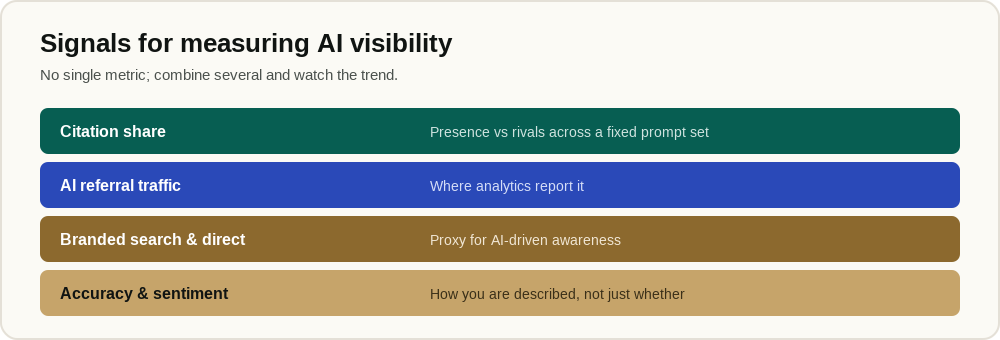
Measure AI search visibility by combining several imperfect signals rather than one metric. Track whether your brand is cited across a fixed set of real prompts and engines, watch referral traffic from AI tools where it is reported, and monitor branded search and direct demand as proxies for AI-driven awareness. Citation share, how often you appear versus competitors for a prompt set, is the closest thing to a core metric, but treat all of it as directional.
Key takeaways
- Combine several imperfect signals; no single AI-visibility metric exists.
- A fixed prompt set plus citation share is the practical core.
- Track presence per engine, plus referral traffic, branded search and sentiment.
- Start in a spreadsheet; add tools once you measure seriously.
- Use results to drive content fixes, and judge by trend, not single runs.
Start with a prompt set
The foundation is a fixed list of prompts a real buyer would ask an AI about your topic, category and brand. Aim for 20 to 50 prompts covering informational questions, comparisons and buying questions. Keep the list stable so results are comparable over time, and version it when you add prompts.
The signals worth tracking
- Citation presence and share across your prompt set, per engine (ChatGPT, Perplexity, Google AI Overviews, Copilot and others).
- Referral traffic from AI tools, where analytics report it, as a floor on measurable clicks.
- Branded search volume and direct visits, which often rise when AI mentions grow.
- Conventional rankings and impressions, since they still feed AI answers like Overviews.
- Sentiment and accuracy of how you are described, not just whether you appear.
Build a simple scorecard
You do not need software to begin. A spreadsheet with one row per prompt and one column per engine, refreshed monthly, captures presence and share. Add notes on wording and accuracy. Over a few cycles the trend becomes clear, and you can tie changes to the content work you shipped.
Where tools help
Dedicated AI-visibility and brand-monitoring tools automate prompt runs across engines, track share over time, and flag sentiment. They save time and add consistency once you are measuring seriously, but they are optional at the start and should match the manual method you already trust, not replace judgement.
Pitfalls to avoid
- Trusting a single run; answers vary, so look at trends across repeated checks.
- Measuring only clicks; much AI value is visibility without a click.
- Changing the prompt set constantly, which breaks comparability.
- Ignoring accuracy; being cited incorrectly can be worse than not appearing.
- Over-investing in tooling before you know what you want to learn.
Tie measurement to action
Measurement is only useful if it changes what you do. When a prompt shows a competitor cited and you absent, inspect their source and your gap, then fix clarity, authority or coverage and re-check next cycle. Treat the scorecard as a backlog generator, not a vanity dashboard.
FAQ
Frequently asked questions
No. Citation share across a fixed prompt set is the closest, but you should combine it with referral traffic, branded search and sentiment.
Not to start. A monthly manual run across your prompt set in a spreadsheet is enough to see trends. Tools add scale and consistency later.
Monthly suits most brands. Answers vary day to day, so frequent single checks mislead; trends over cycles are what matter.
They are proxies for AI-driven awareness. When AI mentions rise, people often search your name or visit directly, even without a measurable AI referral.
Treat it as a priority. Correct the underlying content, make the accurate facts easy to find and quote, and monitor whether the description improves.
Similar posts
AI Search & GEO
Generative Engine Optimization (GEO): The Complete Playbook for Getting Cited by AI
A practitioner's guide to GEO: how to get your brand cited by ChatGPT, Google AI Overviews and Perplexity. What works, what you cannot control, and a 30-day plan.
6 min read
AI Search & GEO
How to Get Your Brand Cited by ChatGPT
How to improve your odds of being cited by ChatGPT: retrievable pages, answer-ready content, consistent branding and real authority. Honest about what you cannot control.
4 min read

AI Search & GEO
How to Get Cited by Perplexity
Perplexity retrieves and cites live sources. Learn how to be discoverable, relevant, quotable and credible so it chooses your page, and how to audit your citations.
3 min read
Related services