AI Search & GEO
How AI Chooses Which Sources to Cite

If you want to be cited by AI, it helps to understand, at a high level, how engines decide. While the exact mechanisms are proprietary and vary by product, the broad pattern is consistent and sensible: retrieve relevant pages, prefer ones that answer clearly, and favour sources that look trustworthy. This article explains that pattern and what it means for your content, while being clear about the limits of what anyone outside these companies can know.
Quick answer
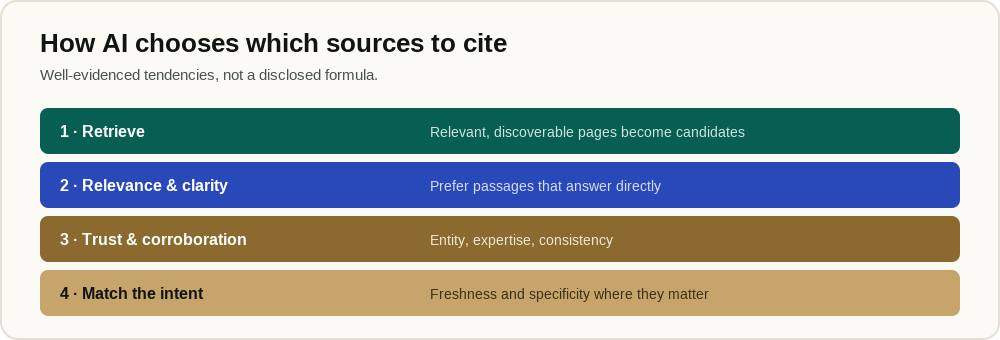
AI engines cite sources they can retrieve, that clearly answer the question, and that they judge credible and consistent with the wider web. In practice that means being discoverable and relevant for the query, stating a clear self-contained answer, and carrying trust signals: a recognisable brand entity, named expertise, corroboration from reputable sources, and accuracy. No provider publishes an exact formula, so treat these as well-evidenced tendencies, not a guaranteed recipe.
Key takeaways
- Engines retrieve, then prefer clear answers from trusted sources.
- Discoverability and relevance are the entry requirement.
- Clear, self-contained answers are easier to select and quote.
- Trust signals, entity, expertise, corroboration, accuracy, tip the choice.
- The exact formula is unknown and shifting; optimise the durable principles.
Step one: retrieval
Most AI answers that cite the web start by retrieving candidate pages for the query, often using a search index. If your page cannot be found or is not relevant for the query, it is not a candidate. Discoverability and relevance are the price of entry, which is why conventional SEO fundamentals still matter.
Step two: relevance and clarity
From the candidates, the engine favours passages that clearly and directly answer the question. Content that states the answer plainly, in a focused section with an unambiguous heading, is easier to select and quote than content where the answer is buried or conditional.
Step three: trust and corroboration
Engines are cautious about citing sources that look unreliable or that contradict the wider web. Signals that build confidence include a recognisable brand entity, named and credentialled authors, consistency with what reputable sources say, and corroboration across the web. A claim that many trusted sources agree on, from a source the engine recognises, is a safer citation.
Step four: freshness and specificity, where they matter
For time-sensitive questions, engines favour current sources. For specific questions, they favour sources with the precise detail. Matching the intent, recency for news, depth for how-to, specifics for comparisons, improves your fit for the query at hand.
What this means for you
- Be discoverable and relevant: the fundamentals are non-negotiable.
- Answer clearly and self-contained, so your passage is easy to select.
- Build trust: a clear entity, named expertise and corroboration.
- Stay accurate and consistent with the wider web.
- Match the intent, including freshness where it matters.
The honest limits
No one outside these companies knows the exact weighting, and it changes. Results vary by phrasing, user and time. So optimise for the durable principles above rather than chasing a rumoured trick, and measure your actual citation presence rather than assuming.
FAQ
Frequently asked questions
No. Providers do not publish exact mechanisms, and they change. The patterns here are well-evidenced tendencies, not a disclosed formula.
Not strictly, but the same discoverability and relevance that help you rank make you retrievable, so strong conventional visibility helps.
Usually because they are more retrievable, answer more clearly, or carry stronger trust signals for that query. Improve those and re-check.
It depends on the question. For news and fast-moving topics it matters a lot; for stable how-to content, clarity and trust matter more.
No. You can meaningfully improve your odds across many queries, but no single result is guaranteed.
Similar posts
AI Search & GEO
Generative Engine Optimization (GEO): The Complete Playbook for Getting Cited by AI
A practitioner's guide to GEO: how to get your brand cited by ChatGPT, Google AI Overviews and Perplexity. What works, what you cannot control, and a 30-day plan.
6 min read
AI Search & GEO
How to Get Your Brand Cited by ChatGPT
How to improve your odds of being cited by ChatGPT: retrievable pages, answer-ready content, consistent branding and real authority. Honest about what you cannot control.
4 min read
AI Search & GEO
How to Get Cited by Perplexity
Perplexity retrieves and cites live sources. Learn how to be discoverable, relevant, quotable and credible so it chooses your page, and how to audit your citations.
3 min read
Related services