Technical SEO
Structured Data for AI Search: What Actually Helps

Structured data, usually added as schema.org markup in JSON-LD, tells search and AI systems what your content means: this is a product with this price, this is an FAQ, this article was written by this person. As answers become AI-generated, people ask whether schema is now a magic lever for getting cited. The honest answer is that it helps comprehension and trust, which supports visibility, but it is one input among many. This article explains which types actually matter and how to use them well.
Quick answer
Structured data helps AI search by making your content easier for machines to understand and trust, but it does not guarantee citations or inclusion. The types that matter most for AI visibility are the ones that describe what a page is and who stands behind it: article, organisation and person, product, FAQ and how-to. Structured data complements clear, accurate page content; it never replaces it, and marking up content a user cannot see will not help.
Key takeaways
- Schema aids comprehension and trust but does not guarantee AI citations.
- Prioritise article and author, organisation and person, product, FAQ and how-to.
- Only mark up visible content, and keep it accurate and consistent.
- Mismatched or hidden markup can hurt more than help.
- Treat structured data as support for clear content, never a substitute.
The schema types that matter for AI visibility
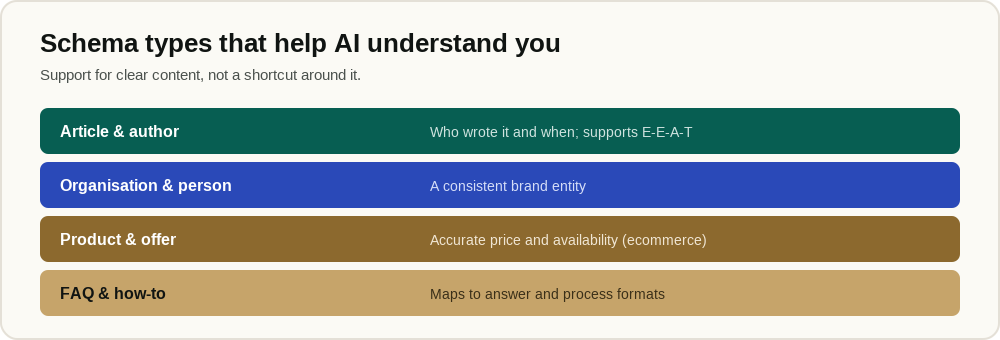
Article and author markup
Describe the article, its headline and date, and the person or organisation behind it. This supports author and entity understanding, which feeds the experience and trust signals AI systems weigh.
Organisation and person
Define your brand and key people consistently across the site, with stable names and identifiers. This strengthens the entity the engines associate with your topic, which is central to being a default source.
Product and offer
For ecommerce, accurately mark up product details, price and availability, and keep them aligned with what the page and feed show. Consistency across page, markup and feed is what builds trust.
FAQ and how-to
Mark up genuine FAQs and step-by-step processes. These map directly to the question-and-answer and procedural formats that answer engines lift.
Rules for using schema well
- Only mark up content that is actually visible on the page; hidden or mismatched markup can be ignored or penalised.
- Keep markup accurate and in sync with the visible content and any feeds.
- Use the types that genuinely match the page rather than stacking irrelevant ones.
- Validate your markup and monitor for errors.
- Treat schema as support for clear content, not a replacement for it.
Where people go wrong
The common failure is believing schema alone drives AI citations. Pages with perfect markup but thin, unclear or inaccurate content still lose to pages that answer the question well. The second failure is mismatch: markup that claims things the visible page does not show, which erodes trust. Fix the content and accuracy first, then add markup to make it legible.
How this fits GEO and AEO
Structured data is a supporting layer of both answer engine optimization and generative engine optimization. It helps machines understand and trust content that is already clear and accurate. The sequence matters: write the answer well, keep it true, then mark it up, not the other way around.
FAQ
Frequently asked questions
Structured data is standardised JSON-LD markup that tells search engines and AI systems what a page is about: the organisation, product, author, FAQ or article details. For answer engine optimisation (AEO), it makes content easier to parse, so answers can be matched to the right entity and cited with confidence. It supports clear writing and genuine expertise; it does not replace them.
It clarifies who wrote the page, which organisation stands behind it, and what each section answers, which helps AI systems choose a trustworthy source. Schema alone does not earn a citation. The page still has to answer the question directly, match what is visible to readers, and be genuinely useful.
It helps machines understand your page, which supports visibility, but it does not guarantee inclusion. Clear, accurate, authoritative content is the primary driver.
It depends on the page. Article and author markup help most content; product markup matters for ecommerce; FAQ and how-to help answer-style pages.
No. Only mark up content present on the page. Hidden or mismatched markup can be ignored or cause problems.
JSON-LD is the widely recommended format and the easiest to maintain. Keep it accurate and validated.
No. Use types that match the page. Irrelevant or excessive markup adds risk without benefit.
Similar posts
AI Search & GEO
Generative Engine Optimization (GEO): The Complete Playbook for Getting Cited by AI
A practitioner's guide to GEO: how to get your brand cited by ChatGPT, Google AI Overviews and Perplexity. What works, what you cannot control, and a 30-day plan.
6 min read
AI Search & GEO
What Is Answer Engine Optimization (AEO)?
AEO structures your content so engines can extract a concise, correct answer. Learn the building blocks, why accuracy matters, and how AEO bridges SEO and GEO.
4 min read
AI Search & GEO
Ecommerce SEO for AI Search: Product Discovery, Helpful Content, and Entity Clarity
How to earn ecommerce visibility in AI search: discoverable pages, explicit product facts, helpful content and clear entities. No guarantees, just durable fundamentals.
3 min read
Related services