AI Search & GEO
What Is Answer Engine Optimization (AEO)?

People increasingly get answers without reading a full page: featured snippets, voice assistants, and AI chat all return a synthesised response. Answer Engine Optimization is how you make sure the answer they get is yours, and that it is accurate. It is not a replacement for SEO; it is the layer that turns a well-ranked page into an extractable answer. This article explains what AEO is, why it matters, and the concrete writing and markup choices that make content answerable.
Quick answer
Answer Engine Optimization (AEO) is the practice of structuring your content so an answer engine, a search feature or AI assistant, can extract a concise, correct response from it. It means leading with a direct answer, using clear question-style headings, keeping facts self-contained, and adding structured data. AEO is a core part of modern SEO and the foundation of getting cited in AI answers, because a machine can only use content it can cleanly parse.
Key takeaways
- AEO structures content so engines can extract a concise, correct answer.
- Lead with a self-contained answer and use question-style headings.
- FAQs, structured data, tables and step lists improve extractability.
- Accuracy matters as much as structure; shaky facts lose citations.
- AEO is the bridge between SEO and GEO, not a separate project.
Why AEO matters
When an engine answers on the spot, the brand that supplied the answer earns the visibility and trust, even if the user never clicks. If your content is hard to parse, the engine will prefer a competitor whose answer is cleaner, or paraphrase without crediting you. AEO protects against both: it makes you the easiest correct source to quote.
The building blocks of answerable content
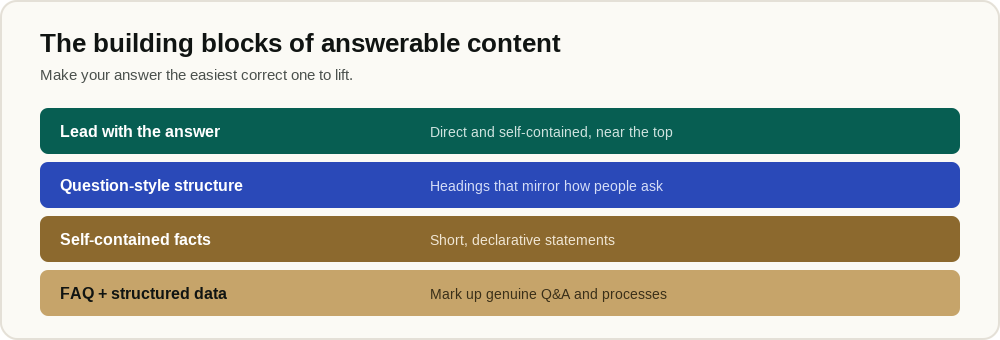
Lead with the answer
State the direct answer to the page's main question in the first paragraph, written so it stands alone without the surrounding context. This is the single highest-leverage AEO habit.
Use question-style structure
Write headings the way people ask questions, and keep each section focused on one question. An engine looking for a specific answer should find an unambiguous passage.
Keep facts self-contained
Avoid answers that depend on earlier sentences to make sense. Short, declarative statements of fact are easier to lift correctly than long, winding explanations.
Add an FAQ and structured data
Collect the common follow-up questions into an FAQ, and mark it up with FAQ schema. Use how-to schema for processes and other relevant types. Structured data helps machines understand and trust the content; it does not replace clear writing.
Use tables and lists for comparisons and steps
Engines lift structured formats well. A short comparison table or a numbered step list is often the cleanest way to present a comparison or a process.
AEO and accuracy
Answerability is worthless if the answer is wrong. Keep facts current, align with reliable sources, and avoid overstated claims. Engines are increasingly cautious about sourcing shaky statements, and a reputation for accuracy makes you a preferred source over time.
How AEO relates to SEO and GEO
AEO sits between SEO and GEO. SEO makes the page discoverable and trusted; AEO makes its answer extractable; GEO uses both to earn citations inside generative AI responses. The same page, built well, serves all three. If you only remember one thing: a model cannot cite what it cannot cleanly read, so answerability underpins everything.
Common mistakes
- Burying the answer deep in the page after lengthy preamble.
- Writing answers that only make sense with the paragraph before them.
- Relying on schema to compensate for unclear content.
- Padding pages with keywords instead of answering the question.
- Letting facts go stale, which erodes trust and citations.
FAQ
Frequently asked questions
No, but it is part of modern SEO. SEO covers discoverability and authority; AEO focuses specifically on making your content an extractable answer.
No. FAQs help, but AEO applies to how you write every answer, lead with it, keep it self-contained, and structure the page clearly.
Sometimes, because the engine may answer on the page. The trade-off is visibility and trust as the cited source; focus on queries where a click still adds value.
FAQ and how-to schema are common starting points, plus article and organisation markup. Use types that genuinely match your content.
Yes. Voice assistants read out a single answer, so clear, self-contained answers are more likely to be chosen.
Similar posts
AI Search & GEO
Generative Engine Optimization (GEO): The Complete Playbook for Getting Cited by AI
A practitioner's guide to GEO: how to get your brand cited by ChatGPT, Google AI Overviews and Perplexity. What works, what you cannot control, and a 30-day plan.
6 min read
AI Search & GEO
GEO vs SEO vs AEO: What's the Difference and How They Work Together
SEO ranks, AEO answers, GEO gets cited by AI. A clear explanation of how the three differ, where they overlap, and one combined workflow that serves all three.
4 min read
Technical SEO
Structured Data for AI Search: What Actually Helps
Which schema types matter for AI visibility, and which do not. How structured data supports AEO and GEO, the rules for using it well, and where people go wrong.
4 min read
Related services