AI Search & GEO
Ecommerce SEO for AI Search: Product Discovery, Helpful Content, and Entity Clarity

AI-powered search experiences are changing how people discover information and compare products, but the fundamentals of a useful ecommerce website remain important. Search systems need to interpret pages, understand entities and relationships, and surface information that genuinely helps users. There is no single optimisation switch that guarantees inclusion in AI-generated answers or shopping experiences. A durable approach combines accessible pages, clear product facts, useful editorial content, coherent site architecture, and reliable structured data.
Quick answer
No. Search and AI systems decide what to surface; sites can improve clarity and usefulness but cannot guarantee inclusion.
Key takeaways
- Ensure important category, product, and guide pages can be crawled and rendered.
- Product pages should clearly communicate product name, brand where relevant, model or SKU where appropriate, materials, dimensions, compatibility, availability, price, shipping information, returns, and variant differences.
- Create buying guides, comparisons, care advice, fit or sizing guidance, and material explainers when they answer real customer questions.
- Use consistent names for the organisation, products, categories, and relevant experts.
Start with discoverability
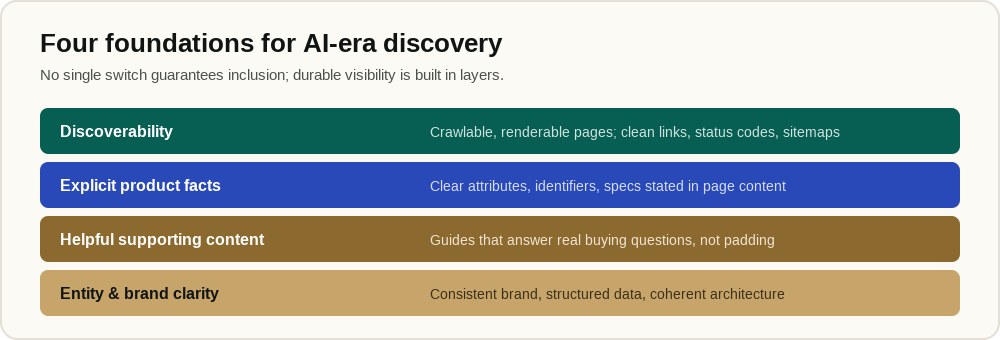
Ensure important category, product, and guide pages can be crawled and rendered. Use sensible internal links, valid status codes, canonical URLs, and XML sitemaps that contain the preferred URLs. Avoid relying on important product information that appears only after an interaction that crawlers may not process as expected. Technical access does not guarantee visibility, but inaccessible or contradictory pages create avoidable barriers.
Make product facts explicit
Product pages should clearly communicate product name, brand where relevant, model or SKU where appropriate, materials, dimensions, compatibility, availability, price, shipping information, returns, and variant differences. Include only facts that are true and supported by the catalogue. Keep visible content and structured data aligned. Do not invent attributes to make a product seem more complete.
Build helpful supporting content
Create buying guides, comparisons, care advice, fit or sizing guidance, and material explainers when they answer real customer questions. Content should add useful expertise rather than restating a product feed. Explain how to choose, what trade-offs matter, and which details vary by product. Keep authorship and review processes clear, and refresh advice when product ranges or policies change.
Strengthen entity and brand clarity
Use consistent names for the organisation, products, categories, and relevant experts. Provide accurate organisation details and author information. Structured data can help describe page content, but it is not a guarantee of rich results or AI citations. Avoid unsupported claims such as ‘AI-approved’ or promises of inclusion in generated answers.
Measure what can be observed
Track organic clicks and impressions, relevant landing pages, product engagement, conversions, and referrals where analytics identifies them. AI search referrals may be incomplete or grouped differently across platforms. Do not infer visibility from a single anecdote or screenshot. Record the source, date, query context, and limitations when conducting manual checks.
Practical 30-day action plan
Week 1: audit access, canonicalisation, and high-value product facts. Week 2: improve a small set of priority product and category templates. Week 3: publish or refresh one or two useful buying resources based on real customer questions. Week 4: validate structured data, internal links, analytics, and baseline performance. Expand only after reviewing quality and operational capacity.
Common mistakes
Do not mass-produce near-identical AI-written pages, add irrelevant FAQs to every product, fabricate reviews, or add schema properties unsupported by visible content. Avoid claims that a particular file, markup type, or content format guarantees AI citations. Prioritise usefulness, accuracy, and crawlability.
FAQ
Frequently asked questions
No. Search and AI systems decide what to surface; sites can improve clarity and usefulness but cannot guarantee inclusion.
No. It complements accessible, accurate page content and does not replace it.
Not necessarily. Provide the information needed to distinguish and evaluate the product without padding the page.
Use available referral and search data cautiously, and document manual checks without treating them as comprehensive measurement.
Similar posts
AI Search & GEO
Generative Engine Optimization (GEO): The Complete Playbook for Getting Cited by AI
A practitioner's guide to GEO: how to get your brand cited by ChatGPT, Google AI Overviews and Perplexity. What works, what you cannot control, and a 30-day plan.
6 min read
SEO
Ecommerce SEO: The Complete Guide to Growing Organic Revenue
Learn how to grow ecommerce organic revenue with category SEO, product pages, technical SEO, structured data, internal linking, content strategy and measurement.
24 min read
AI Search & GEO
SEO, AEO & GEO: The Complete Guide to Search and AI Visibility
Understand SEO, answer engine optimization and generative engine optimization, and learn how to improve visibility across Google Search and AI-powered discovery.
20 min read
Related services
Related work