Technical SEO
Structured Data for Agentic Commerce

Structured data has always been one of the highest-return, lowest-glamour investments in ecommerce. It is markup that sits in your pages and feeds, translating your products into a form machines can read without guessing. For years its main payoff was richer search results. In an agentic world, its importance grows sharply, because the audience is increasingly a machine making a decision, not a person interpreting a page. This piece explains what structured data does in the context of AI agents and assistants, which types matter most, and the principles that keep it working. It assumes you want durable results, so it emphasises accuracy and maintenance over clever tricks.
Quick answer
Structured data is machine-readable markup, chiefly product, offer, review and organisation schema, that tells AI agents and search systems exactly what your products are, what they cost, whether they are available and whether they can be trusted. In agentic commerce, where a machine evaluates you rather than a human reading your page, structured data is the difference between being understood and being ignored. Implement it accurately, keep it in sync with reality, and treat it as foundational rather than optional.
Key takeaways
- Structured data states your products' facts explicitly in a standard machine-readable vocabulary, so agents do not have to infer them.
- In agentic commerce the evaluator is a machine, so clear markup is the difference between being understood and being skipped.
- Prioritise accurate product and offer schema, then genuine review and rating markup, then organisation and brand data.
- Accuracy is paramount: markup that misstates price, availability or specs is worse than none because machines act on it directly.
- Keep structured data synced with live reality and matched to your actual page content; discrepancies erode trust.
- Follow the standard honestly rather than gaming it; the same markup also powers rich search and AI search visibility.
The types that matter most
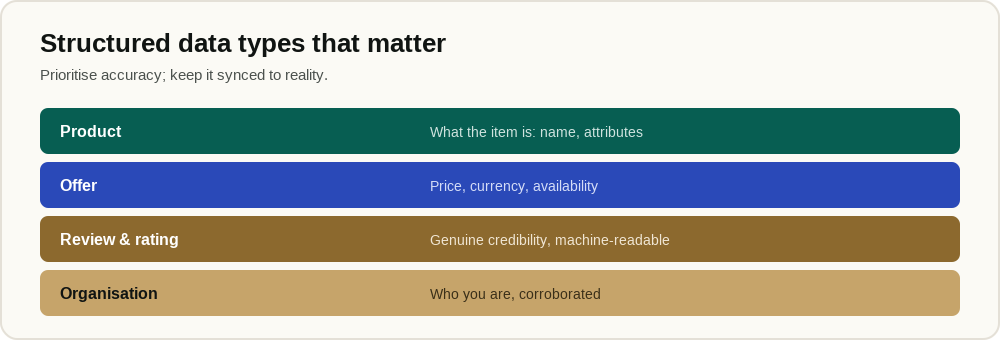
Product and offer
Product schema describes the item: name, description, brand, identifiers, attributes. Offer schema describes the commercial terms: price, currency, availability, condition. Together they let a machine know what you sell and on what terms, the core facts of any shopping decision. Getting these accurate and complete is the priority.
Review and rating
Review and aggregate rating markup expresses credibility in a machine-readable way. Because agents and answer engines weigh trust, structured review data, representing genuine reviews honestly, helps you be chosen over options a machine cannot corroborate. It must reflect real reviews; fabricated or manipulated markup is both wrong and risky.
Organisation and brand
Organisation schema and consistent brand information help machines understand who you are and connect the entity across the web. This supports the consistency and corroboration that AI systems rely on when deciding whether to trust a source.
Principles that keep it working
Accuracy above all
Structured data that misstates price, availability or specifications is worse than none, because machines act on it directly. An agent that recommends you on a stale price creates a bad experience. Mark up what is true, and only what is true.
Keep it in sync with reality
Prices and availability change, and your structured data must change with them. Markup that lags reality causes mismatches. Automate the synchronisation so your schema reflects the live state of your catalogue, not a snapshot from last month.
Match your markup to your page
Structured data should describe what is actually on the page and in your feed. Discrepancies between markup and visible content undermine trust and can cause your data to be disregarded. Treat markup as a faithful translation of real content, never as a place to claim things the page does not support.
Follow the standard, do not game it
Use the established vocabulary as intended. Attempting to manipulate markup for advantage, marking up things that are not there, inflating ratings, tends to backfire and damages trust with the very systems you are trying to reach. The durable play is honest, complete, standard markup.
Where to start
If you are beginning, prioritise accurate product and offer schema across your catalogue, then genuine review markup, then organisation data. Verify that it reflects your live prices and stock, and that it matches your pages. This same work underpins rich search results and AI search visibility, so it pays off well beyond agentic commerce, which is exactly why it belongs near the top of any AI-readiness list.
FAQ
Frequently asked questions
It is machine-readable markup, such as product, offer, review and organisation schema, added to your pages and feeds that states your products' facts explicitly: what they are, what they cost, whether they are available and how they are rated. Machines read it without having to infer meaning from layout or copy.
Because an agent evaluates you by reading data, not by interpreting a page. Clear, accurate markup lets it understand your products, match them to needs and represent you correctly. Without it, the agent may misread or skip you, which in a fast automated comparison means losing out to clearer competitors.
Product and offer schema first, since they state what you sell and on what terms. Then genuine review and rating markup, which expresses credibility a machine can weigh. Then organisation and brand data, which helps machines understand who you are and corroborate you across the web.
No, and trying backfires. Markup that misstates facts or inflates ratings is both dishonest and risky, because machines act on it and because the systems you are trying to reach penalise manipulation. Mark up only what is true and present on the page; honesty is the durable strategy.
Yes. The same product, offer and review markup powers rich results in traditional search and supports visibility in AI search and answer engines. That broad, compounding payoff, combined with low risk, is why accurate structured data belongs near the top of any AI-readiness checklist.
Similar posts
Agentic Commerce
The Agentic Commerce Guide: Selling When AI Does the Shopping
A practitioner's guide to agentic commerce: what it is, what is real versus hype, and the no-regret work, structured data, feeds, trust and frictionless buying, that makes a store ready.
7 min read
AI for Ecommerce
Product Feeds for AI Agents and AI Search
A product feed is the machine-readable version of your catalogue and a core discovery asset as AI agents mediate shopping. What makes a good feed, and why machines do not fill gaps.
6 min read
Technical SEO
Structured Data for AI Search: What Actually Helps
Which schema types matter for AI visibility, and which do not. How structured data supports AEO and GEO, the rules for using it well, and where people go wrong.
4 min read
Related services