AI for Ecommerce
Product Feeds for AI Agents and AI Search

Most ecommerce teams think of the product feed as a technical file they set up once for shopping ads and then ignore. That was always a mistake, and agentic commerce makes it a costly one. The feed is one of the main ways a machine, whether an ad platform, a marketplace, an AI search surface or a shopping agent, comes to know what you sell and whether it fits a need. As more discovery runs through AI systems that read data rather than browse pages, the feed stops being a back-office afterthought and becomes a front-line discovery asset. This piece explains what a product feed is, why it matters more now, and how to make yours one that machines can use well.
Quick answer
A product feed is a structured file of your catalogue, titles, descriptions, prices, availability, images and attributes, that machines read to understand and surface your products. As AI agents and AI search increasingly mediate shopping, feed quality becomes a core discovery asset, not just an ads input. The priorities are completeness, accuracy, rich attributes, correct availability and pricing, and consistency with your site. A clean feed helps shopping ads, marketplaces and AI surfaces alike.
Key takeaways
- A product feed is the machine-readable version of your catalogue and a core discovery asset as AI agents and AI search mediate more shopping.
- Machines do not fill gaps with judgement the way humans do, so missing or wrong attributes mean you are simply absent from or mismatched in comparisons.
- Good feeds are complete, accurate, richly attributed, correctly priced and in-stock in real time, and consistent with your site.
- Lead titles with what the product actually is and its key attributes; machines parse clarity, not cleverness.
- Audit for gaps, fix price and availability sync, align with your site, and maintain the feed as a living asset.
- Feed improvements pay off across shopping ads, marketplaces and AI surfaces at once, making this high-return work.
What a product feed is
A product feed is a structured representation of your catalogue, typically one record per product or variant, with defined fields: a title, description, unique identifier, price, availability, image link, category, and a set of attributes such as brand, colour, size, material and condition. It is the machine-readable version of your catalogue, stripped of design and reduced to facts.
Feeds power shopping ads, populate marketplaces, and increasingly feed the data layer behind AI-assisted shopping. Because so many systems consume the same kind of structured product data, improving your feed tends to pay off in several places at once.
Why feeds matter more in the agentic era
When a person browses, they forgive a lot: a missing attribute, an ambiguous title, a description heavy on adjectives. They fill gaps with judgement. A machine does not. An AI agent matching products to a stated need relies on the attributes being present and correct. If your feed does not say a product's material, size range or key feature, the agent cannot match on it, and you are simply absent from that comparison.
So the feed becomes a gatekeeper. Rich, accurate feeds get considered for more needs; thin feeds get considered for fewer. In a world where agents do the shortlisting, being absent from the data is being absent from the decision.
What makes a good feed
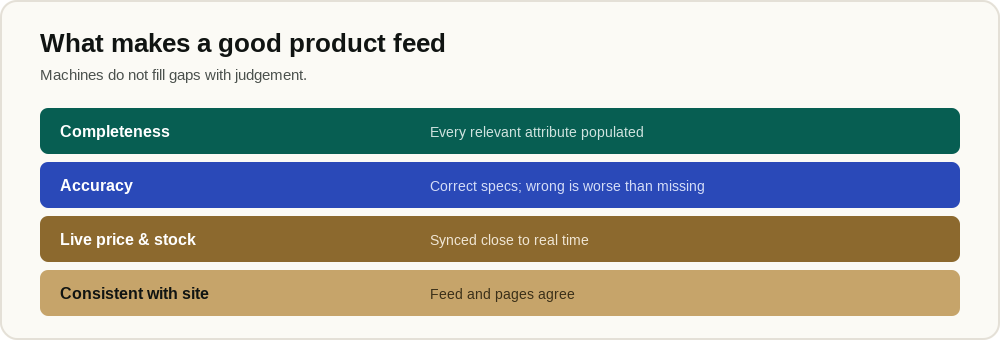
Completeness
Fill every relevant field, and especially the attributes that define fitness for a need: size, colour, material, compatibility, intended use. Each populated attribute is another way an agent can match you. Blank fields are missed opportunities you never see.
Accuracy
Wrong data is worse than missing data, because it leads to mismatches, disappointed buyers and lost trust. Prices, availability and specifications must be correct and current. An agent that recommends you based on a stale price creates a bad experience that reflects on your brand.
Correct availability and pricing in real time
Availability and price change, and feeds that lag reality cause problems: recommending out-of-stock items, or surfacing a price that no longer holds. Keep these synced as closely to real time as your systems allow. This is one of the most common and most damaging feed failures.
Consistency with your site
The feed and your product pages must agree. Contradictions between what a machine reads in the feed and what it finds on your site undermine trust and can cause products to be suppressed. Treat the feed and the site as one source of truth expressed twice.
Strong titles and descriptions
Titles should be clear and descriptive, leading with what the product actually is and its key distinguishing attributes, not clever marketing phrases a machine cannot parse. Descriptions should be factual and specific. Machines extract meaning from these fields, so clarity beats cleverness.
Practical steps to improve yours
Start by auditing your current feed for missing and inaccurate fields; most feeds have more gaps than their owners expect. Prioritise the attributes that matter for matching in your category. Fix the availability and price sync so the feed reflects reality. Align titles and descriptions to be clear and attribute-led. Then keep it maintained, because a feed is a living asset that degrades as your catalogue changes, not a one-time setup.
FAQ
Frequently asked questions
It is a structured file listing your catalogue with defined fields, title, description, identifier, price, availability, image, category and attributes, that machines read to understand and surface your products. It powers shopping ads, marketplaces and increasingly the data behind AI-assisted shopping.
Agents match products to a stated need by reading attributes. If your feed lacks or misstates the attributes that matter, the agent cannot match you and you are absent from that comparison. Rich, accurate feeds get considered for more needs; thin ones get skipped.
Stale availability and pricing. Feeds that lag reality cause agents and shopping surfaces to recommend out-of-stock items or wrong prices, creating bad experiences that damage trust. Keeping availability and price synced close to real time is among the highest-value fixes.
Lead with clarity for machines: state what the product is and its key distinguishing attributes first, rather than a clever marketing phrase. Machines extract meaning from the title to match needs, so a clear, attribute-led title is matched more accurately than a vague one.
Yes. The same structured product data drives shopping ads, marketplace listings and AI search surfaces, so feed improvements tend to help in several places at once. That broad payoff, plus the low risk, makes feed quality one of the better uses of ecommerce effort.
Similar posts
Agentic Commerce
The Agentic Commerce Guide: Selling When AI Does the Shopping
A practitioner's guide to agentic commerce: what it is, what is real versus hype, and the no-regret work, structured data, feeds, trust and frictionless buying, that makes a store ready.
7 min read
Technical SEO
Structured Data for Agentic Commerce
Structured data tells AI agents what your products are, cost, and whether they can be trusted. Which schema types matter, why accuracy is paramount, and how to keep it synced to reality.
5 min read
Agentic Commerce
How to Prepare Your Store for AI Shopping Agents
Preparing for AI shopping agents means making products easy for a machine to find, understand, trust and buy, with structured data, clean feeds and a frictionless checkout. Mostly no-regret work.
6 min read
Related services