AI Search & GEO
SEO, AEO & GEO: The Complete Guide to Search and AI Visibility

Understand SEO, answer engine optimization and generative engine optimization, and learn how to improve visibility across Google Search and AI-powered discovery.
Quick answer
SEO focuses on organic search discovery and performance. AEO describes efforts to make useful information accessible to answer-oriented experiences. GEO describes efforts to improve discovery and citation in generative AI experiences. The terms overlap, and neither AEO nor GEO is a universally standardized discipline.
Key takeaways
- People increasingly discover information through more than a traditional list of blue links.
- The terms overlap because each concerns the same basic challenge: helping the right audience find reliable information from a source that can satisfy its need.
- They can help teams ask better questions.
- AI search products are not all the same.
Introduction: Search is changing, but the fundamentals still matter
People increasingly discover information through more than a traditional list of blue links. They may use Google Search, AI Overviews, AI Mode, conversational assistants, specialist answer engines, social platforms or marketplaces. For businesses, this creates a practical question: how can a website remain discoverable when the experience that presents information to the user keeps changing?
Three terms are often used in this discussion:
These labels are not universally standardized, and different practitioners define them differently. They are best treated as useful ways to describe overlapping goals, not three completely separate disciplines.
Google's current guidance is especially important here: its AI Search features use existing Search systems and do not require special AI markup or a separate set of ranking tricks. Foundational SEO remains relevant. Google also emphasizes valuable, distinctive content rather than generic pages created simply to attract search visits. See its AI features and website guidance and guide to optimizing for generative AI features. citeturn0search2turn0search5
This guide explains what SEO, AEO and GEO mean in practice, what is known versus speculative, and how to build a measurable strategy that improves discovery without wasting time on unsupported “AI SEO hacks.”
- SEO (Search Engine Optimization): improving a website's ability to be discovered and perform in organic search.
- AEO (Answer Engine Optimization): a broad industry term for structuring and presenting useful information so it can serve answer-oriented searches and experiences.
- GEO (Generative Engine Optimization): a broad industry term for improving the likelihood that useful content is discovered, understood, cited or surfaced by generative AI experiences.
1. SEO, AEO and GEO explained
The terms overlap because each concerns the same basic challenge: helping the right audience find reliable information from a source that can satisfy its need.
Think of SEO as the foundation. AEO and GEO describe additional ways teams think about making content useful and discoverable in answer-first or generative experiences. The exact terminology varies across the industry, and no single checklist can guarantee visibility in every platform.
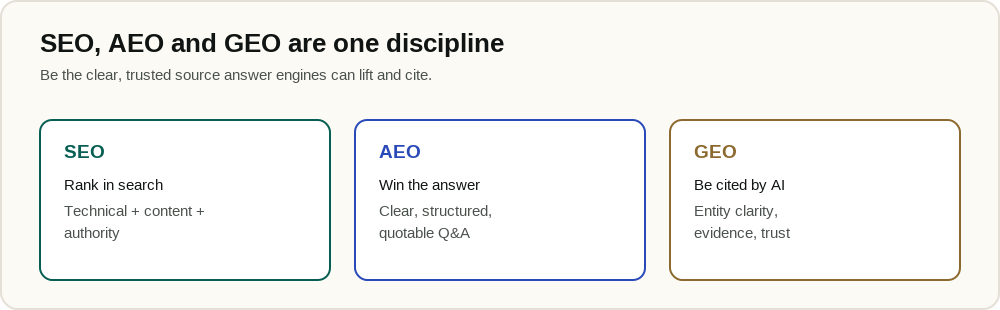
| Discipline | Practical focus | Examples of work | What it cannot guarantee |
|---|---|---|---|
| SEO | Organic search discovery and performance | Crawlability, indexation, page relevance, internal links, content quality, technical health | Rankings, indexing or traffic |
| AEO | Answer-oriented discovery | Clear explanations, useful question-led sections, concise definitions, accurate supporting detail | Being selected as an answer or featured response |
| GEO | Discovery in generative AI experiences | Distinctive source material, clear attribution, accessible content, credible references, monitoring citations where possible | Being cited or mentioned by an AI system |
Why the distinctions matter
They can help teams ask better questions. SEO encourages us to investigate whether important pages can be crawled and satisfy search intent. AEO encourages us to make answers clear and useful. GEO encourages us to consider whether a page offers distinctive evidence, expertise or perspective that a generative system might have a reason to reference.
But creating three separate strategies, three sets of pages and three technical implementations can lead to duplicated effort. A stronger approach is to create one coherent search and discovery strategy, then adapt reporting and content formats to the surfaces that matter to the business.
2. How AI-powered search experiences find and present information
AI search products are not all the same. Google AI Overviews and AI Mode operate within Google Search; other assistants may use their own models, retrieval systems, indexes, licensed sources, connected tools or browsing capabilities. Their sources and responses can differ by query, time, location, product version and user context.
Google explains that its generative search features draw on its Search systems and can use retrieval techniques to ground responses in relevant information. A page must meet the relevant technical requirements and be eligible to appear in Search with a snippet to be considered as a supporting link. Eligibility is not a guarantee of selection. citeturn0search2turn0search7
A simplified discovery path may look like this:
This is a conceptual model, not a universal description of every AI system. Some systems may rely on different data sources or workflows.
- 01A website publishes a page containing information, evidence, products or expertise.
- 02A search or retrieval system discovers and processes eligible content.
- 03For a particular question, the system selects or retrieves sources it considers relevant.
- 04A generative experience may synthesize information and display links or citations.
- 05The user may click through, continue asking questions, compare sources or act without visiting every cited page.
The key implication
Do not optimize for a fictional universal “AI ranking.” There is no single position that applies across all assistants and every question. Focus on things you can control: useful information, accessible pages, clear source attribution, accurate facts, strong site structure, real expertise and a measurement process that records what can actually be observed.
3. What remains foundational
Google's published guidance says the best practices for Search remain relevant to AI features. It does not require a special AI file, new markup or a separate optimization technique to appear in AI Overviews or AI Mode. citeturn0search2turn0search5
The practical foundations are:
Crawlability and indexability
Make sure important pages can be accessed by search crawlers and are not accidentally blocked by robots rules, hosting restrictions, authentication or other technical controls. Ensure the pages you want discovered are eligible for indexing and have appropriate canonical signals.
Clear information architecture
Important content should be reachable through meaningful internal links. A useful page that is isolated, buried or only accessible through a complex interaction may be harder for users and crawlers to discover.
Helpful, original content
Answer the actual need. Avoid pages that merely repeat common knowledge or rewrite competitors without adding something useful. Google's generative AI guidance explicitly emphasizes unique, valuable, non-commodity content. citeturn0search5turn0search7
Accurate structured data
Structured data can help describe supported information, but it must match the visible page. There is no special schema type that guarantees inclusion in AI responses.
Good user experience
Mobile usability, readable content, sensible navigation, working links and appropriate media remain important. AI discovery is not a reason to neglect the website itself.
Reliable business information
For eligible businesses, keep relevant product feeds, Merchant Center information and Business Profile details current. Google lists these among its recommended practices for AI search visibility. citeturn0search2
4. Create content worth finding and citing
The most defensible content strategy is not to publish the most pages. It is to publish information that is genuinely useful, accurate and difficult to replace with a generic summary.
Add value beyond the obvious
A page may become more useful when it includes:
For example, a generic article about ecommerce advertising might define ROAS. A more useful article could explain how to calculate break-even ROAS using gross margin and variable costs, show a clearly labelled illustrative calculation, explain the assumptions, and describe how to use the result in budget decisions. It should not invent a client result or imply that an example is real data.
- A clear explanation based on real subject knowledge.
- Original analysis, examples or a decision framework.
- First-hand observations that can be honestly supported.
- A transparent methodology for calculations, tests or comparisons.
- Relevant limitations and trade-offs.
- Primary-source references for claims that need verification.
- Practical next steps that help the reader make a decision.
Build a library of connected expertise
Choose a clear subject area and cover it with complementary pages. For a performance marketing professional, this could include paid media, ecommerce economics, conversion optimization, analytics, SEO and measurement. For a retailer, it might include product selection, materials, sizing, maintenance and comparison guides grounded in its actual catalogue.
Each page should have a distinct job. A pillar guide introduces a subject and connects to deeper articles. Supporting articles answer specific questions. Case studies show evidence where permission and data allow. Service pages explain what the business offers. Do not publish multiple near-identical pages simply to target slightly different keyword variations.
Use evidence carefully
When reporting a result, explain the context and metric definition. Distinguish revenue from profit, attributed revenue from incremental revenue, and correlation from causation. If the data is confidential or cannot be substantiated publicly, do not publish it.
Where a claim depends on current platform functionality, link to the platform's official documentation and review it before publication. Where a claim is an interpretation or recommendation, label it as such rather than attributing it to a search engine.
5. Make answers clear without writing robotic content
Answer-oriented content should be easy to understand, but it does not need to be reduced to disconnected one-sentence blocks or formulaic FAQs.
A useful structure often includes:
- A descriptive heading that tells readers what the section covers.
- A direct opening answer when the question is straightforward.
- Supporting explanation, context and relevant caveats.
- Examples, evidence or steps where they add value.
- Links to deeper material for readers who need more detail.
Example: weak versus useful answer
Weak: “ROAS is important for ecommerce growth. Businesses should optimize ROAS to improve results.”
More useful: “ROAS is attributed advertising revenue divided by ad spend. It does not account for product cost, fulfilment, discounts, returns or every other variable expense. A campaign with a higher ROAS is not automatically more profitable, so compare it with break-even economics and contribution margin.”
The second answer defines the metric, identifies its limitation and gives the reader a decision-relevant implication.
Use FAQs only when they help
FAQs can clarify genuine customer questions, but they are not a mandatory GEO trick. Do not append dozens of repetitive questions to every page. Avoid inventing FAQ wording and labelling it as exact Google People Also Ask text unless it has actually been checked in live search results.
For complex subjects, a coherent guide with a clear structure is often more useful than a page fragmented into dozens of short answers. Choose the format that serves the reader.
Write for humans, not an imagined parser
Avoid unnatural repetition, keyword stuffing, excessive bold text, artificial “answer capsules” that add no value, and repetitive definitions at the start of every section. Use plain language where it improves clarity, but retain nuance when the subject requires it.
6. Technical accessibility and site structure
Content cannot help a searcher if the relevant system cannot access it or understand which page is the preferred version.
Use a technical audit to check:
For a JavaScript-heavy site, inspect both the initial response and rendered page. Do not assume that content visible in a local browser is automatically available in the same way to every crawler or retrieval system.
- 01HTTP status: Important pages return the intended status and do not lead through unnecessary redirect chains.
- 02Robots directives: Crawling is allowed where needed, including through relevant CDN and hosting controls.
- 03Indexation: Pages intended for organic discovery are eligible for indexing.
- 04Canonicalization: Preferred URLs are consistent with internal links, sitemaps and page annotations.
- 05Internal links: Important pages can be reached through descriptive, crawlable links.
- 06Rendered content: Essential text, product details and links are accessible to search systems.
- 07Sitemaps: XML sitemaps contain preferred, indexable URLs and are kept current.
- 08Page experience: Layout, mobile interaction, navigation and loading behaviour support real users.
- 09Status changes: Redirects and indexation are checked after site migrations or template releases.
Keep the page's main purpose clear
A page should have a clear topic and a stable URL. Descriptive titles and headings, meaningful internal links and a sensible hierarchy help users understand the page and its place in the site.
This does not mean every paragraph needs to be rewritten into a standalone snippet. It means the page should be understandable as a whole and its important information should not be hidden behind unnecessary barriers.
8. Build real expertise and trust
Visibility is not only a technical challenge. Readers need reasons to trust what a page says and to choose that source over alternatives.
A practical trust review asks:
Google's people-first content guidance encourages creators to make authorship clear and avoid deceptive credentials. It also emphasizes original information, useful analysis and content that satisfies readers rather than pages produced primarily to attract search traffic. citeturn0search8turn0search9
- Is the author accurately identified?
- Does the author have relevant, verifiable experience?
- Are claims supported by evidence or reliable primary sources?
- Are limitations and assumptions explained?
- Is the information current where freshness matters?
- Does the page distinguish factual statements from opinions and examples?
- Are commercial interests and affiliations clear when relevant?
- Does the site provide a way to contact the responsible organization?
- Are testimonials, reviews and case studies genuine and permissioned?
Demonstrate experience rather than declaring authority
A paragraph saying “we are experts” is less informative than a useful explanation showing how a decision is made, which factors were considered, what was learned and where the approach may not apply.
Where you can share a real case study, explain the starting situation, intervention, measurement period, outcome and limitations. Where you cannot share data, use an illustrative scenario and label it clearly. Never present a hypothetical calculation as a client result.
9. Improve product, local, image and video discovery
Search visibility is not limited to long-form articles. Depending on the business, products, local services, images and video may be important discovery routes.
Ecommerce and product discovery
Keep product titles, descriptions, prices, availability, identifiers and variant information accurate. Ensure product pages work for shoppers and that structured data reflects what is visible. Where relevant, maintain current product feeds and Merchant Center information. Google specifically includes accurate Merchant Center data among its recommended practices for AI search experiences. citeturn0search2
Local discovery
For businesses serving customers at physical locations, keep the business name, address, opening hours, service details and contact information accurate across relevant official profiles. Use a Google Business Profile where eligible and appropriate. Do not create fake locations or duplicate profiles to target more geographic phrases.
Images
Use high-quality images that add information rather than decoration alone. Provide relevant surrounding text, descriptive alt text where appropriate, and suitable image dimensions. For products, ensure images accurately represent the product and selected variant.
Video
When a demonstration or explanation is easier to understand visually, provide a useful video with a clear title, description and relevant context on the page. Add captions or a transcript when they improve accessibility and comprehension. Do not create video merely to tick an AI optimization box.
Keep information consistent
Product specifications, service descriptions, business details and author information should not contradict one another across pages and feeds. Correctness matters more than manufacturing the appearance of broad online mentions.
10. Measure visibility and business impact
Measurement is one of the hardest parts of AI search strategy because platforms expose different levels of reporting. Do not assume that every assistant provides complete referral, impression or citation data.
Establish a baseline
Record the current state before making changes:
A manual sample is a directional observation, not a universal ranking report. Responses can vary across users, time, location and prompt wording. Record the date, platform, query and observed citation rather than claiming that a single test establishes permanent visibility.
- Organic clicks, impressions, queries and landing pages in Search Console.
- Organic sessions, conversions and revenue in analytics, with the attribution model documented.
- Priority topics and pages.
- Technical indexation and crawl health.
- Referrals from identifiable AI services, where analytics captures them.
- A manually sampled set of relevant questions and whether the site appears as a source, where this can be checked reliably.
- Business outcomes such as qualified leads, sales, revenue or contribution margin.
Separate metrics by what they measure
Google announced new reporting and controls for generative AI Search features in 2026. Availability and scope can change, so check the current Search Console interface and official documentation rather than assuming every site has identical reporting. citeturn0search1
| Metric | What it can help answer | Limitation |
|---|---|---|
| Search Console clicks and impressions | How pages perform in Google Search reporting | Not a complete measure of all AI assistant exposure |
| Organic sessions | Whether organic visits reach the site | Sessions may not align one-to-one with Search Console clicks |
| AI referral sessions | Whether identifiable AI sources send visits | Some exposure may not generate a click or may not be identifiable |
| Citation or mention sampling | Whether a source appears for a defined test set | Results vary and the sample may not represent all users |
| Leads, orders and revenue | Whether discovery contributes to business outcomes | Attribution does not automatically prove incremental impact |
| Conversion rate and lead quality | Whether visitors are relevant and take useful actions | Requires reliable event definitions and enough data to interpret |
Measure what matters to the business
Do not let a new acronym replace the commercial goal. For a service business, relevant outcomes may include qualified enquiries and sales opportunities. For ecommerce, they may include orders, revenue, repeat purchase and margin. For a publisher, they may include engaged readership, subscriptions or other clearly defined goals.
If visibility increases but qualified outcomes do not, investigate the audience, landing page, offer and user journey. If traffic declines while qualified conversions improve, do not assume the strategy has failed without examining the context.
11. A 90-day implementation roadmap
This is a planning framework, not a guarantee of citations, rankings or revenue.
Days 1-30: Audit and baseline
Deliverable: A prioritized technical and editorial backlog with clear owners and success measures.
- 01Identify priority audiences, products, services and questions.
- 02Review Search Console, analytics and existing organic landing pages.
- 03Audit crawlability, indexation, canonical signals and internal linking.
- 04Confirm that key pages have accurate titles, headings, visible text and author information.
- 05Review structured data and product or business information where applicable.
- 06Select a small, relevant set of questions for repeatable manual visibility checks.
- 07Document the baseline and known measurement limitations.
Days 31-60: Improve high-value pages
Deliverable: A documented set of improvements, checked after deployment.
- 01Fix technical blockers affecting important pages.
- 02Improve content where it is generic, incomplete, outdated or poorly matched to user intent.
- 03Add original explanations, examples, verified evidence and useful decision frameworks.
- 04Strengthen internal links between related pages.
- 05Validate structured data and keep product or business information current.
- 06Improve relevant images, videos and mobile page experience.
- 07Add accurate author information and primary-source references.
Days 61-90: Evaluate and refine
Deliverable: A review that separates observed results, plausible explanations and unproven assumptions.
- 01Compare Search Console and analytics trends with the baseline.
- 02Repeat the defined AI visibility sample using the same method.
- 03Review AI referrals where they can be identified.
- 04Examine qualified leads, orders or revenue rather than visibility alone.
- 05Identify pages that still fail to answer the audience's questions.
- 06Update content where platform documentation or facts have changed.
- 07Prioritize the next group of improvements based on evidence.
12. Common myths and mistakes
Myth: GEO replaces SEO.
In practice, useful content and technical accessibility remain foundational. Treat AEO and GEO as overlapping discovery considerations rather than reasons to abandon SEO.
Myth: Every page needs special AI schema.
Google says no special schema.org markup is required for inclusion in its AI Overviews or AI Mode. Use structured data where it accurately describes supported content and meets feature requirements. citeturn0search2turn0search5
Myth: llms.txt is mandatory for Google AI visibility.
Google's current guidance says it is not required for Google Search's generative AI features. Assess any use for other systems against their official guidance. citeturn0search5
Myth: A certain word count or paragraph size guarantees citations.
There is no universally supported formula that guarantees selection. Write the amount and format of content the reader needs.
Myth: Repeating a brand name across many websites guarantees AI mentions.
Inauthentic mentions and low-value publishing are not a reliable strategy. Focus on genuine expertise, accurate references, useful resources and legitimate reputation building.
Myth: An AI citation proves the content generated a sale.
A citation is a discovery signal, not proof of business impact. Track referrals and downstream outcomes where possible.
Mistake: Publishing dozens of generic AI-generated articles.
Google warns that producing many pages without adding value can fall under scaled content abuse. Automation is not the issue by itself; the issue is content produced at scale primarily to manipulate search, with little originality or value. citeturn0search4
Mistake: Reporting a one-time prompt test as a ranking.
AI responses vary. Record the test conditions and avoid generalizing beyond the evidence.
Mistake: Ignoring the website after optimizing the content.
A page still needs to load, render, link correctly, communicate clearly and provide a good experience once the visitor arrives.
Conclusion: Build for discovery, trust and outcomes
SEO, AEO and GEO are best understood as overlapping ways of thinking about how people discover useful information. The technology and interfaces will continue to change, and different systems will expose different data. No shortcut can guarantee that a website will be cited by an AI assistant.
The durable strategy is to make your site technically accessible, publish distinctive and reliable information, demonstrate real expertise, connect pages through a clear structure, keep product and business data accurate, and measure outcomes with appropriate caution.
Apply the framework: Diagnose discoverability and measurement, Acquire relevant visibility, Convert through useful pages and clear journeys, Scale improvements supported by evidence, and Compound what you learn through ongoing review.
The goal is not simply to be mentioned by an AI. It is to become a useful, credible source for the people you want to reach, and to turn that discovery into meaningful business value.
---
Schema and publication checklist
- Use Article or BlogPosting schema with accurate headline, description, image, author, publisher and genuine publication/modification dates.
- Link the author to the real profile or About page; do not invent credentials.
- Use a canonical URL matching the final published route.
- Include the article in the existing /insights/ structure and sitemap where appropriate.
- Ensure the page is crawlable, indexable and linked from a relevant insights listing or related page.
- Validate markup and inspect the URL in Search Console after publishing.
- Add a working table of contents with anchor links.
- Review all external sources and refresh time-sensitive guidance before publication.
- Keep a changelog for substantive updates; do not backdate.
FAQ
Frequently asked questions
SEO focuses on organic search discovery and performance. AEO describes efforts to make useful information accessible to answer-oriented experiences. GEO describes efforts to improve discovery and citation in generative AI experiences. The terms overlap, and neither AEO nor GEO is a universally standardized discipline.
Yes. Google's guidance says the same foundational SEO practices remain relevant to AI features in Google Search. Important pages still need to be technically accessible, useful, reliable and eligible to appear in Search. citeturn0search2
Follow Google's core SEO and content guidance: make important pages crawlable and indexable, use clear internal links, provide useful original content, ensure key information is available in text, use accurate structured data where appropriate and maintain a good page experience. There is no guarantee of inclusion. citeturn0search2turn0search5
Google's current guidance says llms.txt is not required to appear in Google Search's generative AI features. Other platforms may have different practices, so verify any requirements with the specific service rather than assuming a universal rule. citeturn0search5
Useful question-and-answer content can help readers understand a topic, but adding FAQs is not a guaranteed ranking or citation technique. Use them when they address genuine user questions and support the page's purpose.
Google says no special schema.org structured data is required for AI Overviews or AI Mode. Supported structured data can still help describe eligible page content and may support other Search features when implemented accurately. citeturn0search2
Combine standard organic reporting with identifiable AI referral traffic and a documented sample of relevant questions where source citations can be observed. Track qualified leads, orders or other business outcomes. Be transparent about gaps because no single metric captures all AI exposure.
The use of AI does not automatically determine whether content is useful or eligible to rank. Google emphasizes accuracy, quality and relevance, and warns against generating many low-value pages primarily to manipulate rankings. Add original value, verify facts and follow Search policies. citeturn0search4
Similar posts
AI Search & GEO
Generative Engine Optimization (GEO): The Complete Playbook for Getting Cited by AI
A practitioner's guide to GEO: how to get your brand cited by ChatGPT, Google AI Overviews and Perplexity. What works, what you cannot control, and a 30-day plan.
6 min read
SEO
Ecommerce SEO: The Complete Guide to Growing Organic Revenue
Learn how to grow ecommerce organic revenue with category SEO, product pages, technical SEO, structured data, internal linking, content strategy and measurement.
24 min read
Performance Marketing
Performance Marketing for Ecommerce: What Actually Drives Profitable Growth
A profit-first guide to ecommerce performance marketing: how to connect paid media, SEO, conversion optimisation and measurement into one system that grows revenue without sacrificing margin.
11 min read
Related work