Performance Marketing
Performance Marketing for Ecommerce: What Actually Drives Profitable Growth

Performance marketing is often described as digital advertising where results can be tracked. That definition is technically useful but incomplete. For an ecommerce business, the important question is not whether a campaign generated measurable activity. It is whether the activity helped the business acquire the right customers at a cost it can support. This guide is the profit-first system I use: start with the economics, make measurement trustworthy, give each channel a clear job, fix the journey that converts, and scale only on evidence.
Quick answer
Performance marketing for ecommerce is a measurable approach to acquiring and converting customers through channels such as Google Ads, Meta Ads, SEO and lifecycle marketing, tied to business outcomes rather than impressions or clicks. A strong programme connects channel performance with the economics of the store (average order value, gross margin, acquisition cost, returns, repeat purchase and contribution profit). The goal is not the highest possible ROAS on every campaign, but a reliable system that acquires suitable customers and grows without sacrificing profitability.
Key takeaways
- Start with the economics. Know margin, fulfilment, discounts, fees, returns and break-even acquisition cost before setting targets.
- Use each channel for the job it does best: search captures intent, social creates demand, SEO builds durable discovery, CRO converts more of the traffic.
- Treat measurement as infrastructure. Wrong values, duplicate events or missing orders lead to bad decisions even when dashboards look convincing.
- ROAS is one signal, not the business result. Read it with CAC, MER, contribution margin, new-customer share and repeat purchase.
- More budget will not fix weak product pages, an unconvincing offer or a broken checkout. Fix the journey first.
- Scale through evidence, in measured steps, allowing enough time to tell a real improvement from normal variation.
What ecommerce performance marketing should achieve
To hire help for this, read how to choose a performance marketing consultant in Karachi. A campaign can generate thousands of clicks and still fail. It can deliver a low cost per purchase while attracting discount-driven orders with poor margins. It can report strong platform ROAS while the store's overall revenue stays flat because organic sales or returning customers have shifted. It can even look good because the tracking counts the same purchase more than once.
A mature programme therefore works across five connected jobs: create or capture demand, turn interest into orders, measure the journey accurately, improve customer economics, and reinvest where the evidence of incremental value is strongest. This is why performance marketing cannot sit apart from merchandising, pricing, inventory, fulfilment, service, website experience and finance.
Optimise the business outcome, not the dashboard
Ad platforms are useful decision systems, not the business itself. Use platform reporting to diagnose and optimise campaigns; use store, finance and a consistent framework to understand the wider result. When sources disagree, investigate the difference rather than choosing whichever number looks best.
Start with the business model, not the ad account
Before changing bids, audiences or creative, establish what a healthy order looks like. Document selling price and AOV, cost of goods, discounts, payment and marketplace fees, packaging and fulfilment, expected returns and failed deliveries, gross and contribution margin, and the repeat-purchase rate. Do not assume revenue is the amount available to spend on acquisition.
A simple illustration: a store sells an item for PKR 10,000. Assume product cost PKR 4,000, fulfilment PKR 700, payment and packaging PKR 300, and discounts or expected returns averaging PKR 500 per order. That leaves PKR 4,500 before advertising and fixed costs. Spend PKR 3,000 to acquire the order and PKR 1,500 remains before fixed costs. Whether that is attractive depends on the accuracy of the assumptions and on repeat-purchase value.
Calculate your break-even ROAS
A simplified break-even ROAS is 1 divided by the contribution margin rate available for marketing. A 40% contribution margin implies a 2.5x break-even ROAS. This is a planning approximation, not a universal target, and if you need profit after marketing your target must be higher. Do not copy a competitor's ROAS target: their margins and repeat behaviour may be nothing like yours.
Build a measurement foundation you can trust
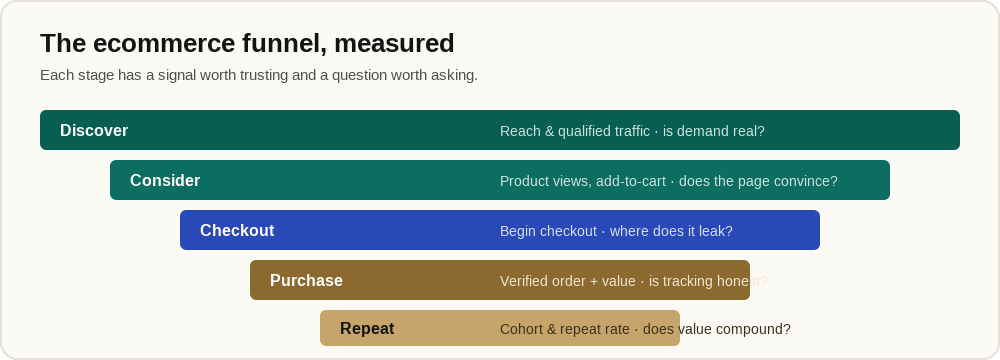
A strategy is only as good as the information guiding it. For an ecommerce store a completed purchase is usually the core conversion, supported by product views, add-to-cart, checkout initiation and payment. For each important event, confirm what triggers it, that it fires once and only when it should, that it carries the correct transaction ID, value and currency, that refunds are represented in reporting, that browser- and server-side events are deduplicated, and that the data reconciles with the order system.
Use platform and business reporting together through a simple weekly scorecard: spend by channel, orders and net sales, new-customer orders, reported ROAS, blended MER, CAC, AOV, contribution after marketing, returns, conversion rate and repeat performance. Keep definitions consistent, and remember attribution is a model for assigning credit, not a perfect record of causality.
Choose channels by customer intent and role
There is no single best channel. Product type, price, purchase frequency, demand, competition, creative resources and budget all affect the right mix. Give each channel a defined job rather than spreading a small budget everywhere.
- Google Ads captures existing intent. Before scaling, check that search terms are relevant, the feed is accurate, brand and non-brand are understood separately, conversion values pass correctly, and the result makes sense against store-level sales.
- Meta Ads creates demand and learns through creative. Build testing around meaningful differences (problem, benefit, demonstration, proof, offer, format) and read creative metrics alongside landing-page behaviour and order quality.
- SEO builds discovery that compounds over time, but it takes time and is never guaranteed. Track whether organic brings qualified visitors and revenue; do not publish thin pages just to add URLs.
- Lifecycle and retention (email, SMS, WhatsApp, with proper consent) make the first order more valuable. They should not hide an acquisition problem, but they improve the value of customers already earned.
Make the offer and customer journey convert
When campaigns bring relevant traffic but sales stay weak, more spend is rarely the answer. Inspect the journey from ad promise to order confirmation. The ad should make a clear promise and the landing page should continue that conversation, sending people to the most relevant destination rather than a generic homepage.
A product page should answer the questions standing between interest and purchase: clear photography, accurate sizing and material detail, price, delivery and availability, returns and warranty, genuine reviews, a clear call to action and helpful answers to common questions. Use analytics and customer feedback to find the actual point of friction, then prioritise fixes by impact, confidence and effort. Not every change needs an A/B test; some broken experiences should simply be fixed.
Understand ROAS, CAC, MER and contribution margin
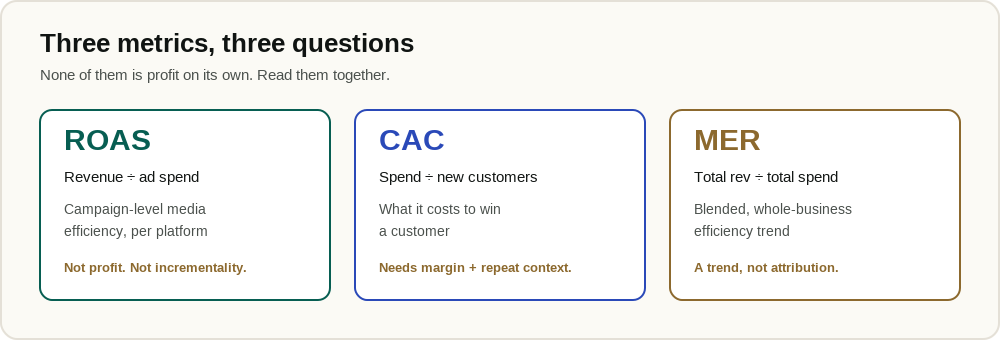
These metrics answer different questions, and treating them as interchangeable leads to bad decisions. ROAS assesses attributed media efficiency. CAC assesses what it costs to win a customer. MER assesses overall marketing efficiency as a trend. Contribution margin assesses how much economic value remains. The most useful operating view combines all four.
| Metric | What it tells you | What it does not tell you alone |
|---|---|---|
| ROAS | Attributed conversion value divided by ad spend | Whether the revenue was incremental or profitable after costs |
| CAC | Cost to acquire a customer, on a defined denominator | Whether customers repeat, or whether the cost is sustainable |
| MER | Total revenue divided by total marketing spend | Which channel caused revenue, or whether it is profitable |
| AOV | Average revenue per order | Whether the order has healthy margin or was discount-driven |
| Contribution margin | Revenue left after the variable costs included | Full net profit if fixed costs are excluded |
Build a practical operating system
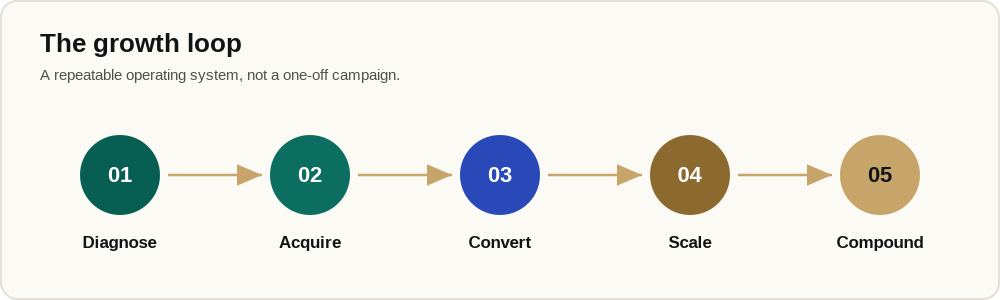
A repeatable operating system reduces reactive changes and helps teams learn. It runs as a loop: diagnose the constraint, acquire the right demand, convert it, scale what holds, and compound the gains.
- 01Diagnose. Start with the business goal, product economics, data quality and customer journey. Separate symptoms from causes: a falling ROAS could be creative fatigue, a price change, tracking changes, seasonality, stock or a shift in conversion mix.
- 02Acquire. Assign each channel a clear job, audience and offer, and set a budget the business can afford to learn from. Do not spread a small budget across too many campaigns.
- 03Convert. Make the ad promise, landing page, product page and checkout work together. Fix broken steps before increasing traffic.
- 04Scale. Increase investment only when the data is credible and operations (stock, delivery, support, cash flow) can absorb it. Scale in measured steps and watch marginal performance.
- 05Compound. Turn what you learn into durable assets: better pages, stronger creative, improved measurement, useful content, retention programmes. Document the learning.
How to scale without losing control
Scaling should be a decision, not a reaction to a few strong days. Before increasing spend, review measurement accuracy, economics and break-even, whether there is enough qualified demand, whether creative and offer have room to run, whether the landing page and checkout can convert more, whether operations can cope, and whether the evaluation window is fair.
Think in marginal terms. A campaign may average 4x ROAS while the extra spend needed to grow delivers less. That can still be worthwhile if the incremental economics meet the target, but it should be a conscious decision. Keep a change log of budget moves, creative launches, promotions, landing-page edits, tracking changes and stock issues, so results are attributed to the right action.
Common mistakes that waste ecommerce budget
- 01Setting a ROAS target before understanding margin.
- 02Treating all attributed sales as incremental.
- 03Optimising for the wrong event, so volume rises without business results.
- 04Making decisions from incomplete or duplicated tracking.
- 05Increasing traffic before fixing the landing page, offer or checkout.
- 06Testing too many things at once, so nothing is learned.
- 07Publishing SEO content with no real purpose, adding URLs instead of value.
- 08Ignoring the customer after the first order, and treating acquisition as the whole of growth.
A practical 30-day action plan
This plan establishes a reliable baseline before making aggressive changes. The order may shift for a business with urgent technical problems, a seasonal launch or limited data.
- Week 1, establish the truth: agree the objective and definition of profitable growth, document margin assumptions, reconcile reported orders with the store, audit conversion events and values, and record a baseline by channel.
- Week 2, find the biggest constraint: review search terms, structure, creative and offer; segment new vs returning customers; review product-page and checkout behaviour; identify the main drop-off and the highest-impact issue.
- Week 3, implement focused improvements: fix tracking and broken journeys first, make one or two high-confidence page or offer changes, refresh creative on a clear insight, and document every change.
- Week 4, evaluate and decide: review over a fair window, compare channel metrics with store revenue and contribution, decide what to continue, stop, test next or scale, and set next month's priorities on evidence, not activity.
Build a growth system, not a collection of campaigns
Sustainable ecommerce growth rarely comes from one clever bid adjustment or one winning ad. It comes from connecting the economics of the business with the channels that attract customers, the experience that converts them, the measurement that guides decisions and the operational capacity to serve them.
Start by understanding the numbers. Make the data trustworthy. Give every channel a clear role. Fix the biggest customer-journey constraint. Then scale what the evidence supports. That is the difference between managing advertising activity and building a performance marketing system designed to grow an ecommerce business.
FAQ
Frequently asked questions
It is a measurable approach to acquiring and converting customers through channels such as paid search, paid social, SEO and lifecycle marketing. Effective ecommerce performance marketing connects campaign results to store revenue, customer acquisition cost, margin and repeat-purchase behaviour.
There is no universally best channel. Google Ads captures existing search intent, Meta Ads introduces products and tests creative, SEO builds organic discovery, and lifecycle marketing supports repeat purchase. Choose based on customer behaviour, product economics, demand, measurement quality and resources.
Use a consistent set of metrics rather than one dashboard number: revenue, orders, ROAS, CAC, MER, AOV, conversion rate, contribution margin, new-customer share and repeat purchase. Define each clearly and reconcile the data with the store's order system.
It depends on product margin, fulfilment, discounts, returns, lifetime value and the profit target. A high ROAS can still be unprofitable at low margins, while a lower initial ROAS may be acceptable with credible repeat-purchase economics. Calculate the break-even point before choosing a target.
It depends on margins, demand, growth goals, conversion volume and how much spend the business can afford to test. Start with unit economics and a measurable plan, then increase investment as evidence and operational capacity support it. Avoid a fixed percentage as a universal rule.
Possible causes include low-intent traffic, a mismatch between ad and landing page, weak product information, price or delivery concerns, low trust, checkout friction, stock problems or inaccurate tracking. Check the full journey and find the largest drop-off before changing budgets.
It depends on how quickly you need demand, whether customers already search for the product, the budget and current organic visibility. Paid media gives faster feedback; SEO builds longer-term discovery. Many brands benefit from both with clear roles and shared measurement.
Review pacing and data quality regularly, but make major decisions on sufficient evidence and a fair conversion window. Frequent unnecessary edits make results harder to read. Respond quickly to genuine issues such as broken tracking, disapproved ads, stockouts or checkout errors.
Similar posts
AI Tools
The AI Marketing Tool Stack (2026): A Practical Buyer's Guide
A practitioner's guide to building an AI marketing tool stack around jobs to be done: general assistant, content, ads, email, analytics and AI visibility. Lean and honest.
4 min read
Performance Marketing
What Is Performance Marketing and How Does It Actually Work?
Learn what performance marketing is, how campaigns work, which channels and metrics matter, and how to connect marketing activity to business outcomes.
11 min read
Performance Marketing
Google Ads vs Meta Ads for eCommerce, and why it is the wrong question
Google captures demand, Meta creates it. For most eCommerce brands the answer is not one or the other but how the two work together.
5 min read
Related services
Related work