SEO
Ecommerce SEO: The Complete Guide to Growing Organic Revenue


Learn how to grow ecommerce organic revenue with category SEO, product pages, technical SEO, structured data, internal linking, content strategy and measurement.
Quick answer
Ecommerce SEO is the process of improving an online store's discoverability and usefulness in organic search. It includes technical SEO, site architecture, category and product-page optimization, content, internal linking, structured data and measurement.
Key takeaways
- Ecommerce SEO is the work of making an online store easier for search engines to discover and understand, while helping shoppers find the right products and make confident buying decisions.
- Begin with the business model, product range and margin profile.
- Keyword research should identify what shoppers are trying to accomplish, not merely collect high-volume phrases.
- Step 1: Start with the catalogue.
Introduction: SEO should grow revenue, not just rankings
Ecommerce SEO is the work of making an online store easier for search engines to discover and understand, while helping shoppers find the right products and make confident buying decisions. It includes much more than adding keywords to product descriptions. Site architecture, category pages, product information, crawlability, indexation, internal links, structured data, content quality and conversion experience all influence how effectively organic search can contribute to a business.
The commercial goal is not simply to increase organic sessions. It is to attract relevant shoppers, help them navigate to suitable products, and turn qualified visits into orders at sustainable economics.
A store can receive substantial traffic and still underperform if visitors land on irrelevant pages, products are unavailable, category pages do not answer shopper questions, or the checkout experience creates friction. Conversely, improving a small set of commercially important category pages may be more valuable than publishing dozens of loosely related articles.
This guide presents a practical ecommerce SEO framework: Diagnose → Acquire → Convert → Scale → Compound. It is designed for stores that need an actionable way to prioritize technical fixes, improve category and product pages, build useful content, and measure organic performance in terms that matter to the business.
1. Define the commercial outcome before choosing keywords
Begin with the business model, product range and margin profile. SEO priorities for a store selling a few high-value products will differ from those for a large catalogue with thousands of variants. The same is true for a fashion retailer with seasonal collections, a furniture store with considered purchases, or a B2B supplier whose buyers need technical specifications and quotation support.
Establish a baseline before making changes. At minimum, review:
Separate pages into useful groups: homepage, category or collection pages, subcategories, product detail pages, editorial guides, help pages and brand pages. This makes it easier to spot whether organic visibility is concentrated in informational content while important commercial pages remain weak.
Create a priority list using four questions:
Avoid assuming every low-ranking URL deserves new copy. Some pages need better internal links, clearer intent, stronger product data, indexation fixes or noindexing rather than more words.
- Organic clicks and impressions by landing page and query in Google Search Console.
- Organic sessions, ecommerce purchases and revenue in analytics, where tracking is configured reliably.
- Revenue and conversion rate by landing page, category and product group.
- Indexable URLs, excluded URLs, crawl errors and canonical patterns.
- Product availability, stock status, price changes and discontinued products.
- Mobile usability, page performance and the purchase journey.
- Existing backlinks, brand demand and the competitive search landscape.
- 01Opportunity: Is there meaningful search demand or demonstrated business value?
- 02Relevance: Does this page satisfy the intent behind the query?
- 03Feasibility: Can the issue be fixed with the available technical and content resources?
- 04Impact: Could the change improve qualified discovery, product consideration or revenue?
2. Research keywords by shopping intent
Keyword research should identify what shoppers are trying to accomplish, not merely collect high-volume phrases. A query such as “linen duvet cover” may indicate a product category search. “How to choose a duvet cover size” is more informational. “Brand X duvet cover king size” may signal a shopper who already knows what they want.
Map keywords to the most appropriate page type.
These examples are illustrative, not keyword-volume claims.
| Search intent | Example query | Likely best page type | Primary purpose |
|---|---|---|---|
| Broad commercial | cotton bedsheets | Category or collection | Help shoppers compare a product range |
| Specific commercial | king size cotton bedsheets | Relevant subcategory or filtered landing page | Narrow choices to a clear need |
| Transactional | buy blue king size bedsheet set | Product or focused collection page | Present a matching offer and purchase path |
| Informational | how to choose bedsheet fabric | Helpful guide | Explain options and support product selection |
| Brand-led | Brand X bedsheet collection | Brand or collection page | Help shoppers find the requested range |
| Problem-solving | how to remove a stain from cotton sheets | Useful guide or care page | Answer a practical question and link to relevant products where appropriate |
A practical keyword research workflow
Step 1: Start with the catalogue. Export categories, subcategories, products, brands and meaningful attributes such as material, size, use case, style or compatibility.
Step 2: Collect real language. Review Search Console queries, site-search terms, customer-service questions, product reviews, sales-team feedback and competitor search results. These sources often reveal wording that a catalogue taxonomy misses.
Step 3: Expand and validate. Use a keyword research tool to explore variations and estimate demand. Treat volume estimates as directional rather than exact. Validate whether the results are dominated by category pages, product pages, videos, guides, marketplaces or brand websites.
Step 4: Group by intent. Cluster close variations that can be served by one strong page. Do not create separate pages for every minor word-order variation unless the searches genuinely require different results.
Step 5: Assign one primary job to each URL. A page can rank for many related terms, but its purpose should be clear. When two pages target the same intent and contain substantially similar content, consider consolidation or a clearer distinction between them.
Step 6: Prioritize commercial relevance. Search demand matters, but so do margin, inventory, conversion potential and the store's ability to serve the need. A high-volume phrase with poor product fit may be less valuable than a smaller, more relevant opportunity.
Use competitor research to find gaps, not copy pages
Competitor analysis can reveal category structures, terminology, content formats and questions shoppers expect answered. It should not become a process of copying headings or reproducing another site's descriptions. Look for a genuine gap: clearer comparisons, better filters, more complete specifications, more useful care guidance, or a better explanation of which product suits which buyer.
3. Build a search-friendly site architecture
A clear hierarchy helps people browse and gives search engines useful paths between related pages. A common pattern is:
Homepage → Main category → Subcategory → Product
For example:
/bedding/ → /bedding/bed-sheets/ → /bedding/bed-sheets/cotton/ → /products/cotton-sheet-set/
This is an example structure only. The correct URLs depend on the catalogue, platform and existing site conventions.
Important categories should be reachable through crawlable links, not only through a search box or JavaScript interaction that search engines may not reliably discover. Link from relevant parent categories to subcategories, and from category pages to products. Use breadcrumbs where they help users understand where they are.
Keep URLs consistent
Descriptive, stable URLs are easier for people to understand and easier to manage during site changes. Use readable words, consistent casing and a predictable hierarchy. Avoid unnecessary session IDs and tracking parameters in internal links.
Do not change established URLs simply to make them look shorter. If a URL already earns traffic or links, a migration needs a clear reason, a complete redirect map and careful monitoring. Every avoidable URL change adds risk.
For product variants, decide whether meaningful variants should have separate URLs and how those URLs relate to the main product. Google's ecommerce URL guidance recommends consistent signals across internal links, sitemaps and canonical annotations. The correct implementation depends on how variants are represented and whether they have distinct search value. See Google's official ecommerce URL structure guidance.
4. Optimize category and collection pages
Category pages are often central to ecommerce SEO because they organize a range of products around a broad shopping need. Yet many stores leave them with only a heading, a product grid and generic text copied across multiple categories.
A useful category page should help a shopper understand the range and choose the right option. It should also communicate the page's subject clearly to search engines.
Category page checklist
Title tag: Write a distinct, descriptive title that reflects the category and the shopper's likely language. Avoid repetitive keyword strings and boilerplate titles across every collection.
H1 heading: Make the main heading clear and consistent with the page's purpose. A category page should not use a vague promotional phrase as its only descriptive heading.
Introductory copy: Add concise, useful context where it helps shoppers understand the range. Explain relevant materials, fit, sizing, intended use or selection considerations. Do not add a long paragraph solely to reach a word count.
Product assortment: Ensure the products shown actually match the category. Keep unavailable or irrelevant products from dominating the page, and make stock and variant information understandable.
Filters and sorting: Provide useful filters such as size, material, colour or price when appropriate. Make sure they help shoppers rather than creating uncontrolled numbers of crawlable URLs.
Internal links: Link to meaningful subcategories, buying guides and related collections. Use descriptive anchor text that explains the destination.
Unique value: If two categories differ only by a trivial label and show the same products, consider whether both deserve separate indexable pages. If a category has a genuinely distinct audience or product set, explain that distinction.
Where should category copy appear?
Place explanatory content where it supports the buying journey. A short introduction above the product grid may establish relevance; additional buying advice below the grid may help shoppers compare options without pushing products too far down the page. Test the experience rather than assuming one layout suits every category.
Avoid using the same block of generic SEO copy on dozens of collections. It makes pages less useful and gives shoppers little reason to prefer one category over another.
5. Improve product page SEO
Product pages must answer the questions that stand between a shopper and a confident purchase. Basic manufacturer copy is rarely enough when many retailers sell the same item.
Build product pages around decision-making
Include the information customers need to evaluate the item:
Use a consistent template, but write meaningful details for each product or product family. For large catalogues, prioritize important products and develop a scalable content model for the rest. Avoid automatically generating thousands of near-identical descriptions that add no useful information.
- A clear product name and accurate description.
- Key features, materials, dimensions, size or compatibility.
- Colour and variant information that matches the selected option.
- Price, currency, availability and stock status.
- Shipping, returns, warranty or care details where relevant.
- Original, clear product images with useful alternative text.
- Reviews or ratings only when they are genuine and displayed in accordance with applicable policies.
- Helpful related products or accessories where they genuinely assist the shopper.
Handle variants carefully
Sizes, colours and other variants can complicate URL management, stock status and structured data. Decide which variants need distinct URLs, make the selected variant clear to shoppers, and ensure price and availability information matches what the page actually offers.
Where variants share one primary product page, ensure the implementation is consistent across canonical tags, internal links, structured data and feeds. Do not assume that every variant needs its own indexable page or that all variants should always be collapsed into one URL. The decision depends on user intent, the uniqueness of the content and how the platform renders variants.
Product copy should be specific
Weak description: “Premium quality, stylish and durable. Buy now.”
More useful description: “A 300-thread-count cotton sateen sheet set with a smooth finish, available in queen and king sizes. Check the size guide for mattress depth compatibility and review the included pieces before ordering.”
The second example is illustrative. Only publish claims such as fabric composition, thread count or included pieces when product data verifies them.
6. Fix technical SEO and indexation
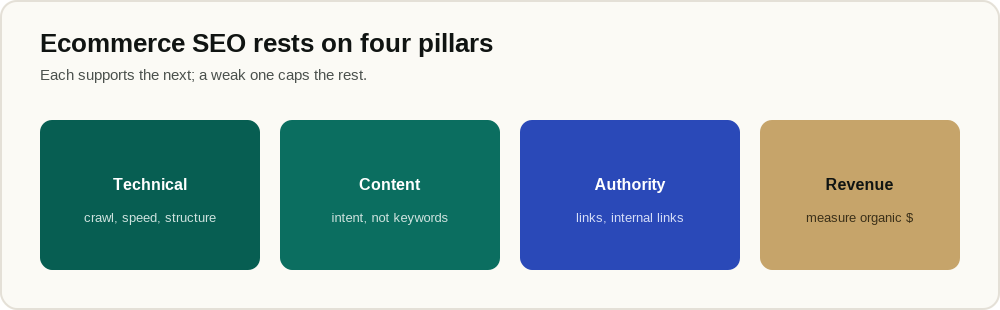
Technical SEO makes it possible for search engines to access, interpret and index the pages that deserve to appear in results. It cannot compensate for weak products or irrelevant content, but technical problems can prevent strong pages from being discovered or understood.
Start with crawl and indexation evidence
Use Google Search Console, server logs where available, a crawler and platform data to answer:
Do not treat every URL excluded from Google's index as an error. Search engines should not index every sort order, internal search result, duplicate variant or empty category. The objective is to make important pages discoverable and reduce waste caused by unnecessary URL combinations.
- Can important pages be crawled?
- Are they eligible for indexing?
- Do they return the intended HTTP status?
- Are canonical annotations consistent?
- Are important pages linked internally?
- Does the XML sitemap contain the preferred URLs?
- Are redirects working without unnecessary chains?
- Are there large numbers of duplicate or low-value URLs?
- Does the rendered page expose important content and links?
Canonical tags, redirects and sitemaps
A canonical tag signals which URL should be treated as the preferred version among duplicate or very similar pages. It is a signal, not an absolute command. Google's systems can select a different canonical when other evidence conflicts.
For consistent signals:
A sitemap helps discovery but does not guarantee indexing. Submit it in Search Console and monitor processing and indexing patterns rather than judging success only by the number of URLs listed.
- Link internally to the preferred URL.
- Include preferred, indexable URLs in the XML sitemap.
- Use a self-referencing canonical on indexable pages where appropriate.
- Redirect permanently moved URLs to the most relevant replacement.
- Avoid canonicalizing unrelated pages to a popular category or the homepage.
- Do not use robots.txt as a canonicalization method.
JavaScript and rendering
Some ecommerce storefronts render navigation, product data or content through JavaScript. Test what search engines can access, not only what appears in a normal browser session. Important products should be reachable through crawlable links, and essential content should be available in the rendered HTML that Google can process.
When investigating a rendering issue, compare the raw response, rendered output and URL Inspection results. Coordinate with developers before making template-level changes.
Pagination and infinite scroll
Product grids may use pagination, “load more” buttons or infinite scroll. Ensure that products beyond the first view remain discoverable through a crawlable implementation. Each paginated page should have a stable URL when the page represents a distinct set of results. Do not assume a user-facing scroll interaction automatically gives crawlers access to every product.
A decision framework for filters
Potential indexable landing page: A filter combination maps to a meaningful search need, has a stable URL, presents a useful assortment and can be maintained as products change.
Useful for shoppers but not necessarily for indexing: A sort order or narrow filter improves onsite navigation but does not create a distinct search landing page.
Potential duplicate or crawl trap: Multiple parameter combinations return nearly identical products or generate effectively unlimited URL variations.
Document which patterns should be crawlable, indexable, canonicalized or excluded from internal discovery. Work with developers to avoid conflicting directives. Blocking crawling may prevent Google from seeing a canonical tag on the blocked URL, so do not use robots.txt as a substitute for a considered indexation strategy.
Monitor crawl patterns and organic landing pages after changes. A blanket rule applied to every parameter can accidentally hide valuable landing pages or prevent discovery of products.
9. Build a useful content and internal-linking system
Content should solve real customer questions at different stages of the shopping journey. A good guide may help shoppers understand materials, sizing, maintenance, compatibility or product selection before they are ready to buy.
Start with questions that customers genuinely ask. Use support conversations, product reviews, Search Console, sales feedback and keyword research. Then decide whether the answer belongs on a category page, product page, help page or standalone article. Do not create a new blog post when a concise answer on the relevant product page would serve the customer better.
Content formats that can support ecommerce
The content should be grounded in expertise and product knowledge. Avoid unsupported superiority claims, invented tests, fake author credentials or articles that simply rephrase competing pages.
- Buying guides that explain how to compare product options.
- Size, fit or compatibility guides.
- Care and maintenance instructions.
- Comparisons that explain real differences between product types.
- Troubleshooting articles that help customers use or maintain products.
- Materials and manufacturing explainers, where the business can verify the details.
- Seasonal guides that remain useful beyond a short campaign window, when appropriate.
Connect content to commercial pages naturally
Internal links help shoppers move from learning to product discovery. A buying guide about choosing bedding fabric could link to the relevant material collections. A product care guide could link to compatible care products if that helps the reader.
Use anchor text that accurately describes the destination. Link to the most relevant collection or product rather than repeatedly sending every article to the homepage. Also link from important commercial pages to helpful guides when those guides support a buying decision.
Build topic clusters around a clear core page, but do not force every article into a rigid structure. The priority is a useful information architecture that makes relationships clear to readers and crawlers.
People-first content and E-E-A-T
Google describes helpful content in terms of usefulness, originality, expertise, trust and satisfying the user's need. E-E-A-T means experience, expertise, authoritativeness and trustworthiness; it is a framework for thinking about quality, not a single score that can be added to a page.
For an expert-led article, make the author identity accurate, link to a real author profile, explain relevant experience where it genuinely applies, cite primary sources for technical claims and update content when the underlying guidance changes. Do not invent firsthand experience or claim that a method produced a result unless the evidence supports it.
Google's people-first content guidance is a useful editorial review reference.
10. Improve image SEO and page experience
Product imagery helps shoppers evaluate products and can support discovery in image-based search surfaces. Use clear, relevant images that accurately represent the item. Avoid relying on images to communicate essential product information that is absent from text.
Image checklist:
Alt text is not a place to stuff keywords. For a product image, describe what the shopper needs to understand, such as the product type, colour or visible detail. If the surrounding text already conveys the same information, keep the alt text concise.
Page experience matters to shoppers as well as search visibility. Review mobile navigation, layout shifts, loading behaviour, image zoom, variant selection, add-to-cart interactions and checkout friction. Core Web Vitals can help diagnose aspects of loading, interactivity and visual stability, but do not treat a single performance score as a complete measure of user experience.
- Use descriptive file names where practical.
- Write concise alt text that describes the image's purpose and meaningful visual details.
- Leave decorative images with empty alt text where appropriate.
- Use suitable dimensions and responsive image delivery.
- Compress images without making product details difficult to inspect.
- Avoid unnecessarily large files and redundant image variants.
- Ensure important product images are crawlable and not blocked by access rules.
- Keep image content consistent with the product and selected variant.
11. Measure SEO performance beyond traffic
Use a measurement model that connects visibility to business outcomes.
Leading indicators
- Impressions and clicks for priority query groups.
- Indexation and crawl health for important page types.
- Organic landing-page coverage.
- Category and product page visibility.
- Search appearance and rich-result eligibility where relevant.
- Internal-link coverage and content improvements completed.
Commercial outcomes
Search Console clicks and analytics sessions are different measurements and should not be expected to match exactly. Attribution, consent settings, tracking implementation, time zones and reporting definitions can all affect the numbers.
Use annotations to record releases, redirects, template updates, feed changes and major stock changes. Compare performance across meaningful periods and account for seasonality, promotions and inventory availability. Avoid crediting an SEO change for every movement that occurs after it.
A useful reporting question is not only “Did organic traffic grow?” but also “Which landing pages attracted more qualified shoppers, what happened after the visit, and what should we improve next?”
- Organic sessions to relevant landing pages.
- Ecommerce conversion rate and orders.
- Organic-attributed revenue, interpreted in light of the analytics attribution model.
- Revenue and conversion trends for priority categories.
- New versus returning customer behaviour, where reliably measured.
- Contribution margin or profit after variable costs, where the business has the data.
12. A practical 90-day ecommerce SEO action plan
This plan is a prioritization template, not a promise of ranking or revenue results. Timing will depend on catalogue size, development capacity and the condition of the site.
Days 1-30: Diagnose and establish the baseline
Deliverable: A baseline report and a prioritized technical, content and commercial-page backlog.
- 01Verify Search Console and analytics access and document tracking limitations.
- 02Crawl the site and classify URLs by page type and indexation status.
- 03Review sitemap, robots directives, canonicals, redirects and HTTP responses.
- 04Identify the highest-value categories and products using business data.
- 05Map primary search intents to the most appropriate landing pages.
- 06Check product data quality, stock status, variants and structured data.
- 07Create a prioritized issue register with impact, effort, owner and validation method.
Days 31-60: Fix foundations and improve priority pages
Deliverable: A documented set of changes deployed and checked against the original issues.
- 01Resolve critical crawl, canonical, redirect and internal-link issues.
- 02Improve titles, headings and content on selected priority categories.
- 03Upgrade important product pages with verified specifications and useful information.
- 04Implement or correct relevant structured data.
- 05Review faceted navigation and parameter handling with developers.
- 06Improve image delivery and the most disruptive mobile experience issues.
- 07Add contextual internal links between guides, categories and products.
Days 61-90: Expand useful coverage and refine
Deliverable: A performance review and the next-quarter SEO roadmap.
Do not expect every change to show an immediate result. Crawling, indexing, competitive conditions, site authority, seasonality and implementation quality affect how quickly outcomes become visible.
- 01Publish or improve content based on validated customer questions.
- 02Expand successful category and product-page improvements to similar page groups.
- 03Review Search Console query and landing-page trends.
- 04Check indexation and structured data after template or navigation changes.
- 05Evaluate organic conversion and revenue trends with attribution caveats.
- 06Investigate pages with impressions but weak click-through rates, where title or snippet improvements may help.
- 07Update the backlog based on observed evidence.
13. Common ecommerce SEO mistakes
Writing copy only to reach a word count. There is no universal ideal length. Include the information needed to help the shopper and fulfil the page's purpose.
Creating a page for every keyword variation. Near-duplicate pages can confuse site architecture and create maintenance overhead. Consolidate when one page can satisfy the intent.
Ignoring category pages. Articles alone will not fix weak commercial landing pages. Review the pages that actually present the catalogue.
Allowing filter combinations to multiply unchecked. Faceted URLs need a deliberate crawl and indexation policy.
Using inaccurate structured data. Markup should reflect visible, current information. Incorrect prices, availability or review claims undermine trust and may affect eligibility.
Changing URLs without a migration plan. Map old URLs to relevant destinations, implement redirects, update internal links and monitor the transition.
Treating rankings as the final KPI. Rankings are diagnostic indicators. Evaluate whether organic discovery brings relevant visits and contributes to business goals.
Publishing generic content at scale. More pages are not automatically better. Content should provide distinct value and be maintained.
Ignoring stock and product lifecycle. Discontinued or unavailable products need a deliberate user and SEO strategy. The right action depends on whether a replacement exists, whether the URL has value and whether the product is expected to return.
Making changes without recording them. Keep a release log so you can connect observed movements to technical changes, content updates and business conditions.
Conclusion: Build an SEO system that compounds
Sustainable ecommerce SEO is a connected operating system, not a list of isolated keyword edits. Technical foundations help search engines reach important pages. Clear architecture and internal links make the catalogue easier to navigate. Useful category and product pages help shoppers make decisions. Accurate structured data improves machine understanding. Content answers genuine questions, while measurement helps the team learn what to improve next.
Apply the framework in sequence: Diagnose the site and its commercial opportunities, Acquire qualified organic discovery, Convert through useful pages and a clear purchase journey, Scale the improvements that work, and Compound the gains through continuous measurement and refinement.
The best next step is to identify the small group of technical issues and commercial pages with the clearest opportunity, fix them properly, and use evidence to decide what comes next.
---
Schema and publication checklist
- Use Article or BlogPosting structured data with a truthful headline, description, image, author, publisher, datePublished and dateModified where applicable.
- Link the author to the real author/about profile and use accurate credentials only.
- Use a canonical URL matching the final published route.
- Include the article in the site's existing /insights/ system and XML sitemap if appropriate.
- Ensure the page is crawlable, indexable and linked from a relevant insights listing or related page.
- Validate structured data and inspect the URL in Google Search Console after publishing.
- Use a genuine publication date; do not backdate.
- Add a visible table of contents with working anchor links.
- Review links, spelling, mobile layout, image alt text and page performance.
- Record the publication date and any later substantive updates.
- Recheck official documentation before implementation if Google's supported features or requirements have changed.
FAQ
Frequently asked questions
Ecommerce SEO is the process of improving an online store's discoverability and usefulness in organic search. It includes technical SEO, site architecture, category and product-page optimization, content, internal linking, structured data and measurement.
Start by checking crawlability, indexation, canonical URLs and internal links. Then prioritize categories and products based on commercial value and search intent. Improve page information, product data, navigation, useful content and measurement. Validate each change rather than making large numbers of untracked edits.
Neither page type is universally more important. Category pages can serve broad shopping needs and help users explore a range, while product pages answer detailed questions about a specific item. Their priority depends on the catalogue, demand, competition and the way customers search.
There is no universal word-count requirement. Write enough to help shoppers understand the category and choose products. Some categories need only concise guidance; others benefit from detailed comparisons or selection advice. Avoid adding repetitive copy solely to make a page longer.
Only when a filtered page serves a distinct, useful search need and can be maintained as a quality landing page. Many sort orders and filter combinations should remain navigation tools rather than separate search pages. Decide based on intent, content, inventory and technical behaviour.
Structured data helps search engines interpret product information and may make pages eligible for supported rich results. It does not guarantee rich results or higher rankings. The markup must be accurate, relevant and consistent with visible page content.
There is no reliable universal timeline. Results depend on the site's current condition, competition, crawl and indexing patterns, the scale of changes, product demand and implementation quality. Track technical progress and leading indicators while allowing enough time to evaluate meaningful commercial trends.
Measure organic visibility and clicks alongside qualified landing-page visits, orders, conversion rate and revenue. Where possible, evaluate profitability and customer value too. Interpret attribution carefully and account for seasonality, promotions, stock availability and analytics limitations.
Similar posts
AI Search & GEO
Generative Engine Optimization (GEO): The Complete Playbook for Getting Cited by AI
A practitioner's guide to GEO: how to get your brand cited by ChatGPT, Google AI Overviews and Perplexity. What works, what you cannot control, and a 30-day plan.
6 min read

AI Search & GEO
SEO, AEO & GEO: The Complete Guide to Search and AI Visibility
Understand SEO, answer engine optimization and generative engine optimization, and learn how to improve visibility across Google Search and AI-powered discovery.
20 min read
Performance Marketing
Performance Marketing for Ecommerce: What Actually Drives Profitable Growth
A profit-first guide to ecommerce performance marketing: how to connect paid media, SEO, conversion optimisation and measurement into one system that grows revenue without sacrificing margin.
11 min read
Related services
Related work