Meta Ads
How to Scale Meta Ads Without Destroying ROAS or Profitability

Scaling Meta Ads is not simply a matter of increasing the daily budget. Spend can rise while efficiency declines, acquisition costs increase, or the business generates revenue that does not translate into profit. A sustainable scaling process connects campaign performance to business economics, tracking quality, creative capacity, inventory, and fulfilment. The objective is not to preserve one attractive dashboard metric at all costs. It is to increase useful customer acquisition while keeping the business inside acceptable profitability and operational limits. There is no universal percentage or budget increase that works for every account. The right approach depends on conversion volume, campaign stability, audience size, creative supply, margins, and how reliably results are measured.
Quick answer
There is no universal increase that is safe for every account. Consider current performance stability, conversion volume, margins, audience size, and the risk of disrupting delivery. Make changes you can evaluate and avoid scaling beyond the business's economic limits.
Key takeaways
- Before scaling Meta Ads:
- Before changing a campaign, decide what the business is trying to grow.
- Revenue is not profit.
- Scaling from unreliable data can amplify the wrong conclusion.
The short answer
Before scaling Meta Ads:
If performance deteriorates, diagnose the cause before making repeated budget changes. More spend will not fix weak creative, a poor offer, inaccurate tracking, or a landing page that fails to convert.
- 01Confirm purchase tracking and revenue values are reliable.
- 02Define the maximum acceptable acquisition cost using contribution margin and business goals.
- 03Check performance over a period that reflects the conversion cycle, not just a strong day.
- 04Identify whether the current constraint is budget, creative, offer, landing page, audience, or fulfilment.
- 05Make a controlled change and give it enough time to evaluate.
- 06Monitor new-customer acquisition, blended business performance, and contribution margin alongside platform ROAS.
1. Define what successful scaling means
Before changing a campaign, decide what the business is trying to grow.
Possible objectives include:
These goals are related but not identical. A campaign can generate more revenue while acquiring fewer new customers, or it can grow new-customer volume while short-term ROAS falls. The team should agree on the intended outcome before judging the result.
- More first-time customers.
- Higher contribution after marketing costs.
- More total revenue within a defined efficiency range.
- Greater volume for selected products or categories.
- Stable acquisition through a seasonal demand period.
- Faster learning about creative concepts or audience response.
Set economic guardrails first
Revenue is not profit. Product cost, fulfilment, shipping subsidies, payment fees, discounts, cancellations, refunds, and other variable expenses affect how much remains to cover advertising and fixed costs.
A simplified break-even ROAS can be estimated as:
Break-even ROAS = 1 ÷ contribution margin rate available to cover advertising
For example, if the contribution margin available to cover ad spend is 40%, the simplified break-even ROAS is 2.5x. This is an illustrative calculation, not a universal target. The margin definition must be agreed with finance, and the business may need performance above break-even to cover overhead and meet its profit goal.
Also decide how to evaluate new-customer acquisition. If repeat purchases are part of the business model, use actual cohort evidence and consider cash-flow limits rather than assuming every new customer will generate future revenue.
2. Make sure measurement can support the decision
Scaling from unreliable data can amplify the wrong conclusion. Review the measurement foundation before interpreting a change in ROAS or cost per purchase.
Check:
Conversions API can help send eligible event data from a server or other supported source, but it does not automatically solve every attribution or measurement problem. Implementation, event quality, consent, and deduplication still matter.
- The correct Meta Pixel is installed and firing.
- Purchase events contain the correct value and currency.
- Conversions are not being counted twice.
- Conversions API events are configured and deduplicated where applicable.
- Browser and server events are mapped consistently.
- Consent, browser restrictions, checkout changes, and site releases have not disrupted tracking.
- Platform-reported orders and revenue are reconciled with the ecommerce platform or order system.
- Refunds, cancellations, and failed payments are reflected in business reporting where possible.
Keep attribution consistent
Meta Ads Manager and other platforms may report different conversion totals because their attribution methods and settings differ. Do not treat platform-reported revenue as a direct measurement of incremental revenue.
For account-level decisions, pair platform metrics with store revenue, new-customer data, contribution margin, and blended marketing efficiency. Where the business has enough scale and the method is appropriate, incrementality experiments can help test whether advertising is producing additional outcomes.
3. Check whether the campaign is genuinely ready
A single strong day is not enough evidence to justify a major scaling decision. Review the account across a suitable time window and consider the purchase cycle, promotion calendar, and volume of conversions.
Look at:
Ask whether performance is repeatable or explained by a one-off promotion, a small number of high-value orders, a seasonal demand spike, or a tracking change.
Do not use a rigid rule such as “scale after exactly three profitable days” for every account. The evidence required depends on spend, conversion volume, average order value, and how noisy the business's results are.
- Spend and conversion volume.
- Cost per purchase and attributed ROAS.
- New versus returning customer mix, where measurable.
- Average order value and product mix.
- Conversion rate on the website.
- Creative frequency and signs of fatigue.
- Stock availability and delivery performance.
- Refunds, cancellations, and payment failures.
- Blended revenue and marketing spend.
4. Choose the right scaling lever
There are several ways to increase outcomes. They should not all be treated as budget changes.
Budget scaling
Increase spend on campaigns or ad sets that have credible evidence of meeting the business's goals. A gradual increase can make changes easier to diagnose, but no specific increment guarantees that performance will remain stable.
After a budget change, monitor spend delivery, conversion volume, acquisition cost, and business-level performance. Avoid making several major changes simultaneously if you need to understand what caused the result.
Creative scaling
Creative often becomes the constraint when a campaign has already reached a large share of its available audience or when the same ads have been shown repeatedly. More budget cannot indefinitely compensate for a limited supply of relevant, persuasive creative.
Develop a repeatable creative process:
A creative testing system should record the hypothesis, asset, audience context, spend, outcome, and next action. Avoid declaring a winner from a small or noisy sample without considering the economics and conversion delay.
- Identify the customer problem or buying motivation.
- Test different hooks and value propositions.
- Demonstrate product benefits clearly.
- Address objections such as fit, quality, delivery, returns, or trust.
- Use real product imagery and accurate claims.
- Create variations that test a meaningful hypothesis rather than cosmetic changes alone.
- Track which concepts produce quality customers, not only inexpensive clicks.
Offer and landing-page scaling
Sometimes the limiting factor is not the ad account. The offer may be unclear, shipping costs may surprise customers, the product page may lack useful information, or checkout may be difficult on mobile.
Before adding budget, review:
Improving the conversion experience can increase the value of existing traffic, but confirm the effect with reliable data rather than assuming every site change will improve performance.
- Ad-to-landing-page message consistency.
- Product availability and variant selection.
- Price, discount terms, shipping cost, and delivery estimates.
- Product photos, specifications, sizing, and trust information.
- Page speed and mobile usability.
- Checkout errors and payment options.
- Return policy and customer support visibility.
Product and catalogue scaling
For ecommerce advertisers, not every product has the same margin, stock availability, return rate, or demand. A product with high revenue and weak contribution may be a poor scaling candidate.
Review performance by product or category where the data supports it. Keep inventory, gross margin, discounting, and fulfilment capacity in the decision. Ensure product catalogue information is accurate and that feed or landing-page issues are not creating friction.
5. Avoid unnecessary campaign restructuring
Repeatedly rebuilding campaigns can make results harder to interpret and may disrupt delivery. Before changing the structure, identify the actual problem.
Questions to ask:
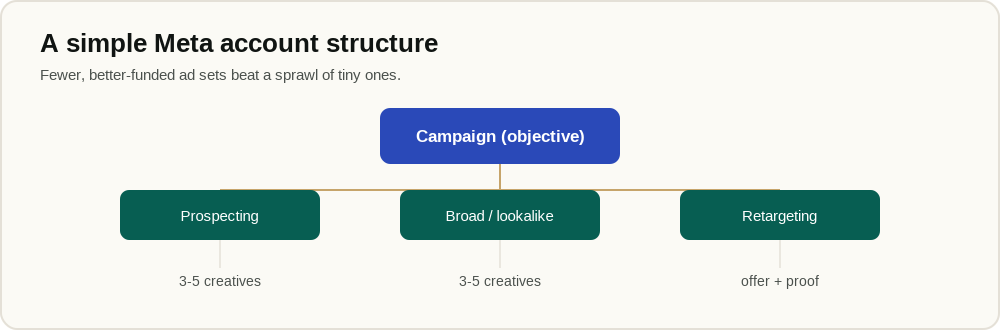
Meta's campaign automation features and Advantage+ options can be useful in suitable situations, but they do not remove the need for sound creative, clear objectives, reliable events, and business-level measurement. Choose the structure that fits the account and objective rather than following a universal template.
- Is the current campaign generating sufficient conversion volume?
- Are there genuinely different business objectives that require separate treatment?
- Is budget being fragmented across too many campaigns or ad sets?
- Is the team separating audiences without a clear reason?
- Are overlapping campaigns competing for similar opportunities?
- Is the problem actually creative fatigue or a weak offer rather than structure?
6. Use a controlled scaling process
A practical process can be organized into five stages.
Stage 1: Establish the baseline
Record current spend, purchases, cost per purchase, attributed ROAS, new-customer indicators, store revenue, MER, and contribution margin if available. Note promotions, stock changes, and tracking issues.
Stage 2: State a specific hypothesis
Examples:
Each hypothesis should identify the expected result and the metric that would challenge it.
- Increasing budget on a stable campaign may increase purchase volume within the current acquisition-cost range.
- A new creative concept may reach customers who have stopped responding to existing ads.
- Improving a product page may increase the percentage of qualified visitors who purchase.
Stage 3: Change one major variable where practical
Avoid simultaneously changing budget, creative, audience, attribution settings, and landing page unless there is a strong operational reason. Isolating changes makes it easier to learn from the result.
Stage 4: Monitor at the right interval
Use a review window appropriate to conversion delay and volume. Watch for delivery problems or tracking failures promptly, but avoid reacting to every short-term fluctuation.
Stage 5: Keep, reverse, or investigate
Compare the result with the original hypothesis and the economic guardrails. If results worsen, determine whether the cause is normal variation, a measurement issue, creative fatigue, site conversion, a product or offer change, or a real decline in efficiency.
Document what changed and what was learned. A record of decisions prevents teams from repeating the same tests without learning.
7. Diagnose common scaling problems
Spend rises but purchase volume barely changes
Possible explanations include limited demand, weak creative, audience saturation, poor delivery, site conversion issues, or a tracking problem. Check delivery and funnel metrics before increasing spend again.
ROAS falls after budget increases
A larger budget may reach less responsive opportunities, but this is not the only possible cause. Check product mix, average order value, promotion timing, attribution settings, conversion delay, and whether the comparison periods are equivalent.
If ROAS falls but total contribution after marketing increases, the change may still be acceptable. If revenue rises while contribution deteriorates beyond the agreed guardrail, scaling may not be economically sound.
Cost per purchase increases
Investigate CPM, click-through rate, landing-page conversion rate, average order value, creative response, and customer mix. A higher cost per purchase can originate at different stages, so avoid assuming that audience targeting is always the cause.
Frequency rises and performance weakens
Frequency alone does not prove creative fatigue, but rising frequency alongside declining engagement or conversion performance can be a useful signal. Refresh the creative concept, examine audience reach, and confirm whether the product or offer still resonates.
Platform ROAS looks strong but business results do not
Check attribution, duplicate events, returning customer mix, discounts, refunds, and store-side order reconciliation. Compare platform reports with total revenue, new-customer acquisition, and contribution margin.
New customers become more expensive
Check whether the campaign is increasingly reaching existing customers, whether new-customer identification is reliable, and whether the offer is attracting the right buyers. Separate retention performance from new-customer acquisition where measurement allows.
8. A practical scaling dashboard
A useful dashboard should connect ad delivery to business outcomes.
Metric definitions should remain consistent. Use each metric to diagnose a question rather than treating every dashboard movement as an instruction to change the account.
| Layer | Metrics to review | Why it matters |
|---|---|---|
| Delivery | Spend, impressions, CPM, reach, frequency | Shows how spend is being delivered |
| Creative response | Outbound CTR, landing-page views, video engagement where relevant | Helps identify whether the ad is earning attention |
| Website funnel | Landing-page conversion rate, add-to-cart, checkout initiation, purchase rate | Helps locate conversion friction |
| Campaign outcome | Purchases, cost per purchase, attributed revenue, ROAS | Describes platform-reported results |
| Customer quality | New customers, returning customer share, cancellations, refunds | Adds context to acquisition performance |
| Business economics | Total revenue, marketing spend, MER, contribution margin | Helps evaluate blended efficiency and economic quality |
9. A 30-day implementation plan
This is an example workflow, not a guaranteed performance timeline.
Week 1: Audit
Week 2: Prepare
Week 3: Test
Week 4: Evaluate
Some accounts require longer to accumulate useful data; others need immediate technical intervention. Use the plan as a sequence, not a promise that every phase can be completed in seven days.
- Validate Pixel, Conversions API, event values, deduplication, and order reconciliation.
- Review recent performance and business economics.
- Identify the primary constraint: budget, creative, offer, website, product, or measurement.
- Agree on acquisition-cost and contribution-margin guardrails.
- Develop creative hypotheses and prepare relevant variations.
- Fix clear landing-page, catalogue, or checkout issues.
- Define what will be changed and how the result will be judged.
- Run the selected controlled change.
- Monitor delivery and tracking health.
- Avoid adding unrelated changes that obscure the learning.
- Compare results with the baseline, accounting for conversion delay and business changes.
- Review campaign metrics alongside new-customer data and blended performance.
- Keep, reverse, or investigate the change.
- Record the next test based on evidence.
10. The principles to remember
- Scale profitable customer acquisition, not spend for its own sake.
- Define profitability with real cost inputs, not revenue alone.
- Validate measurement before trusting a performance change.
- Use creative, offer, website, and product improvements as scaling levers.
- Make controlled changes where practical and document the hypothesis.
- Evaluate results over a window suited to the buying cycle and data volume.
- Treat platform ROAS as one signal, not proof of incrementality.
- Keep inventory, fulfilment, cash flow, and customer experience inside the scaling decision.
FAQ
Frequently asked questions
There is no universal increase that is safe for every account. Consider current performance stability, conversion volume, margins, audience size, and the risk of disrupting delivery. Make changes you can evaluate and avoid scaling beyond the business's economic limits.
Possible reasons include reaching less responsive audiences, creative fatigue, changing product or customer mix, seasonal effects, website conversion issues, tracking differences, and ordinary performance variation. Diagnose the funnel and business data before assuming the budget change alone caused the decline.
Not automatically. Duplicating can create more complexity and make results harder to interpret. First decide whether the account has a clear structural limitation that duplication would solve. Consider creative supply, budget allocation, and measurement before restructuring.
No. High reported ROAS may coexist with low margin, returning-customer-heavy revenue, discounts, or attribution inflation. Review acquisition cost, contribution margin, new-customer performance, and blended business results.
Monitor spend delivery, purchases, cost per purchase, attributed ROAS, creative response, website conversion, new-customer indicators, and business-level measures such as MER and contribution margin where available. Interpret changes over a suitable period.
No campaign type guarantees performance. Automation can help delivery in suitable circumstances, but outcomes still depend on the objective, creative, offer, data quality, website experience, competition, and business economics.
Similar posts
Meta Ads
Meta Ads for Ecommerce: The Complete 2026 Growth Guide
Learn how to build, measure and scale Meta Ads for ecommerce in 2026, from campaign structure and creative testing to tracking, ROAS and profitable growth.
16 min read
Meta Ads
Meta Ads Creative Testing for Ecommerce: A Practical Framework for 2026
Learn how to test Meta Ads creatives for ecommerce with clear hypotheses, useful variations, reliable measurement, and a repeatable optimisation process.
18 min read
Performance Marketing
Performance Marketing for Ecommerce: What Actually Drives Profitable Growth
A profit-first guide to ecommerce performance marketing: how to connect paid media, SEO, conversion optimisation and measurement into one system that grows revenue without sacrificing margin.
11 min read
Related services
Related work