Meta Ads
Meta Ads for Ecommerce: The Complete 2026 Growth Guide

Meta Ads can help ecommerce brands introduce products to new customers, generate purchases, bring interested shoppers back and promote product ranges across Facebook, Instagram and other eligible Meta placements. Sustainable results depend on more than campaign settings. The offer, product economics, creative quality, website experience, tracking and measurement all influence whether paid social creates profitable growth. A practical starting point is to define the business outcome, verify purchase tracking, use a campaign structure that receives useful data, test genuinely different creative concepts and evaluate performance using both platform metrics and business-level profitability. Automation can help with delivery, but it cannot fix weak margins, inaccurate event data, poor product-market fit or a difficult checkout.
Quick answer
Meta Ads can help ecommerce brands introduce products to new customers, generate purchases, bring interested shoppers back and promote product ranges across Facebook, Instagram and other eligible Meta placements. Sustainable results depend on more than campaign settings. The offer, product economics, creative quality, website experience, tracking and measurement all influence whether paid social creates profitable growth. A practical starting point is to define the business outcome, verify purchase tracking, use a campaign structure that receives useful data, test genuinely different creative concepts and evaluate performance using both platform metrics and business-level profitability. Automation can help with delivery, but it cannot fix weak margins, inaccurate event data, poor product-market fit or a difficult checkout.
Key takeaways
- Meta Ads are paid placements across Meta technologies, including Facebook and Instagram.
- Understand what a sustainable order looks like before deciding how much to spend.
- A simplified revenue-based calculation is:
- Optimisation is only as useful as the signals it receives.
Table of contents
- 01What Meta Ads can do for ecommerce
- 02Start with business economics
- 03Set up tracking before spending
- 04Choose a campaign objective and structure
- 05Use Advantage+ thoughtfully
- 06Build a creative testing system
- 07Plan audiences and retargeting
- 08Optimise the website and checkout
- 09Read metrics accurately
- 10Diagnose common problems
- 11Scale sustainably
- 12A practical 30-day plan
- 13FAQs
1. What Meta Ads can do for ecommerce
Meta Ads are paid placements across Meta technologies, including Facebook and Instagram. For ecommerce, they can support demand creation, product discovery, purchase acquisition, catalogue promotion, retargeting and customer growth. For example, a fashion brand might demonstrate fabric and fit, a furniture retailer might explain dimensions and delivery, and a beauty brand might show how a product is used.
Meta is not a replacement for every other channel. Search advertising can capture existing intent; SEO can compound organic visibility; email and SMS can support retention. Paid social often works best when its role is clear and channels are evaluated together.
2. Start with business economics, not Ads Manager
Understand what a sustainable order looks like before deciding how much to spend. Review selling price after discounts, product cost, fulfilment, shipping subsidy, payment fees, expected returns, refunds and other variable costs. Decide how much contribution must remain to cover overhead and profit.
Calculate a break-even ROAS
A simplified revenue-based calculation is:
Break-even ROAS = 1 ÷ contribution margin percentage before advertising
If the contribution margin available before advertising is 40%, the simplified break-even ROAS is 1 ÷ 0.40 = 2.5x. This is illustrative, not a universal target. The margin definition must include relevant variable costs and exclude advertising spend itself. A business may need a higher target to cover overhead, cash-flow needs or its profit goal.
A campaign with lower ROAS may still contribute to growth if it acquires valuable new customers. A campaign with high reported ROAS can still be weak if it relies on discounts, claims credit for existing demand or attracts orders with poor margins. Set targets using business economics, not a competitor's benchmark.
3. Set up tracking before spending
Optimisation is only as useful as the signals it receives. Audit the path from ad click to completed order.
Check the Meta Pixel
Confirm that the Pixel is installed on the correct domain and relevant events fire on the expected actions. Common ecommerce events include ViewContent, AddToCart, InitiateCheckout and Purchase. The exact implementation depends on the ecommerce platform and integration. Verify that purchase events are not duplicated and purchase value and currency are correct. Test the real customer journey rather than relying only on a tag appearing in a browser extension.
Consider the Conversions API
Meta's Conversions API can send eligible event data from a business server or supported partner integration. It can complement browser-based Pixel events, but it is not a magic switch for better results. Event mapping, permissions, privacy and consent handling, and deduplication must be configured correctly when browser and server events describe the same action.
Use Meta's official implementation guidance and your ecommerce platform's documentation. After setup, compare received events with actual orders and investigate discrepancies. Tracking must respect applicable laws, consent requirements, platform terms and customer privacy choices. A server-side setup does not remove privacy obligations.
Reconcile advertising with business records
Ads Manager, analytics, order systems and CRM reports may differ because of attribution windows, modelling, reporting delays and counting methods. Document the differences and use consistent business definitions rather than forcing every dashboard to show the same number.
4. Choose the objective and campaign structure
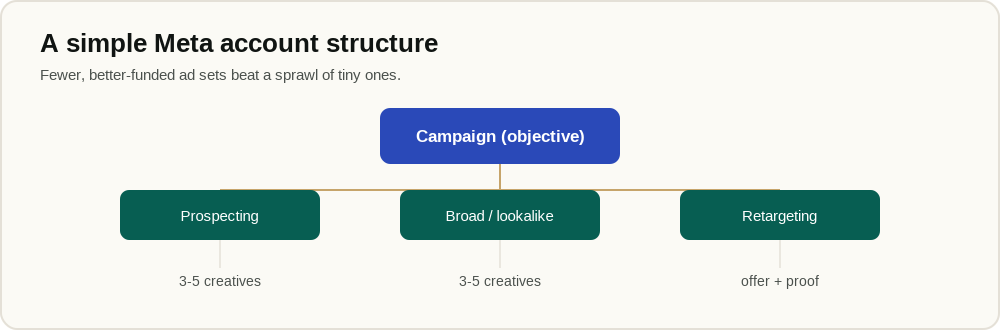
Start with the outcome the business needs. For a store whose main goal is website purchases, a Sales objective with a suitable purchase optimisation event is often a logical starting point. The best setup depends on purchase volume, sales process, product type, tracking quality and operational constraints.
Avoid unnecessary complexity. An account does not become more sophisticated just because it has dozens of campaigns and ad sets. Fragmentation can divide budget and conversion signals across too many places.
A practical structure might include:
This is a framework, not a mandatory four-campaign recipe. Some accounts benefit from consolidation; others need separation for markets, product lines, margin groups, inventory or reporting. Separate campaigns when there is a meaningful business reason. Avoid splitting audiences just because a traditional checklist says every funnel stage needs its own campaign.
- 01Core acquisition: A primary campaign aimed at purchases, using an automated or manual setup suited to the account.
- 02Creative testing: A controlled process for introducing new concepts and comparing them with current winners.
- 03Catalogue activity: Use when the catalogue, product range and objective justify it.
- 04Retargeting or customer campaigns: Add only when they serve a distinct purpose and the audience size, budget and measurement support them.
5. Use Advantage+ and automation thoughtfully
Meta continues to develop automated campaign and creative tools. Advantage+ Sales campaigns are among the options intended to help ecommerce advertisers use Meta's delivery systems to find people likely to complete a desired action. Available controls and naming may change, so verify the current Ads Manager interface and official guidance.
Automation still depends on advertiser inputs: a clear objective, correct conversion event, useful data, sufficient budget, strong offer, varied creative, accurate product information and a sound measurement plan.
An automated Sales setup may be a reasonable test when purchase tracking is reliable, the store has enough conversion activity to assess results, product pages are healthy and the business can accept less granular control over some delivery decisions. More controlled settings may be appropriate for strict geographic or product constraints, low conversion volume, a specific experiment or unusual purchase economics. Use the simplest setup that meets the requirement. Evaluate options against the same business outcome where possible.
6. Build a creative testing system
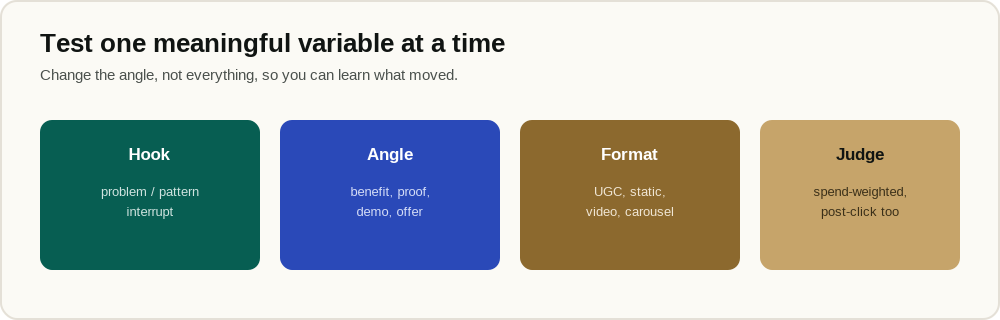
The ad must make the right person stop, understand the product, believe the value and take the next step. Creative is not just a design task; it is a way to communicate and test reasons to buy.
Useful creative concepts include:
For fashion, test fit, fabric, styling, occasion and close-up detail. For furniture, test dimensions, comfort, materials, delivery and room context. Creative should answer real purchase questions.
For each concept, document the audience motivation, product benefit, supporting evidence, opening hook, visual sequence, offer, call to action, landing page, hypothesis and success metric. This makes the learning clearer. If every ad uses the same hook, footage and promise, the team may be producing variations without learning much.
Use vertical video, square or landscape formats, carousel, static images or catalogue formats where they suit the message and available placements. Design for mobile, make the product clear quickly and keep text legible. A simple product image with a clear benefit can outperform a complicated video in some contexts, so test rather than assume.
Frequency, falling CTR, rising acquisition cost and declining purchase volume can be signs of creative fatigue, but none proves fatigue by itself. Seasonality, offer changes, tracking issues and competition can also matter. Review the full pattern and introduce new concepts before performance deteriorates severely.
- Product demonstration: Show the product in a realistic use case.
- Problem and solution: Explain a customer problem and show how the product helps.
- Benefit-led: Focus on a specific customer outcome.
- Comparison: Explain a legitimate difference between options.
- Social proof: Use genuine customer feedback with permission and without exaggeration.
- Expert or founder explanation: Add credible context about materials, fit, quality or use.
- Offer-led: Communicate a clear promotion or delivery proposition with accurate terms.
- Product range: Help shoppers discover relevant items using an appropriate format.
7. Plan audiences and retargeting
Audience strategy should reflect the product, available signals and buying process.
Broad or Advantage+ audiences: Broader settings can give the delivery system room to find potential buyers. They may be worth testing when the product has a clear market, creative communicates who it is for and tracking provides useful purchase signals.
Interest and manual audience inputs: These can still be useful for structured tests, niche products or specific market requirements. A list of interests is not automatically a strategy. Check that the audience is relevant, large enough and compliant with Meta's policies.
Retargeting: Retargeting can address eligible people who viewed products, added items to cart, started checkout or engaged with the brand. Before building a dedicated campaign, ask whether the audience is large enough, whether the message differs from prospecting, whether recent purchasers should be excluded, whether the conversion window suits the buying cycle and whether the campaign adds incremental orders.
A small store may not need a separate retargeting campaign. Audiences can be too small to support meaningful spend, and excessive repetition can annoy shoppers. Test whether a separate layer adds value rather than assuming it must exist. Existing customers may be valuable for repeat purchases and cross-sells, but separate acquisition from retention reporting where possible.
8. Optimise the website and checkout
A successful ad brings a relevant shopper to the site. The website must finish the job.
Use the funnel to find the bottleneck. If clicks are healthy but product views are low, investigate landing-page behaviour and tracking. If add-to-cart activity is strong but purchases are weak, check shipping, price, payment options and checkout errors. If conversion rate is healthy but acquisition cost is high, examine auction costs, creative, product economics and average order value.
- Message match: The landing page delivers what the ad promised.
- Mobile usability: Text, imagery, navigation and forms work well on a phone.
- Product detail: Images, sizing, dimensions, materials, specifications, delivery and returns information answer purchase questions.
- Trust: Reviews are genuine; contact details and policies are clear.
- Offer clarity: Customers are not surprised by hidden costs or conditions.
- Availability: Product feeds, stock and landing pages agree.
- Checkout: Payment options, fields, error messages and steps do not add unnecessary friction.
- Speed: Test on real mobile devices and investigate major delays.
9. Read metrics accurately
Use three reporting layers:
Use Ads Manager for campaign optimisation, analytics and CRM for customer-journey context, and order or finance data for commercial reality. Platform attribution is useful, but it is not a perfect measure of incremental impact.
- 01Delivery and creative: Reach, impressions, CPM, frequency, CTR and engagement help diagnose delivery and response.
- 02Conversion funnel: Landing-page views, product views, add-to-cart, checkout and purchases help locate friction.
- 03Business outcome: Revenue, new-customer share, returns, contribution margin, repeat purchases and overall marketing efficiency show whether growth is valuable.
| Metric | What it helps answer | Important limitation |
|---|---|---|
| CPM | What does it cost to reach people? | Lower CPM does not guarantee valuable traffic. |
| CTR | Does creative earn attention and clicks? | Clicks may not represent purchase intent. |
| CPC | How much does a click cost? | Cheap clicks can convert poorly. |
| Add-to-cart rate | Do visitors show buying interest? | An add-to-cart is not a completed order. |
| Conversion rate | What share of visits convert? | Definitions and traffic quality matter. |
| CPA / cost per purchase | How much does a tracked purchase cost? | Does not include every business cost. |
| ROAS | How much attributed revenue is reported per ad dollar? | Not profit and not proof of incrementality. |
| New-customer CAC | What does it cost to acquire a new customer? | Depends on the agreed cost scope and definition. |
| Contribution margin | What remains after relevant variable costs? | Requires accurate cost data. |
10. Diagnose common performance problems
High CPM: Possible causes include competitive auctions, audience or placement constraints, seasonality and creative response. Compare CPM with CTR, conversion rate, reach and cost per purchase. Do not restructure the account based on CPM alone.
Good CTR but few purchases: The ad may attract attention without matching the product page. Check traffic quality, page speed, price, shipping, stock, checkout and event tracking. Review whether the creative encourages curiosity without explaining the actual value.
Many add-to-carts but few checkouts: Investigate delivery costs, payment methods, checkout errors, delivery timing, return policy and unexpected fees. Confirm add-to-cart and purchase events are correctly implemented.
Rising cost per purchase: Check the time window and spend level. Then review creative, frequency, audience reach, conversion rate, average order value, inventory, discounts and tracking changes. Compare against the business's target CPA and contribution margin, not a generic benchmark.
Ads Manager and store revenue do not match: Attribution windows, reporting delays, view-through attribution, modelling, time zones and event issues can contribute. Document definitions used by each system and reconcile trends with order data. Do not automatically assume one platform is the source of truth for every decision.
Learning status or fluctuating results: Delivery depends on the campaign setup and optimisation event. Frequent significant edits, fragmented ad sets or low conversion volume can make results less stable. Avoid changes made only to force a status label to change. Check current Meta guidance, allow a reasonable evaluation window and act when evidence or business conditions justify it.
11. Scale sustainably
Scale based on repeatable performance, not one unusually good day. Before increasing spend, confirm tracking is reliable, results cover a meaningful period, stock and fulfilment can support more orders, acquisition costs meet the target, the website converts traffic and the team can produce new creative.
There is no universal budget-increase percentage that is safe for every account. The impact depends on spend, delivery, conversion volume, campaign settings and business risk. Make measured changes, observe how delivery and marginal cost respond, and avoid changing budget, creative, targeting and landing page simultaneously unless an urgent issue requires it.
Scale the system, not just the budget. Sustainable growth may require more creative concepts, better product pages, improved catalogue quality, stronger offers, wider availability, retention programmes or better measurement.
Average ROAS can hide the cost of the next unit of growth. If a campaign performs well at low spend, the next increase may reach less responsive customers. Monitor the additional spend and contribution it generates, while allowing for measurement uncertainty and normal volatility.
12. A practical 30-day action plan
Week 1: Diagnose
Deliverable: A prioritised list of tracking, campaign, creative and website issues.
- Review the business goal, contribution margin and target acquisition cost.
- Audit objectives, events, account structure and budgets.
- Verify Pixel and Conversions API setup where used.
- Check purchase values, currencies and duplicate events.
- Review mobile site, product pages, checkout and stock.
- Establish a baseline report with clear metric definitions.
Week 2: Simplify and prepare
Deliverable: A launch-ready account and creative plan.
- Remove fragmentation where there is no business reason to keep it.
- Select a suitable primary purchase campaign structure.
- Review catalogue and product-page consistency.
- Build a creative test matrix with distinct concepts.
- Confirm geography, offer terms and budget guardrails.
- Document the hypothesis behind each planned change.
Week 3: Test and observe
Deliverable: A decision log separating evidence from assumptions.
- Launch the agreed structure and creative tests.
- Monitor delivery, event quality, landing-page behaviour and purchases.
- Avoid unnecessary edits that make results hard to interpret.
- Investigate technical or commercial problems promptly.
- Record what the data supports and what remains uncertain.
Week 4: Improve and plan the next cycle
Deliverable: A prioritised roadmap tied to business outcomes.
- Identify concepts and products showing credible promise.
- Diagnose funnel drop-offs and implement high-impact website fixes.
- Compare platform reporting with store and business data.
- Decide what to continue, stop, retest or scale.
- Plan the next creative round around customer objections and evidence.
Final takeaway
Meta Ads can be a powerful ecommerce acquisition channel, but sustainable performance comes from the system around the ads. Start with economics and measurement, choose a structure that fits the account, develop genuinely different creative, make the website easy to buy from and judge results against business outcomes.
Use automation where it helps, keep campaign complexity purposeful and scale only when the evidence supports it. The goal is not simply more attributed revenue. It is to acquire customers and grow the business at an acceptable, sustainable cost.
For the broader strategy connecting paid media, SEO, conversion rate optimisation and measurement, read Performance Marketing for Ecommerce: What Actually Drives Profitable Growth. Confirm the internal URL before publishing.
FAQ
Frequently asked questions
They can work for brands with a relevant product, clear offer, usable website, reliable measurement and enough margin to support acquisition. Results vary by category, creative, competition and execution. No platform guarantees profitable sales.
There is no universal best campaign for every store. A Sales campaign optimised for purchases, including an appropriate Advantage+ setup where available, can be a reasonable starting point when tracking and purchase volume support it. Verify current Ads Manager options and compare alternatives against the same business goal.
Consider them when automation fits the account and you have reliable purchase data, a strong offer and varied creative. Use more controlled settings when there is a clear need, such as a specific test or market constraint. Evaluate business outcomes rather than the campaign label alone.
The budget should reflect target acquisition cost, cash available, expected conversion volume and fulfilment capacity. Start with a budget that can test a clear hypothesis without putting the business at unacceptable risk. Spend does not guarantee a specific number of purchases.
A good ROAS meets the business's financial goals. Calculate a break-even point using the correct contribution margin, then account for overhead, customer value and new-customer acquisition. Generic benchmarks may be irrelevant to your margins and attribution setup.
Many advertisers use browser and server-side event signals together where supported, but the right implementation depends on the platform, setup and privacy requirements. Map events correctly and deduplicate where needed. Follow current Meta and ecommerce-platform documentation.
Not automatically. It depends on audience size, budget, buying cycle and whether the campaign adds incremental value. For a small store, a separate retargeting campaign may fragment spend. Test it when there is a clear purpose and enough data to evaluate it.
Make changes for reasons supported by evidence, such as a tracking problem, stock issue, policy issue or sustained performance pattern. Frequent changes without a clear hypothesis can make results harder to interpret. Review cadence depends on spend, conversion volume and urgency.
Similar posts
Performance Marketing
Performance Marketing for Ecommerce: What Actually Drives Profitable Growth
A profit-first guide to ecommerce performance marketing: how to connect paid media, SEO, conversion optimisation and measurement into one system that grows revenue without sacrificing margin.
11 min read
Meta Ads
Meta Ads Campaign Structure for Ecommerce in 2026
Learn how to structure Meta Ads campaigns for ecommerce, from objectives and budget allocation to creative testing, retargeting, measurement, and scaling.
22 min read
Meta Ads
Meta Ads Creative Testing for Ecommerce: A Practical Framework for 2026
Learn how to test Meta Ads creatives for ecommerce with clear hypotheses, useful variations, reliable measurement, and a repeatable optimisation process.
18 min read
Related services
Related work