Meta Ads
Meta Ads Creative Testing for Ecommerce: A Practical Framework for 2026

Learn how to test Meta Ads creatives for ecommerce with clear hypotheses, useful variations, reliable measurement, and a repeatable optimisation process.
Quick answer
It is a structured process for comparing creative ideas, messages, formats, or offers to learn which ones support the campaign’s objective. Good testing includes a hypothesis, suitable measurement, business guardrails, and a documented decision.
Key takeaways
- Creative testing is not about producing as many ads as possible.
- A useful test should reduce uncertainty.
- Before briefing a designer, editor, creator, or performance marketer, identify the problem the ad needs to solve.
- A hypothesis states what you intend to change, why it might matter, and what evidence will help assess it.
Introduction
Creative testing is not about producing as many ads as possible. It is about learning which messages, demonstrations, offers, and formats help the right customers understand a product and take action.
For ecommerce, an ad can attract attention but still fail to generate profitable orders. A strong creative testing process therefore looks beyond likes, views, and click-through rate. It connects the creative idea to the product page, checkout journey, purchase quality, and the economics of the business.
The goal is not to find one permanent winning ad. Customer needs, competition, product availability, offers, and delivery conditions change. A repeatable testing process helps a brand develop new ideas, evaluate evidence responsibly, and refresh its creative pipeline before performance becomes dependent on a small number of ads.
This guide explains how to build a practical Meta Ads creative testing system in 2026, including hypotheses, test design, creative variables, measurement, fatigue, reporting, and a 30-day workflow. Specific Ads Manager features can change, so verify current options in Meta’s official documentation before publishing or implementing platform-specific instructions.
Table of contents
- 01What creative testing should answer
- 02Start with the business problem
- 03Build a creative hypothesis
- 04Choose what to test
- 05Design a useful test
- 06Select metrics in context
- 07Read results without jumping to conclusions
- 08Creative fatigue and refresh planning
- 09Organise the creative pipeline
- 10Common testing mistakes
- 11A practical testing workflow
- 12A 30-day plan
- 13FAQs
- 14Visual assets and publishing checklist
1. What should creative testing answer?
A useful test should reduce uncertainty. It should help the team make a decision about the next creative, message, or customer proposition.
Examples of test questions include:
These are hypotheses, not assumptions about what will win. The answer must come from the account’s evidence and business context.
Creative testing should connect three levels:
Attention metrics can help diagnose the opening or format. They should not replace purchase and margin analysis when the goal is profitable sales.
- Does a clear product demonstration communicate the benefit better than a lifestyle image?
- Does addressing a specific customer objection improve qualified traffic or purchases?
- Does a product-focused opening work better than a problem-led opening?
- Does showing product details help shoppers understand quality or fit?
- Does a creator-style demonstration communicate the product more credibly than a polished studio ad?
- Does a different offer improve conversion enough to justify its effect on margin?
- 01Attention: did the creative earn a relevant view or interaction?
- 02Consideration: did people click through and engage with the product or landing page?
- 03Business outcome: did the traffic generate valid orders and commercially acceptable results?
2. Start with the business problem
Before briefing a designer, editor, creator, or performance marketer, identify the problem the ad needs to solve.
These are diagnostic possibilities, not one-to-one rules. A weak result can have several causes. Do not automatically blame the creative when the product page, checkout, tracking, pricing, or fulfilment may be the limiting factor.
A useful creative brief includes the business problem, target customer need, product truth, proposed message, expected signal, and commercial guardrails.
| Observed problem | Potential creative direction | What else to check |
|---|---|---|
| People see the ad but rarely click | Make the product, audience, or benefit clearer | Placement, audience relevance, offer, and delivery |
| Clicks are healthy but purchases are weak | Address objections and clarify the proposition | Landing page, price, shipping, checkout, tracking |
| Product views are strong but add-to-cart activity is weak | Demonstrate value, details, use cases, or fit | Product page content, stock, price, and trust |
| Purchases are coming at an unsustainable cost | Test stronger value communication or higher-intent product angles | Margin, attribution, conversion rate, order quality |
| Performance depends on one or two ads | Expand the concept pipeline and develop new angles | Spend concentration, frequency, audience size, delivery |
| Customers misunderstand the product | Show dimensions, material, use, compatibility, or limitations | Product information and customer support questions |
3. Build a clear creative hypothesis
A hypothesis states what you intend to change, why it might matter, and what evidence will help assess it.
A practical template:
Example:
This is an illustrative hypothesis, not a claim that close-ups always perform better.
For [customer or situation], testing [creative change] may improve [expected customer response] because [reason]. We will evaluate it using [primary metric] alongside [guardrail metrics], while checking [relevant business constraint]. For shoppers unfamiliar with the product’s construction, a close-up demonstration of material and finishing may improve product understanding and purchase intent. We will review purchase performance alongside landing-page engagement and order quality, while keeping the offer and destination consistent.
Define the decision before launch
Before the test begins, decide what outcomes would lead you to:
Predefining the decision reduces the temptation to reinterpret results after seeing them.
- Keep the concept and develop more variations
- Retest with a clearer execution
- Move the concept into the ongoing creative mix
- Pause it because the evidence is weak or the economics are unacceptable
- Investigate a website, offer, audience, or tracking issue instead
4. Choose what to test
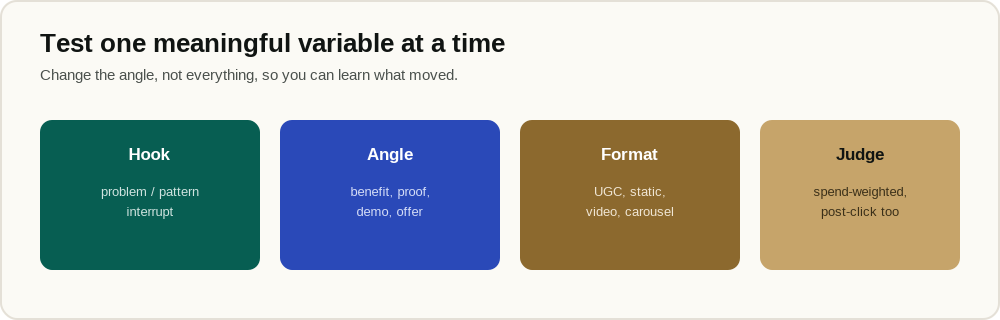
Creative contains multiple variables. Organising them helps the team learn from the outcome instead of producing disconnected variations.
A. Customer problem or motivation
Explore different real customer needs, such as convenience, comfort, durability, appearance, ease of use, gifting, or solving a specific frustration. Use customer research, reviews, search queries, support questions, and product knowledge to identify credible motivations. Do not invent customer testimonials or claim research that has not been conducted.
B. Message angle
The same product may be explained through different angles:
Choose angles that reflect genuine product advantages. Avoid unsupported superlatives, misleading comparisons, or promises the business cannot fulfil.
- Product benefit
- Product construction or material
- Use case or demonstration
- Comparison with a common alternative, where factual and fair
- Objection handling
- Seasonal relevance
- Value or bundle
- Brand craftsmanship or process, if verifiable
C. Hook or opening
For video, the opening seconds should quickly establish relevance. Possible approaches include showing the product in use, presenting a common problem, revealing a detail, demonstrating an outcome, or asking a specific question. The hook must connect to what follows; attention gained through a misleading opening can create low-quality traffic.
D. Format and execution
Potential formats include static images, carousels, short-form video, demonstrations, customer-created content with proper permission, product-detail footage, and collection-focused creative. Format should serve the message and available assets rather than being selected solely because it is fashionable.
E. Proof and trust
Useful proof may include accurate product details, genuine customer reviews used with permission, demonstrations, verified certifications, clear delivery information, or transparent policies. Do not manufacture ratings, reviews, credentials, before-and-after claims, or performance evidence.
F. Offer and call to action
Offers can affect both conversion and margin. If testing discounts, bundles, shipping incentives, or payment options, assess whether any conversion lift justifies the cost. Keep offer terms clear and consistent between the ad and landing page.
G. Visual treatment
Test composition, framing, product visibility, lighting, background, text overlays, and how the product is shown in context. Ensure important product attributes are represented accurately. For products where colour, scale, texture, or dimensions matter, avoid visual treatments that could mislead shoppers.
5. Design a useful test
A test needs enough clarity to support a decision. The exact method depends on budget, conversion volume, delivery options, and how much certainty the business needs.
Change a meaningful variable
If the objective is to understand whether a product demonstration works better than a lifestyle image, keep other major elements reasonably consistent where practical. If the two ads also have different offers, landing pages, headlines, and audiences, the test may still compare two complete concepts, but it will not isolate the effect of the visual format.
Both kinds of tests can be useful. Label them correctly:
- Variable-focused test: designed to learn about one major difference.
- Concept test: compares two broader creative ideas that differ in several ways.
Avoid too many simultaneous variations
Launching a large number of ads with limited spend can leave each variation with little evidence. Start with a manageable set that matches the budget and expected purchase volume. The right number is account-specific; there is no universal number of ads that guarantees a reliable result.
Keep a record of context
Record the launch date, campaign and ad set, creative ID or name, concept, format, offer, landing page, spend, results, and any major changes. Note seasonal periods, stock constraints, price changes, and website releases that may affect interpretation.
Understand the limits of platform delivery
Ads in the same ad set may not receive equal spend or impressions. Delivery systems optimise based on their own signals, so a simple comparison of ads is not necessarily a controlled experiment. If you need a more rigorous causal comparison, investigate current platform experiment tools or another appropriate test design, and follow the platform’s setup guidance.
Do not call an informal comparison a statistically conclusive experiment unless the methodology supports that claim.
6. Choose metrics that match the objective
No single metric explains every creative result. Choose a primary metric based on the business goal and use secondary metrics to understand why performance may have changed.
| Metric | Useful for | Limitations |
|---|---|---|
| Thumb-stop or early-view signal, where available | Diagnosing whether a video opening attracts attention | Definitions and availability vary; attention does not prove purchase intent |
| Click-through rate | Assessing whether the ad generates clicks | Clicks can be low quality or driven by curiosity |
| Cost per click | Monitoring the cost of traffic | Cheap clicks are not necessarily valuable clicks |
| Landing-page views | Checking whether clicks become page visits | Does not establish purchase intent or profitability |
| Add-to-cart rate | Diagnosing product consideration | Cart activity may not convert into valid orders |
| Purchase conversion rate | Assessing the journey from visits to purchases | Depends on the denominator and tracking quality |
| Cost per purchase | Monitoring media cost per tracked purchase | Does not automatically equal new-customer CAC or profitable acquisition |
| ROAS | Comparing reported attributed revenue with ad spend | Not a profit metric and affected by attribution settings |
| New-customer CAC | Understanding acquisition cost for new customers | Requires a reliable way to identify new customers and a defined cost scope |
| Contribution margin | Assessing commercial value after relevant variable costs | Requires accurate cost and order data |
Use a metric hierarchy
A practical hierarchy for a purchase-focused campaign is:
The hierarchy changes if the campaign’s actual objective is leads, store visits, or another outcome. Match the metric to the objective rather than judging every campaign by purchases.
- 01Business guardrails: margin, valid orders, cancellations, returns, stock, and fulfilment.
- 02Primary performance metric: the metric agreed for the test, such as cost per purchase or new-customer CAC.
- 03Diagnostic metrics: click-through rate, landing-page views, add-to-cart rate, and conversion rate.
- 04Attention metrics: video-view or engagement signals where they help explain the result.
7. Read results without jumping to conclusions
A creative result needs context. Consider the amount of spend, number of conversions, time since launch, conversion lag, seasonality, audience, offer, landing page, and product availability.
Scenario 1: strong engagement, weak purchases
Possible explanations include a curiosity-driven hook, unclear pricing, a mismatch between the ad and product page, slow loading, unexpected delivery costs, weak product information, or a tracking problem. Review the journey before producing endless new hooks.
Scenario 2: low click-through rate, acceptable purchase economics
The creative may attract a smaller but more relevant audience. If the business outcome is healthy and volume is sufficient for the goal, do not reject it solely because its click-through rate is lower than another ad.
Scenario 3: good ROAS, low order volume
The creative may be effective in a narrow context but unable to spend at a larger scale, or the campaign may be constrained by budget, audience, stock, or delivery. Examine the opportunity and commercial constraints before assuming the ad can scale indefinitely.
Scenario 4: performance drops after a strong period
Investigate changes in spend, creative exposure, frequency, audience, competition, offer, landing page, tracking, seasonality, stock, and fulfilment. A decline is not automatically proof of creative fatigue.
Scenario 5: one ad gets most of the spend
This may reflect the delivery system’s allocation, not definitive proof that the ad is the best creative for every audience or future period. If a fair comparison is important, use an appropriate test design instead of assuming equal delivery occurred.
8. Creative fatigue and refresh planning
Creative fatigue is often used to describe a decline in effectiveness as an audience repeatedly encounters the same creative. It can happen, but it is not the only explanation for a performance decline.
Review trends together:
Do not use one universal frequency threshold as an automatic pause rule. The appropriate interpretation depends on the campaign, audience, placement, creative, and business outcome.
- Frequency and reach, interpreted in the context of audience size and campaign type
- Click-through rate and cost trends
- Conversion rate and cost per purchase
- Spend distribution across creatives
- Audience composition and delivery
- Changes to the offer, product, price, website, and stock
- Seasonal changes and broader market conditions
Build a refresh pipeline before you need it
A useful creative pipeline has several stages:
The objective is not to refresh creative on a rigid calendar regardless of performance. It is to keep a pipeline ready and use evidence to determine when refreshes are needed.
- 01Research: collect customer questions, objections, reviews, search terms, and product insights.
- 02Brief: define the hypothesis, message, format, and guardrails.
- 03Produce: create variations with a clear reason for each.
- 04Quality check: confirm accuracy, permissions, offer terms, destination, and platform requirements.
- 05Test: launch using the planned setup.
- 06Evaluate: record results and limitations.
- 07Develop: turn useful learnings into new concepts rather than merely duplicating the same ad.
- 08Archive: retain naming, assets, and learnings so the team can avoid repeating failed tests without a reason.
9. Organise the creative pipeline
A simple naming system helps the team connect an ad to its hypothesis. For example:
Market_Product_Angle_Format_Version_Date
Illustrative example:
PK_Bedding_MaterialProof_Video_V02_2026-10
Use a consistent naming convention that fits the account. Avoid putting excessive detail in names if it makes them unreadable; store full briefs and results in a linked creative log.
Recommended creative log fields
Keep asset permissions, creator agreements, usage rights, music licences, and required disclosures organised. Do not assume that an asset can be reused indefinitely or across every placement just because it was approved once.
- Creative name and ID
- Market and product group
- Customer problem or motivation
- Creative angle and format
- Hypothesis
- Offer and landing page
- Launch and review dates
- Spend and delivery context
- Primary and diagnostic metrics
- Order quality or margin notes, where available
- Decision and rationale
- Follow-up concept
10. Common creative testing mistakes
Mistake 1: testing without a hypothesis
If every new ad has no clear purpose, results become a list of numbers rather than a source of learning.
Mistake 2: treating engagement as business success
Views, likes, and comments may be useful signals, but they do not prove that an ad generated profitable sales.
Mistake 3: changing too many things and claiming one cause
A concept test can compare multiple differences, but the team should not claim that one specific element caused the outcome when several elements changed together.
Mistake 4: stopping too early
A few clicks or purchases may not be enough to support a confident decision. Consider spend, volume, lag, and variability.
Mistake 5: letting weak economics hide behind high ROAS
Assess contribution margin, order validity, new-customer acquisition, returns, and fulfilment costs alongside attributed platform results.
Mistake 6: copying competitors without context
Competitor ads can inspire hypotheses, but you usually cannot see their margin, conversion rate, audience, targeting, or business objective. Do not assume an ad is profitable simply because it is visible.
Mistake 7: using misleading creative
Overstated claims, inaccurate product visuals, fabricated reviews, and unclear offer terms may damage trust and create policy or legal risk. Creative should represent the product and offer honestly.
Mistake 8: ignoring the landing page
A strong ad cannot fully compensate for a slow or confusing destination, missing product information, unexpected costs, or a difficult checkout.
Mistake 9: failing to preserve learning
If the team does not record the hypothesis and result, it may repeat similar tests or lose useful context when staff or agencies change.
11. A practical creative testing workflow
Step 1: identify the bottleneck
Use the available funnel and business data to decide whether the biggest issue appears to be attention, traffic quality, product consideration, checkout, or economics. Treat this as a working diagnosis, not a certainty.
Step 2: research the customer
Use genuine customer questions, reviews, search queries, support conversations, and product knowledge. Remove personal data and follow applicable privacy and permission requirements.
Step 3: choose one learning objective
Decide whether the test compares a message, hook, format, demonstration, offer, or broader concept.
Step 4: write the brief
Include the target need, product truth, creative idea, hypothesis, destination, metrics, guardrails, and required approvals.
Step 5: produce distinct variations
Make the differences meaningful enough to teach the team something. Do not create superficial variations simply to increase the number of ads.
Step 6: check implementation
Verify media, copy, destination URL, mobile rendering, tracking, offer terms, rights, disclosures, and product availability.
Step 7: launch with a clear test design
Use a setup that fits the account’s budget and required level of control. Understand that ordinary delivery may allocate spend unevenly.
Step 8: evaluate in context
Review the primary metric, diagnostic signals, commercial guardrails, conversion lag, and relevant changes during the test.
Step 9: document the decision
Record whether to keep, revise, retest, scale, or stop the concept, and why. Include any uncertainty or data limitations.
Step 10: turn learning into the next brief
A result is valuable when it informs the next creative decision. If a product-detail concept appears promising, test a new product detail or use case rather than only changing the background colour.
12. A 30-day creative testing plan
This plan is illustrative. Adapt the pace to production capacity, budget, purchase volume, and the time needed to observe outcomes.
Week 1: research and diagnose
Deliverable: prioritised creative hypotheses.
- Review campaign and creative performance.
- Check the purchase journey and tracking.
- Gather customer questions and objections.
- Identify the biggest business problem to address.
- Review product accuracy, offers, permissions, and available assets.
Week 2: brief and produce
Deliverable: approved creative test queue.
- Select a manageable set of distinct concepts.
- Write a brief for each concept.
- Prepare variations that support the intended learning.
- Confirm landing pages and commercial details.
- Create the creative log and naming convention.
Week 3: launch and monitor
Deliverable: quality-checked tests with a complete record.
- Launch according to the planned campaign structure.
- Verify delivery and tracking.
- Avoid unnecessary edits that make interpretation harder.
- Monitor major technical or commercial issues.
- Record spend and exposure context.
Week 4: evaluate and iterate
Deliverable: decision log and next-cycle briefs.
- Review business outcomes and diagnostic metrics.
- Account for conversion lag and limited data.
- Identify concepts that merit a follow-up.
- Investigate website or offer issues when the funnel indicates a bottleneck.
- Plan the next creative cycle.
Final takeaway
Creative testing works best when it is a disciplined learning process, not a race to publish more ads. Start with a real business problem, write a clear hypothesis, test meaningful creative ideas, measure the result in context, and preserve what the team learns.
A strong creative pipeline is built from customer insight, truthful product communication, reliable measurement, and repeatable decisions. The objective is not merely to find an ad that attracts attention. It is to discover messages that help the right customers understand the product and support sustainable ecommerce growth.
FAQ
Frequently asked questions
It is a structured process for comparing creative ideas, messages, formats, or offers to learn which ones support the campaign’s objective. Good testing includes a hypothesis, suitable measurement, business guardrails, and a documented decision.
There is no universal number. Choose a manageable quantity that matches the budget, expected conversion volume, and the degree of comparison you need. Too many variations with too little delivery can make results difficult to interpret.
There is no fixed duration that guarantees a reliable answer. Consider spend, conversions, conversion lag, campaign delivery, seasonality, and the confidence needed for the decision. Set a review plan before launch and avoid treating a short, low-volume result as conclusive.
Use a metric that matches the campaign objective. For ecommerce purchases, cost per purchase, new-customer CAC, revenue, and contribution margin may be important. Click-through rate and engagement can help diagnose creative response but should not replace business outcomes.
Creative fatigue describes a possible decline in an ad’s effectiveness after repeated exposure. Diagnose it using several trends and check other explanations, such as offer changes, audience shifts, website problems, stock, or seasonality.
When you want to isolate the effect of a specific variable, keep other major factors consistent where practical. When comparing broader concepts, several factors can change together, but interpret the result as a concept comparison rather than proof about one individual element.
Not based on click-through rate alone. Consider purchase performance, audience quality, conversion rate, spend, and the purpose of the test. A lower click-through rate can coexist with commercially useful results.
Competitor ads can generate ideas, but their visible ads do not reveal their costs, conversion rates, margins, targeting, or profitability. Use inspiration to develop your own truthful, differentiated concepts, and respect intellectual property and usage rights.
Similar posts
Meta Ads
Meta Ads for Ecommerce: The Complete 2026 Growth Guide
Learn how to build, measure and scale Meta Ads for ecommerce in 2026, from campaign structure and creative testing to tracking, ROAS and profitable growth.
16 min read
Meta Ads
Meta Ads Campaign Structure for Ecommerce in 2026
Learn how to structure Meta Ads campaigns for ecommerce, from objectives and budget allocation to creative testing, retargeting, measurement, and scaling.
22 min read
Meta Ads
How to Scale Meta Ads Without Destroying ROAS or Profitability
Learn how to scale Meta Ads with disciplined budget increases, creative testing, measurement checks, and profitability guardrails for ecommerce.
13 min read
Related services
Related work