Technical SEO
Programmatic SEO for Ecommerce


Programmatic SEO is one of the most powerful and most abused techniques in the field. The idea is simple: instead of writing each page by hand, you generate pages at scale from structured data using templates, so you can cover hundreds or thousands of related searches that would be impossible to address manually. For ecommerce, with large catalogues and many attribute combinations, the potential is huge. But the same mechanism that creates value at scale can create junk at scale, thin, templated, near-duplicate pages that bury a site and risk penalties. This piece explains how to use programmatic SEO to capture real demand without becoming a spam generator, because the technique is only as good as the discipline behind it.
Quick answer
Programmatic SEO is generating many pages from structured data and templates to target many related searches at scale, for example a page for every product attribute combination, location, or use case that people actually search for. Done well it captures real demand that would be impractical to cover by hand. Done badly it floods a site with thin, near-duplicate pages that help nobody and invite penalties. The line between the two is whether each generated page is genuinely useful and targets real search demand, or exists only to exist.
Key takeaways
- Programmatic SEO generates many pages from data and templates to target many related searches at a scale manual writing cannot reach.
- The technique is neutral; value or harm depends entirely on whether each generated page is useful and targets real demand.
- It creates value when it captures genuine search demand with genuinely useful pages, both conditions must hold.
- It goes wrong when it floods a site with thin, near-duplicate pages generated for their own sake, risking penalties and diluting quality.
- Generation is cheap, so the temptation is to generate everything possible; the discipline is generating only what is useful.
- Research real demand, make each page substantively useful and distinct, and prune pages that do not earn their place.
What programmatic SEO is
Programmatic SEO means creating pages systematically from data and templates rather than one at a time. You define a template, feed it structured data, and generate a page for each data point: a page per location, per attribute combination, per use case, per comparison. The result is coverage at a scale manual writing cannot reach.
The appeal is obvious. If people search for many specific variations, "X for Y", "X in location Z", "X vs W", and each variation represents real demand, programmatic generation lets you address all of them efficiently. The technique itself is neutral; everything depends on whether the pages it produces are genuinely useful.
Where it creates real value
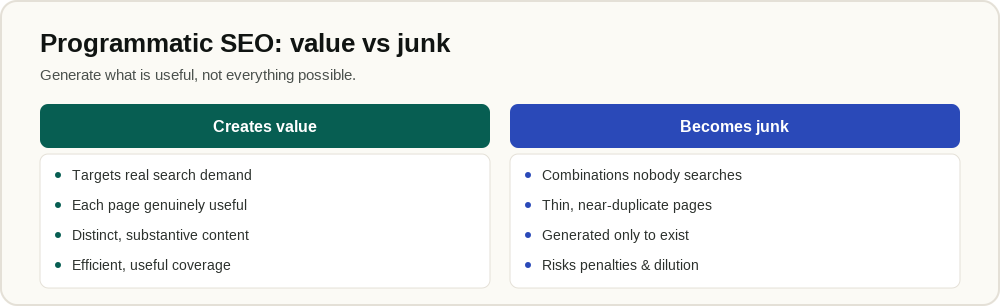
Programmatic SEO works when it captures genuine search demand with genuinely useful pages. The test has two parts, and both must hold.
First, real demand: the searches you target must be ones people actually make. Generating pages for combinations nobody searches for produces pages nobody wants, wasting crawl budget and diluting the site. Research what variations have genuine demand, and generate for those.
Second, genuine usefulness: each generated page must actually serve the person who lands on it, with content, data or options relevant to their specific search, not a template with a word swapped and nothing of substance. For ecommerce this often means pages that surface genuinely relevant products, specifications, or guidance for the specific query. When both parts hold, programmatic SEO is simply an efficient way to be useful at scale.
Where it goes wrong
The failure mode is thin, near-duplicate pages generated for their own sake. When you generate pages for combinations without real demand, or pages that differ only in a swapped word with no substantive content, you create exactly the low-value, templated mass that search engines work to filter out and sometimes penalise.
This is the central risk, and it is easy to fall into because generation is cheap. The temptation is to generate everything possible rather than everything useful. A site that does this floods its own index with pages that help nobody, drowns its genuinely good pages, wastes crawl budget, and signals low quality across the whole domain. Scale amplifies the damage as readily as the value.
Doing it responsibly
The discipline is to let usefulness and real demand govern what you generate, not what is technically possible. Research the actual search demand and generate pages only for variations people genuinely look for. Make each page substantively useful for its specific query, with real, relevant content, rather than a hollow template. Ensure generated pages are distinct enough to justify their own existence, if two would be near-identical and serve the same need, they should probably be one. And monitor quality and performance: if generated pages are not useful and not earning engagement, prune them rather than letting them accumulate.
Used this way, programmatic SEO is a legitimate, powerful technique for capturing real demand efficiently. The question to ask before generating any set of pages is simple: does each one target a real search and genuinely help the person who arrives? If yes, generate with confidence. If no, you are manufacturing the kind of thin content that eventually costs you.
FAQ
Frequently asked questions
It is creating pages systematically from structured data and templates rather than writing each one by hand, so you can target many related searches at scale, a page per location, attribute combination, use case or comparison. The technique is neutral; its value depends entirely on whether the pages it generates are genuinely useful and target real demand.
The technique itself is not; generating useful pages that serve real searches efficiently is legitimate. What violates guidelines and risks penalties is using it to mass-produce thin, near-duplicate pages with no real substance or demand. The line is quality and usefulness, not whether pages were generated programmatically.
When there is genuine search demand for many specific variations, attribute combinations, use cases, comparisons, and you can generate pages that are each substantively useful for their specific query. If you can satisfy both real demand and genuine usefulness at scale, it is a powerful fit for large catalogues.
Pages generated for combinations nobody searches for, or pages that differ only in a swapped word with no substantive, relevant content, are thin. They exist to exist rather than to help anyone, waste crawl budget, dilute the site, and signal low quality. Substance and real demand are what separate useful generated pages from junk.
Generate pages only for variations with real search demand, make each one genuinely useful for its specific query rather than a hollow template, keep generated pages distinct enough to justify existing, and monitor performance, pruning pages that are not useful or earning engagement. Let usefulness and real demand govern what you generate, not what is technically possible.
Similar posts
SEO
Ecommerce SEO: The Complete Guide to Growing Organic Revenue
Learn how to grow ecommerce organic revenue with category SEO, product pages, technical SEO, structured data, internal linking, content strategy and measurement.
24 min read
Technical SEO
Ecommerce SEO for Large Catalogues: Managing Faceted Navigation, Crawl Budget, and Indexation
10 min read

SEO
Ecommerce Category Page SEO: How to Build Pages That Rank and Help Shoppers Choose
Learn how to optimise ecommerce category pages with better architecture, helpful copy, internal links, filters, and measurement.
15 min read
Related services