Technical SEO
Ecommerce SEO for Large Catalogues: Managing Faceted Navigation, Crawl Budget, and Indexation

Large ecommerce catalogues create a discovery challenge: the site may contain thousands of products, variants, filters, sorting combinations, and changing inventory states. The goal is not to make every possible URL indexable. It is to help search engines discover and understand pages that provide distinct value, while keeping low-value URL combinations from overwhelming site architecture and maintenance. “Crawl budget” is often used broadly, but the practical task is to ensure important pages are crawlable, internally discoverable, technically consistent, and worth indexing. For most smaller sites, crawl budget is not the first problem to solve. For very large or frequently changing sites, URL generation, internal linking, server capacity, and crawl patterns can become important.
Quick answer
Faceted navigation lets shoppers refine product listings by attributes such as size, brand, colour, material, or price. It can create many URL combinations, so the site needs a clear policy for which combinations are useful search landing pages.
Key takeaways
- SEO title: Ecommerce SEO for Large Catalogues: Facets and Indexation
- Before changing technical rules, understand how the platform creates URLs.
- Crawling means a search engine requests and processes a URL.
- Faceted navigation lets shoppers refine a catalogue by size, colour, brand, material, price, rating, or compatibility.
SEO metadata
SEO title: Ecommerce SEO for Large Catalogues: Facets and Indexation
Meta description: Learn to manage faceted navigation, parameter URLs, product variants, crawl budget, and indexation for large ecommerce websites.
Suggested URL: /insights/large-catalogue-ecommerce-seo-faceted-navigation/
Primary keyword: ecommerce SEO large catalogue
Secondary keywords: faceted navigation SEO, ecommerce crawl budget, ecommerce indexation, parameter URLs SEO, ecommerce product variants
Category: Ecommerce SEO
Author: Afshaan Ahmed Memon
1. Discover and classify URL patterns
Before changing technical rules, understand how the platform creates URLs. Document:
Use a crawler and, where appropriate, server logs or platform data to identify URL patterns. Sample representative URLs rather than inferring the whole system from a handful of examples. Group URLs by pattern, estimate scale, and determine which patterns lead to useful pages.
Create a URL taxonomy with the pattern, purpose, example, intended crawlability, indexation decision, canonical behaviour, sitemap status, and owner. This makes implementation decisions clear and avoids isolated fixes that fail to address the underlying pattern.
- Core category, subcategory, and product URL patterns.
- Product variants and their URL behaviour.
- Filter and sort parameters.
- Search, pagination, and tracking parameters.
- URLs generated by recommendations, campaigns, or internal site search.
- Rules for out-of-stock, discontinued, and unpublished products.
- XML sitemap generation and canonical logic.
2. Understand crawling versus indexing
Crawling means a search engine requests and processes a URL. Indexing means it considers a page for inclusion in its search index. A page can be crawlable but not indexed, and a URL blocked by robots.txt may still be known through links or other signals.
For large catalogues, ask:
A high number of excluded URLs is not automatically a defect. Filters, sort variants, duplicate URLs, and parameter pages may be intentionally excluded. Investigate patterns and business intent before trying to make every URL indexed. A sitemap helps discovery but does not guarantee indexing.
- Can search engines discover important pages through links or sitemaps?
- Can they crawl URLs without technical barriers?
- Do pages return the intended status and render useful content?
- Are canonical and indexing signals consistent?
- Does each candidate page provide distinct value?
- Are generated URL combinations consuming crawl activity without meaningful benefit?
3. Classify faceted navigation
Faceted navigation lets shoppers refine a catalogue by size, colour, brand, material, price, rating, or compatibility. It improves usability but can create a very large number of URL combinations.
Classify facets into:
Do not apply a blanket rule that all filters should be indexed or blocked. The decision should reflect demand, available inventory, page quality, duplication, internal linking, and the ability to maintain the page over time.
- Core category facets that customers commonly use to browse.
- Potential search-demand facets that may represent a distinct landing-page need.
- User-experience filters that help shoppers but may not warrant indexation.
- Sort and display controls that change presentation rather than the underlying category.
- Combinatorial or low-value combinations with little distinct content or demand.
- Internal search and session URLs, which should be assessed separately.
4. Decide which filtered pages deserve indexation
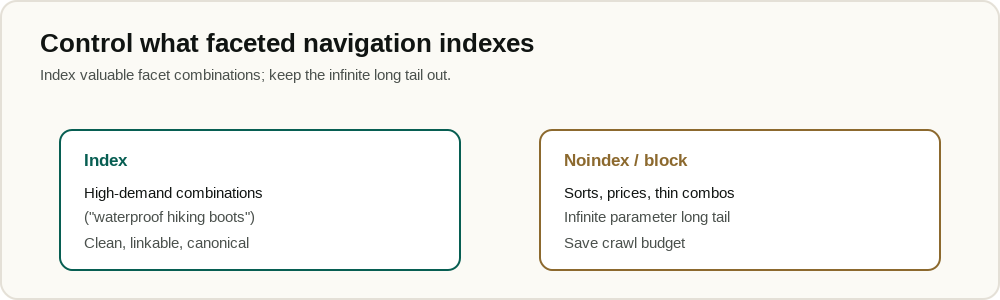
A filtered page may deserve to be a search landing page when it serves a clear user need and has a stable, useful assortment. A meaningful product group based on a common attribute may warrant a dedicated category or collection page if customers search for it and the business can maintain it.
Assess candidates using:
When a filter combination is important, a clean category URL may be easier to manage than a long chain of arbitrary parameters. Avoid creating indexable pages for every possible combination simply because the platform can generate them.
- Evidence of search demand or relevant existing impressions.
- Distinct product selection and stable availability.
- Clear page purpose and understandable navigation.
- Useful title, heading, and content.
- Internal links from relevant categories.
- A canonical URL and consistent sitemap policy.
- A plan for inventory changes and empty-result states.
- A manageable number of combinations.
5. Control parameter URLs
Parameters can be used for filtering, sorting, tracking, pagination, search, and other purposes. Identify what each parameter changes before deciding how it should be handled.
For each parameter family, document its purpose, allowed values, whether it changes the product set or only presentation, whether it can be combined with others, internal-link behaviour, indexation intent, and canonical/robots policy.
Sorting parameters often change product order rather than category intent. Tracking parameters usually should not become separate canonical landing pages. Filters require more nuance because some combinations may have genuine search value.
Do not rely on robots.txt as a universal canonicalisation or removal method. Blocking crawling can prevent search engines from seeing page-level canonical or noindex signals. Test parameter rules carefully, including encoded characters, multiple filters, empty values, repeated parameters, pagination, and user-facing filter behaviour.
6. Handle product variants and duplicate URLs
Product variants may represent different sizes, colours, materials, or configurations. Whether variants should have distinct URLs depends on the shopping experience, product differences, search demand, and platform design.
Audit whether variants share a URL or have separate URLs; whether variant selection updates the URL and visible state; whether title, image, price, availability, and structured data reflect the selected variant; and whether canonical tags, internal links, and sitemap entries are consistent.
Do not automatically canonicalise all variants to a parent page if each is meaningfully distinct and the site is designed to expose it separately. Conversely, avoid indexable duplicate URLs for every option when the page provides no distinct search value.
For duplicated product URLs caused by category paths or tracking parameters, choose a consistent preferred URL, align internal links and sitemaps, and use redirects where consolidation is appropriate. Validate across templates rather than fixing only a few examples.
8. Coordinate sitemaps, canonicals, robots, and status codes
Treat these signals as a coordinated system.
XML sitemaps: Include canonical, indexable URLs that the site wants search engines to discover. Remove URLs that redirect, return errors, or are intentionally excluded.
Canonical tags: Indicate the preferred URL among duplicate or very similar pages. Ensure the destination is accessible and appropriate.
Robots directives: Confirm important pages are not unintentionally noindexed. Remember that robots.txt controls crawling, while noindex is a page-level indexing directive that requires the crawler to access the page.
Status codes: Important live pages should return the intended success response. Redirect obsolete URLs deliberately and avoid chains or loops. Empty filter combinations should not masquerade as valuable category pages if they have no meaningful content.
Internal links: Prefer linking directly to the intended canonical URL instead of relying on redirects or canonical hints to resolve avoidable inconsistencies.
9. Monitor crawl patterns and indexation
Use tools appropriate to the site's scale. Search Console can show indexation patterns and search performance; a crawler can map URLs and internal links; server logs, where available and appropriately handled, can show requests made by search-engine crawlers.
Monitor changes in discovered URL patterns, important templates becoming excluded or inaccessible, crawl activity concentrated on parameter combinations, response-code patterns, canonical mismatches, sitemap quality, indexation trends for priority categories, and new URL patterns introduced by releases.
Do not interpret a single count as a success metric. A reduction in indexed URLs can be healthy if low-value duplicates were removed, while a stable count can hide a loss of important pages. Evaluate the quality and purpose of the URLs affected. Keep a record of releases and URL-policy changes so subsequent observations can be assessed without assuming causation prematurely.
10. A 30-day implementation plan
Week 1, Discover and classify
Week 2, Decide policy
Week 3, Implement controlled changes
Week 4, QA and monitor
Large catalogues and complex platforms may need a longer rollout. Make rules explicit and validate them before applying them broadly.
- Crawl the site and document URL patterns.
- Review Search Console indexation and performance reports.
- Identify parameters, filters, variants, and duplicate URL patterns.
- Create a URL taxonomy and baseline.
- Identify filter combinations with clear search and business value.
- Define indexation, canonical, sitemap, and internal-link rules by URL family.
- Agree on empty-state and discontinued-product handling.
- Review current Google guidance and platform limitations.
- Test changes in staging where possible.
- Apply parameter and canonical logic to a representative set.
- Update internal links and sitemap generation.
- Validate product variants and filter interactions.
- Crawl the updated site and test important user journeys.
- Confirm status codes, canonical destinations, robots directives, and sitemap membership.
- Monitor Search Console and available crawl data.
- Document remaining risks and the next iteration.
11. Diagnose → Acquire → Convert → Scale → Compound
Diagnose: Map URL patterns, identify crawl and indexation barriers, and distinguish valuable landing pages from redundant combinations.
Acquire: Make priority categories, products, and genuinely useful filtered collections discoverable.
Convert: Preserve filters and navigation that help shoppers find suitable products without creating confusing URL behaviour.
Scale: Apply consistent template and parameter rules across the catalogue, testing edge cases.
Compound: Monitor crawl patterns, maintain the URL taxonomy, and revisit decisions as the catalogue and customer demand change.
The objective is not the smallest possible index or the largest possible one. It is a coherent, maintainable site where search engines can discover pages that provide real value.
Conclusion
Large-catalogue SEO depends on deliberate URL management. Discover how the platform generates URLs, classify facets and variants, decide which pages deserve indexation, align canonicals and sitemaps, improve internal discovery, and monitor the patterns that matter.
The goal is not to index every possible combination or block as many URLs as possible. It is to make valuable pages accessible and understandable while keeping technical complexity under control.
FAQ
Frequently asked questions
Faceted navigation lets shoppers refine product listings by attributes such as size, brand, colour, material, or price. It can create many URL combinations, so the site needs a clear policy for which combinations are useful search landing pages.
No. Index combinations that have a distinct purpose, useful product selection, and a sustainable maintenance plan. Other combinations can remain useful to shoppers without being treated as separate search landing pages.
No. It is most relevant when a site is large, generates many URLs, changes frequently, or shows evidence that crawling is not focused on important pages. Many sites should first address content quality, internal linking, and basic technical issues.
No. Robots.txt controls crawling and is not a canonicalisation mechanism. Blocking a URL can prevent crawlers from seeing page-level signals. Choose a policy based on the URL's purpose and current guidance.
It depends on the platform, customer experience, variant differences, and search intent. Keep canonical tags, internal links, sitemaps, visible product data, and structured data consistent with the chosen strategy.
No. A sitemap helps communicate URLs for discovery, but does not guarantee crawling or indexing.
Similar posts

Technical SEO
Ecommerce SEO for Duplicate Content: Canonicals, Consolidation, and Indexation
Learn how to diagnose ecommerce duplicate content, choose canonical URLs, consolidate similar pages, and manage parameters without harming product discovery.
10 min read

Technical SEO
Ecommerce SEO for Product Variants: URLs, Canonicals, and Structured Data
Learn how to manage ecommerce product variants for SEO, including URL strategy, canonical tags, internal links, product structured data, and indexation.
9 min read

SEO
Ecommerce SEO: The Complete Guide to Growing Organic Revenue
Learn how to grow ecommerce organic revenue with category SEO, product pages, technical SEO, structured data, internal linking, content strategy and measurement.
24 min read
Related services
Related work