Performance Marketing
Performance Max vs Advantage+: Which and When

"Performance Max or Advantage+" is a common question, but it is slightly the wrong one. These are the flagship automated offerings of two different platforms, Google and Meta, not competing products on the same platform. For most ecommerce advertisers the answer is both, run well, with budget split by evidence. This guide compares what each is, their strengths and quirks, and how to decide where your money goes.
Quick answer
Performance Max is Google's automated campaign type that spans Search, Shopping, YouTube, Display, Gmail and Maps. Advantage+ is Meta's suite of automation for Facebook and Instagram, including Advantage+ shopping campaigns. They are not direct rivals you choose between; they are each platform's AI-led way to advertise, and most ecommerce brands use both. The real question is how to run each well and how to split budget, guided by where your customers are, which platform drives incremental sales, and your margins, rather than a blanket "which is better".
Key takeaways
- Performance Max (Google) and Advantage+ (Meta) are different platforms' AI campaigns, not direct rivals.
- Google and Performance Max are strong at capturing intent and demand.
- Meta and Advantage+ are strong at generating demand from signals and creative.
- Most ecommerce brands should use both, run well.
- Split budget by evidence: where customers are, incrementality and profit.
What each one is
Performance Max (Google)
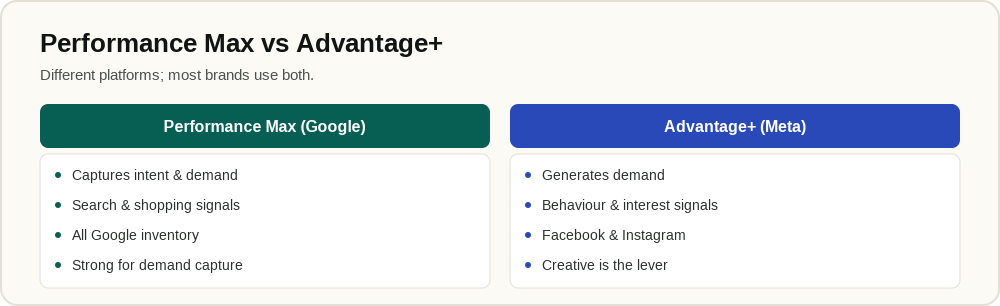
A single automated campaign type that uses Google's AI to serve across all of Google's inventory, Search, Shopping, YouTube, Display, Gmail and Maps, optimising toward your goal. It leans heavily on Google's intent signals and search demand.
Advantage+ (Meta)
Meta's suite of automation for Facebook and Instagram, with Advantage+ shopping campaigns as the headline for ecommerce. It plays to Meta's strength: finding buyers from behavioural and interest signals, with strong creative as the main input.
How they differ in nature
The platforms have different strengths, so their automation behaves differently:
That is why they complement rather than replace each other: they reach customers at different moments.
- Google, and Performance Max, is strong on capturing existing intent and demand, including search.
- Meta, and Advantage+, is strong on demand generation: finding and interesting buyers who were not searching.
- Google leans on queries and shopping signals; Meta leans on behaviour and creative.
How to split budget
Do not pick one in the abstract. Decide allocation from evidence:
Start with a sensible split, measure incrementality and profit, and reallocate toward what actually drives growth.
- Where are your customers, and where does each platform find incremental buyers for you?
- Which drives more profitable new-customer revenue, tested with incrementality where possible?
- What do your margins and goals demand from demand capture versus demand generation?
FAQ
Frequently asked questions
It is the wrong question: they are different platforms' automated campaigns, not rivals on one platform. Most ecommerce brands use both. The better question is how to run each well and how to split budget by evidence.
For most ecommerce advertisers, yes. Google captures existing intent and demand; Meta generates demand from signals and creative. They reach customers at different moments, so they complement each other.
By evidence, not defaults: where your customers are, which platform drives incremental, profitable new-customer sales (test with incrementality), and what your margins need. Start sensible, measure, and reallocate toward real growth.
Both automate targeting and placement and give limited visibility into where budget goes. Manage the opacity by feeding them strong inputs and accurate conversion values, keeping guardrails, and judging on profit and incrementality rather than reported ROAS.
Strong inputs and correct goals: accurate conversion values, good creative and signals, clear guardrails, and measuring real profit. The automation can only optimise toward the goal and data you give it.
Similar posts

Google Ads
AI in Google Ads: Smart Bidding, Performance Max and Asset Generation
Google Ads is now AI-driven: Smart Bidding, Performance Max and generative assets. Where AI shows up, how to work with it, and the controls that keep automation honest.
4 min read
Meta Ads
AI in Meta Ads: A Practical Guide to Advantage+
Meta's Advantage+ automates targeting, placement and budget. Where it helps most, why strong creative is now your main lever, and how to measure on real profit.
3 min read
Google Ads
Google Performance Max for Ecommerce: Setup, Optimisation, and Measurement
Learn how to set up, optimise, and measure Google Performance Max for ecommerce, from Merchant Center feeds and conversion tracking to ROAS, profitability, and testing.
17 min read
Related services