Google Ads
AI in Google Ads: Smart Bidding, Performance Max and Asset Generation


Much of Google Ads is already automated, and more of it every year. That is not a reason to hand over judgement. The accounts that do well are the ones where a human sets clear goals, supplies strong inputs and creative, and keeps checking what the AI is optimising toward. This guide explains where AI shows up in Google Ads, how to work with it rather than against it, and the controls that keep automation honest.
Quick answer
Google Ads is now heavily AI-driven: Smart Bidding sets bids in real time against your goals, Performance Max automates targeting and placement across Google's inventory, and generative features draft assets like headlines and images. Used well, this saves time and can improve efficiency. Used blindly, it hides where your money goes and can chase the wrong goal. The job of the marketer has shifted from manual levers to feeding the system good inputs, setting the right goals and guardrails, and auditing what the automation actually does.
Key takeaways
- Google Ads is now mostly AI-driven; the marketer's job is inputs, goals and oversight.
- Smart Bidding is strong but only as good as your conversion data and values.
- Performance Max can work but is opaque; feed it well and keep what control you can.
- Generative assets are drafts to review, not finished creative.
- Judge success on profit, not just platform-reported numbers.
Where AI shows up in Google Ads
Free download: use the paid media account audit template to check your tracking, structure and creative tests against this guide.
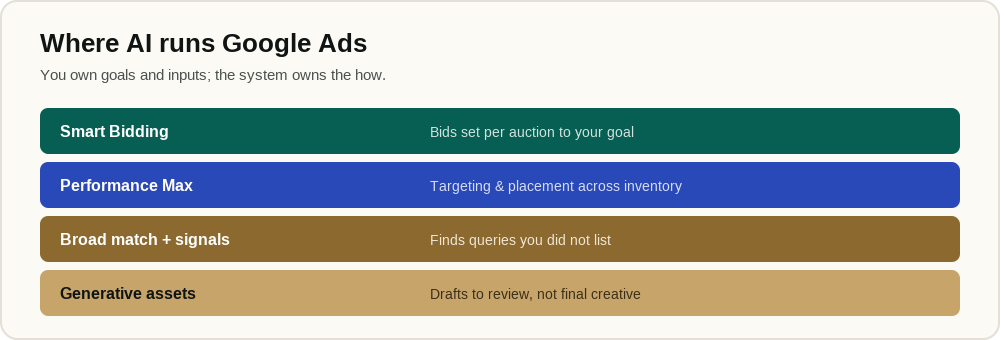
AI now runs through most of the platform:
The common thread: the system decides more of the "how", and you decide the "what" and "why".
- Smart Bidding sets bids per auction to hit a target such as ROAS or cost per action.
- Performance Max automates targeting, placement and asset mix across Search, Shopping, YouTube, Display, Gmail and Maps.
- Generative tools draft text and image assets from your inputs.
- Broad match plus Smart Bidding leans on signals to find queries you did not list.
- Recommendations suggest changes, some useful, some not.
Smart Bidding, briefly
Smart Bidding uses signals at auction time to bid toward your goal. It usually beats manual bidding at scale, but it is only as good as the goal and the conversion data you give it. A target set too aggressively starves volume; a weak or wrongly valued conversion signal sends it chasing the wrong outcome. Feed it accurate conversion values, not just conversion counts.
Performance Max: power and opacity
Performance Max can perform well, but it is a black box: limited visibility into placements, search terms and where budget goes. Give it strong asset groups, accurate conversion values, and useful audience signals, and use what reporting and account structure you can to keep some control and transparency. Do not run it blind alongside everything else and assume the reported numbers tell the whole story.
Generative assets: a draft, not a decision
Generative headlines, descriptions and images are a fast starting point, not finished creative. Review everything for accuracy, brand fit and claims you can stand behind. Treat AI-made assets as drafts a human approves.
The marketer's job now
- Set the right goal and value the right conversion accurately.
- Supply strong creative and useful signals as inputs.
- Set guardrails: budgets, targets, exclusions, brand safety.
- Audit what automation does: search terms where visible, placements, spend.
- Keep profit, not just platform-reported ROAS, as the real scoreboard.
FAQ
Frequently asked questions
For most accounts at scale, Smart Bidding outperforms manual bidding because it reacts per auction. Manual still has niche uses, but the bigger lever now is giving the AI accurate goals and conversion values.
Cautiously. It can perform well, but it is opaque about placements and spend. Feed it strong assets, accurate conversion values and good signals, keep what control and reporting you can, and judge it on real profit.
Yes, more than ever. Automation decides the "how"; a human must set the right goal, value conversions correctly, supply creative, set guardrails and audit what the system actually does.
No. Treat them as drafts. Review for accuracy, brand fit and defensible claims before publishing. They speed up production but still need human judgement.
Optimising toward the wrong goal. If your conversion tracking or values are wrong, the AI will efficiently chase the wrong outcome. Get measurement right before you scale automation.
Similar posts
AI Tools
The AI Marketing Tool Stack (2026): A Practical Buyer's Guide
A practitioner's guide to building an AI marketing tool stack around jobs to be done: general assistant, content, ads, email, analytics and AI visibility. Lean and honest.
4 min read
Performance Marketing
Performance Max vs Advantage+: Which and When
Performance Max (Google) and Advantage+ (Meta) are different platforms' AI campaigns, not direct rivals. How each works, where they differ, and how to split budget by evidence.
3 min read
Google Ads
Google Ads for Ecommerce: A Practical Growth Guide for 2026
Learn how to structure Google Ads for ecommerce, combine Search, Shopping and Performance Max, measure profitability, improve product feeds, and scale responsibly.
19 min read
Related services