Meta Ads
AI in Meta Ads: A Practical Guide to Advantage+

Meta advertising has shifted from manual audience building to AI-led automation. Advantage+ is the umbrella for that shift. For many ecommerce advertisers it has become the default, and often the better, way to run acquisition. But automation is not autopilot. This guide explains what Advantage+ does, where it helps most, where to keep control, and how to work with Meta's AI so it works for your margins.
Quick answer
Meta's Advantage+ is a suite of AI features that automate targeting, placements, budget and creative decisions across Facebook and Instagram. Advantage+ shopping campaigns and broad, automated targeting often work well for ecommerce, because Meta's strength has always been finding buyers from signals rather than manual audiences. The winning approach is to give the system room to find customers, feed it strong and varied creative, set clear goals and guardrails, and judge results on real profit rather than only the numbers Meta reports.
Key takeaways
- Advantage+ is Meta's suite of AI automation for targeting, placement, budget and creative.
- It plays to Meta's strength: finding buyers from signals, so broad often beats manual.
- With targeting automated, strong and varied creative is your main lever.
- Keep control of goals, brand safety and measurement.
- Judge results on real profit and incrementality, not only Meta's reported numbers.
What Advantage+ actually is
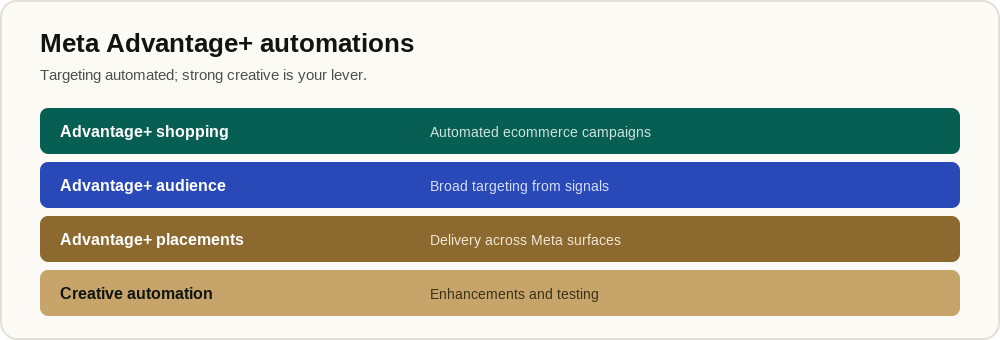
Advantage+ is a set of automation features, not one product:
The theme matches Google's: the system handles more of the "how", you own the goal, the creative and the guardrails.
- Advantage+ shopping campaigns automate much of structure, targeting and placement for ecommerce.
- Advantage+ audience uses broad targeting and signals to find buyers beyond the audiences you name.
- Advantage+ placements spread delivery across Meta's surfaces.
- Creative enhancements and automation tweak and test assets.
Where Advantage+ helps most
Meta's core strength is matching the right people to the right ad from behavioural signals. Advantage+ leans into that. For ecommerce acquisition, broad automated targeting often beats hand-built audiences, because the system explores more and reacts faster than a human can. It also reduces the busywork of managing many narrow ad sets.
Feed it strong, varied creative
With targeting automated, creative becomes the main lever you control. The system needs enough variety to test: different hooks, formats, angles and messages. Weak or thin creative limits what even good automation can do. Most of your effort should go into producing and refreshing strong creative, not micromanaging audiences.
Where to keep control
- Set clear goals and accurate conversion values, not just conversion counts.
- Guard the brand: creative quality, claims, placements you do not want.
- Watch for over-crediting: Meta's reported results can flatter; check against your own data and incrementality where you can.
- Keep enough structure to learn what is working, without fragmenting delivery.
A sensible way to run it
- Give the system room to find buyers rather than boxing it into narrow audiences.
- Concentrate effort on a steady stream of strong, varied creative.
- Set goals, budgets and guardrails, then let it stabilise before judging.
- Measure on profit and, where possible, incrementality, not platform numbers alone.
FAQ
Frequently asked questions
For most ecommerce acquisition, broad automated targeting through Advantage+ often performs as well or better than hand-built audiences, because Meta's strength is finding buyers from signals. Test it against your current setup rather than assuming.
Creative. With the system handling targeting and placement, a steady stream of strong, varied creative becomes your main lever. Put most of your effort into producing and refreshing it.
Platform-reported results can over-credit, especially with modelled and view-based conversions. Check Meta's numbers against your own order data and, where possible, run incrementality tests to see true lift.
For acquisition, giving Advantage+ room with broad targeting usually lets it explore and perform better than narrow, hand-picked audiences. Keep guardrails, but avoid over-constraining the system.
Give it time to exit the learning phase and stabilise, and enough conversions to be meaningful. Judging too early, on too little data, leads to premature changes that reset learning.
Similar posts
AI Tools
The AI Marketing Tool Stack (2026): A Practical Buyer's Guide
A practitioner's guide to building an AI marketing tool stack around jobs to be done: general assistant, content, ads, email, analytics and AI visibility. Lean and honest.
4 min read
Performance Marketing
Performance Max vs Advantage+: Which and When
Performance Max (Google) and Advantage+ (Meta) are different platforms' AI campaigns, not direct rivals. How each works, where they differ, and how to split budget by evidence.
3 min read
Meta Ads
Meta Ads for Ecommerce: The Complete 2026 Growth Guide
Learn how to build, measure and scale Meta Ads for ecommerce in 2026, from campaign structure and creative testing to tracking, ROAS and profitable growth.
16 min read
Related services