Technical SEO
Is Infinite Scroll Bad for SEO? Pagination vs Infinite Scroll

Every category with more products than fit on one screen faces the same question: how do you present the rest? The two common answers, traditional pagination and infinite scroll, look like a UX decision, but they have real SEO consequences because they determine whether search engines can reach the products beyond the first screen. Get this wrong and you can bury a large part of your catalogue where crawlers never go. Get it right and every product stays discoverable. This piece explains how each approach affects SEO and how to implement listing pages so that discoverability is never the price of a nicer interface.
Quick answer
Pagination and infinite scroll are two ways to split a long list of products across a category page, and each has SEO consequences. The safest approach for ecommerce is crawlable, real paginated links (page 2, 3, and so on as actual anchor tags) so search engines can reach every product. Infinite scroll looks slick but hides products behind JavaScript that crawlers may never trigger, so if you use it, back it with a crawlable paginated structure underneath. The goal is simple: every product must be reachable by a real link.
Key takeaways
- The one rule: every product must be reachable by a crawlable link, or search engines may never discover it.
- Traditional pagination with real URLs and real anchor-tag links is the SEO-safe default for category listings.
- Infinite scroll loads products via JavaScript on scroll, an action crawlers do not take, so alone it can bury most of a category.
- If you use infinite scroll or a load-more button, back it with a crawlable paginated structure underneath.
- Pagination's job is discovery and reachability, not ranking deep pages as targets in themselves.
- Verify by checking whether a crawler or a JavaScript-disabled view can reach products on later pages.
The core requirement: every product must be reachable
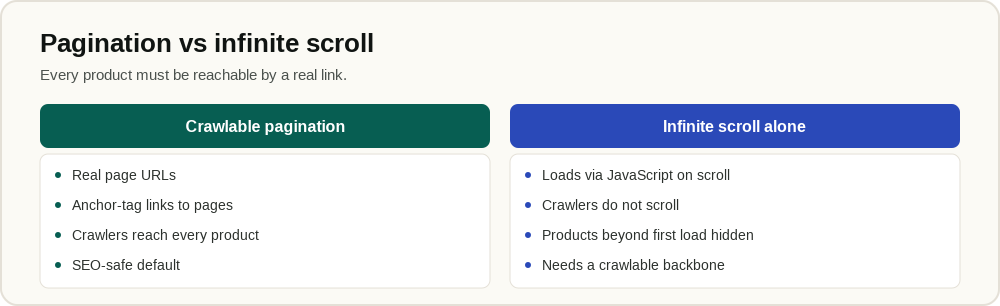
Strip away the detail and there is one rule: every product should be reachable by a crawlable link. Search engines discover products by following links. If products beyond the first page of a category are only accessible in ways a crawler cannot follow, they may never be discovered, no matter how good they are. Pagination and infinite scroll are good or bad for SEO precisely to the extent that they keep products reachable by real links.
Traditional pagination
Traditional pagination splits a listing into numbered pages, each with its own URL, connected by links: page 1, page 2, and so on. Done properly, this is the SEO-safe default, because each page is a real URL with real links, and crawlers can walk through the whole set to discover every product.
The keys to doing it well: each paginated page should have a genuine, crawlable URL and real anchor-tag links to the other pages, not buttons that only work via JavaScript. The pages should be indexable enough that crawlers follow them to reach products, while you avoid treating deep paginated pages as valuable ranking targets in themselves. The job of pagination is discovery and reachability, which it does reliably when the links are real.
Infinite scroll
Infinite scroll loads more products as the user scrolls, with no page breaks. It can feel smooth for browsing, but it carries a real SEO risk: the additional products are typically loaded by JavaScript in response to scrolling, an action a crawler does not perform. If that is all there is, everything beyond the initial load may be invisible to search engines, burying most of the category.
Infinite scroll is not automatically fatal, but it is only safe when there is a crawlable structure underneath it. The standard solution is to pair infinite scroll for users with real, crawlable paginated URLs for crawlers, so the slick experience sits on top of a discoverable foundation. If you cannot or will not provide that underlying structure, infinite scroll will cost you discovery of the hidden products.
Practical guidance
For most ecommerce sites, the pragmatic path is clear. Use real, crawlable pagination as the backbone of category discovery, with genuine URLs and anchor links. If you want infinite scroll or a load-more button for the user experience, layer it on top of that crawlable pagination rather than replacing it. Then verify: check that a crawler, or a view with JavaScript disabled, can actually reach products on later pages. The test is always whether every product is reachable by a real link, and if the answer is no, discovery is at risk no matter how good the interface feels.
FAQ
Frequently asked questions
Not automatically, but it is risky on its own. Infinite scroll loads more products via JavaScript when the user scrolls, which crawlers do not do, so products beyond the initial load can be invisible to search engines. It is only safe when paired with a crawlable paginated structure underneath that crawlers can follow.
Traditional pagination with real, crawlable URLs and genuine anchor-tag links to other pages is the safe default. It lets crawlers walk through the whole listing and discover every product. Slick interfaces like infinite scroll can be layered on top, but a crawlable paginated backbone should exist.
They can, if the additional products load only via JavaScript with no crawlable alternative, the same risk as infinite scroll. The fix is the same too: ensure a crawlable paginated structure exists underneath so search engines can reach everything the button would reveal to a user.
Verify that a crawler, or your page viewed with JavaScript disabled, can actually reach products on later pages through real links. If later-page products are only accessible via JavaScript-driven scrolling or clicking with no crawlable URLs, discovery is at risk regardless of how smooth the interface feels.
Not really; their job is discovery and reachability, letting crawlers find every product, rather than being valuable ranking targets themselves. Make sure paginated pages are crawlable so products are discovered, but focus your ranking efforts on the category and product pages, not on page 7 of a listing.
Similar posts
SEO
Ecommerce SEO: The Complete Guide to Growing Organic Revenue
Learn how to grow ecommerce organic revenue with category SEO, product pages, technical SEO, structured data, internal linking, content strategy and measurement.
24 min read
SEO
Ecommerce Category Page SEO: How to Build Pages That Rank and Help Shoppers Choose
Learn how to optimise ecommerce category pages with better architecture, helpful copy, internal links, filters, and measurement.
15 min read
Technical SEO
JavaScript SEO for Ecommerce
Search engines render JavaScript, but imperfectly and with delay, so JS-only content and links are a risk. The pragmatic rule: put what matters for SEO in the HTML crawlers first receive.
5 min read
Related services