Technical SEO
JavaScript SEO for Ecommerce


Modern ecommerce storefronts lean heavily on JavaScript: product data loaded after the page, filters and variants rendered client-side, content that appears only once scripts run. This makes for rich experiences and creates a specific SEO risk: if search engines cannot reliably see your JavaScript-rendered content, it may as well not exist for ranking and discovery. The topic is surrounded by outdated advice and overconfidence in both directions, that search engines handle everything fine, or that JavaScript is fatal for SEO. The truth is in between and is manageable once you understand how rendering actually works. This piece explains the real risk and the pragmatic way to avoid it.
Quick answer
JavaScript SEO is about making sure content rendered by JavaScript, common in modern ecommerce storefronts, is actually visible to search engines. Search engines can render JavaScript, but it is slower, costlier and less reliable than reading HTML, so critical content and links that appear only after client-side rendering can be missed or delayed. The safe approach is to serve important content and links in the initial HTML through server-side rendering or prerendering, and to test what search engines actually see rather than assuming.
Key takeaways
- JavaScript SEO is about ensuring JavaScript-rendered content and links are reliably visible to search engines.
- Search engines can render JavaScript, but it is a deferred, costly, sometimes incomplete step compared with reading HTML.
- Critical content, product descriptions, titles, prices, category text, should be in the initial HTML, not dependent on client-side rendering.
- Navigation and important links should be real crawlable links in the markup, not purely JavaScript-generated.
- Serve important content via server-side rendering or prerendering/static generation; let JavaScript enhance on top.
- Test what search engines actually see with rendering and inspection tools rather than assuming JavaScript is handled fine.
How search engines handle JavaScript
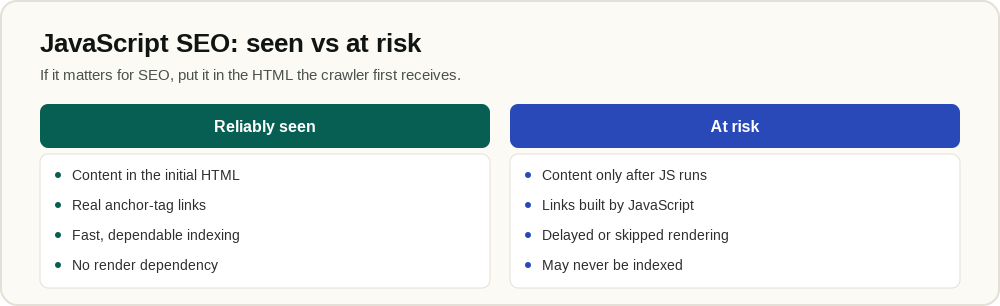
Major search engines can execute JavaScript and render pages much as a browser does, so JavaScript content is not invisible to them in principle. But rendering is a second, deferred, resource-intensive step compared with reading HTML directly. The engine first reads your HTML, then queues the page for rendering later, then sees the JavaScript-generated content.
This has consequences. Rendering can be delayed, so JavaScript content is discovered more slowly. It can be incomplete or fail if scripts error, time out, or depend on interactions. And it costs the engine resources, which on a large site interacts with crawl budget. So while JavaScript content can be seen, relying entirely on client-side rendering for critical content is a gamble with worse odds than serving it in HTML.
What this means for ecommerce
The risk concentrates on the things that matter most for ecommerce SEO.
Critical content
If product descriptions, titles, prices, key attributes, or category content load only via client-side JavaScript, they may be seen late or unreliably. Content that is essential for ranking should be in the initial HTML, not dependent on a rendering step that might lag or fail.
Links and discovery
If your internal links, pagination, or navigation are generated purely by JavaScript and not present as real links in the HTML, search engines may struggle to discover and follow them. This can leave products undiscovered. Navigation and important links should be real, crawlable links in the markup.
The pragmatic solution
The reliable approach is to serve important content and links in the initial HTML, so search engines get them without depending on rendering. The main techniques are server-side rendering (the server sends fully-rendered HTML) and prerendering or static generation (pages are rendered to HTML ahead of time). Modern ecommerce frameworks support these, and for SEO-critical pages they are strongly preferable to pure client-side rendering.
You do not have to abandon JavaScript or rich interactivity. The goal is that the content and links search engines need are present in the HTML, while JavaScript enhances the experience on top. This is progressive enhancement applied to SEO: the baseline works without relying on client-side rendering, and scripts add richness.
Test what search engines actually see
The cardinal rule is to verify rather than assume. Use tools that show you the rendered HTML as a search engine sees it, and check that your critical content and links are present. Use search engines' own inspection tools to see how they render specific pages. View a page with JavaScript disabled to see the baseline. Do not trust that "search engines handle JavaScript fine" in general; confirm that they handle yours. Many JavaScript SEO problems are invisible until you look at what the engine actually receives.
FAQ
Frequently asked questions
Yes, major search engines can execute JavaScript and render pages, so the content is not invisible in principle. But rendering is a deferred, resource-intensive second step that can be delayed, incomplete or fail. Relying entirely on client-side rendering for critical content is riskier than serving it in HTML.
No, but relying on it for critical content and links is risky. JavaScript is fine for enhancing the experience. The problem arises when essential content, product details, or discovery links exist only after client-side rendering, where they may be seen late or unreliably. The fix is to serve those in the initial HTML.
Server-side rendering sends fully-rendered HTML from the server, so search engines get the content immediately. Client-side rendering sends minimal HTML and builds the content with JavaScript in the browser, so engines must render it in a deferred step. For SEO-critical pages, server-side rendering or prerendering is more reliable.
Test what search engines actually see: use rendering and inspection tools to view the rendered HTML, check that critical content and links are present, and view pages with JavaScript disabled to see the baseline. Many JavaScript SEO problems are invisible until you examine what the engine actually receives.
No. The goal is progressive enhancement: ensure the content and links search engines need are in the HTML, then let JavaScript add richness and interactivity on top. You keep the modern experience while guaranteeing the SEO-critical baseline does not depend on a rendering step that might lag or fail.
Similar posts

SEO
Ecommerce SEO: The Complete Guide to Growing Organic Revenue
Learn how to grow ecommerce organic revenue with category SEO, product pages, technical SEO, structured data, internal linking, content strategy and measurement.
24 min read

Performance Marketing
Core Web Vitals for Ecommerce
Core Web Vitals measure loading, responsiveness and stability on real users. What LCP, INP and CLS mean for ecommerce, why they matter for revenue, and where to focus to improve them.
5 min read

Technical SEO
Is Infinite Scroll Bad for SEO? Pagination vs Infinite Scroll
Pagination and infinite scroll decide whether crawlers reach products beyond the first screen. Why crawlable paginated links are the safe default, and how to back infinite scroll safely.
5 min read
Related services