Performance Marketing
The Modern Ecommerce Marketing Funnel

The marketing funnel is one of the most useful and most abused ideas in the field. Useful, because it names the distinct jobs marketing must do to turn strangers into customers. Abused, because people treat it as a literal description of how customers behave, as if everyone enters at the top and marches down in order. Customers never quite behaved that way, and in 2026 they behave that way less than ever. This piece sets out what the funnel still gets right, where the modern customer journey diverges from it, and how to think about the funnel so it helps rather than misleads.
Quick answer
The classic linear funnel, awareness to consideration to purchase, still describes the jobs marketing must do, but customers no longer move through it in order. They discover brands in AI answers and social feeds, research in bursts across devices, and buy when ready rather than when a funnel diagram says they should. The modern funnel is better understood as a set of jobs to serve at any moment, with measurement and retention woven through, rather than a tidy one-way path.
Key takeaways
- The funnel's stages still name real, distinct jobs: awareness, consideration, conversion, retention; a brand weak at any one has a problem.
- The stages are a map of jobs, not of behaviour; customers do not move through them in order.
- Discovery has fragmented into AI answers, social and messaging, much of it invisible and none of it a clean funnel entry.
- Research is non-linear and cross-device, and customers buy on their own timeline, not on your nurture schedule.
- Treat the funnel as jobs to serve at all times for whoever shows up, rather than stages to push people through.
- Run measurement and retention through the whole funnel as constant disciplines, not as a final step.
What the funnel still gets right
The funnel's enduring value is that it separates jobs. Someone who has never heard of you needs something different from someone comparing you against a rival, who needs something different again from someone with a full basket hesitating at checkout. Awareness, consideration, conversion and retention are real and distinct jobs, and a brand that neglects any of them has a weakness.
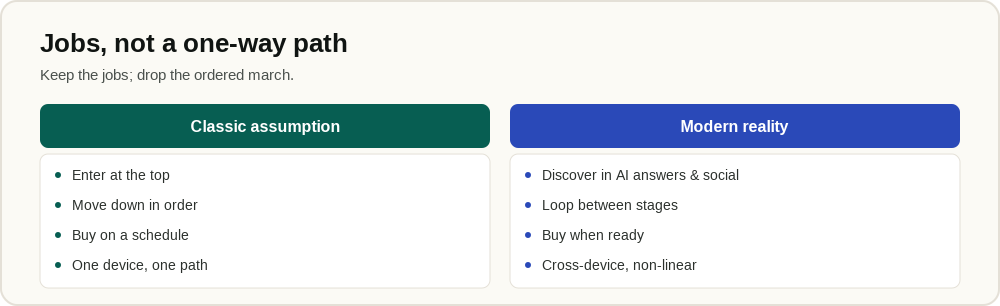
So the stages are not wrong as a map of jobs. They are wrong only when taken as a map of behaviour. Keep the jobs, drop the assumption that customers do them in your preferred order.
Where the modern journey diverges
Discovery has fragmented
People now discover products in places that produce no clean funnel entry: an AI assistant answering a question, a creator's video, a friend's message, a marketplace search. Much of this is invisible to your analytics, and none of it respects a staged entry point. The top of the funnel is wider and blurrier than it used to be, and a lot of it you cannot see.
Research is non-linear and cross-device
A single purchase decision now sprawls across sessions and devices: a phone at lunch, a laptop in the evening, back to the phone days later. Customers loop between consideration and awareness, leave and return, and compress or stretch the journey unpredictably. The neat left-to-right progression is a convenient fiction.
Buying happens when the customer is ready
Customers increasingly buy on their own timeline, not when a nurture sequence decides they are ready. Someone can go from never having heard of you to buying in a single sitting, or sit on an abandoned basket for a month and then convert. Your job is to be ready whenever they are, not to march them along a schedule.
How to think about it instead
The practical reframing is to treat the funnel as a set of jobs you must serve at all times, for whoever shows up in whatever state. Rather than asking which stage a customer is in and pushing them to the next, ask whether you are doing each job well: Are you discoverable to people who do not know you, including inside AI answers? Do you make comparison and consideration easy? Is your path to purchase frictionless whenever someone is ready? Do you bring buyers back?
This is less tidy than a diagram with arrows, but it matches how people actually behave and it stops you from forcing customers through steps they have no interest in following.
Weave measurement and retention through everything
Two things the classic diagram tucks away deserve to run through the whole modern funnel. Measurement, because a fragmented, cross-device, partly invisible journey cannot be managed on last-click alone; you need blended metrics and full-funnel thinking to see what is working. And retention, because in a world where acquisition is expensive and discovery is unpredictable, the customers you already have are your most reliable source of growth. Neither is a stage at the end. Both are constant disciplines.
FAQ
Frequently asked questions
Yes, as a description of the distinct jobs marketing must do, but not as a literal map of how customers behave. Customers discover, research and buy in non-linear, cross-device ways, so use the funnel to check you are doing each job well, not to force people through ordered stages.
AI assistants now answer product and category questions directly, so a growing share of discovery happens inside AI answers with no click and no clean funnel entry. This makes the top of the funnel wider, blurrier and harder to measure, and makes being citable by AI engines part of awareness.
It means a single decision spreads across sessions, devices and channels, looping between stages rather than progressing neatly. You should aim to serve each job, discoverability, easy consideration, frictionless purchase, retention, at any moment, rather than assuming customers are at a known stage.
Not necessarily, but use them to represent jobs and measure each with suitable metrics, backed by blended and full-funnel measurement. Avoid reporting that assumes clean linear progression, because it will mislead you about where customers actually are.
Running through all of it. Because acquisition is costly and discovery unpredictable, existing customers are the most reliable growth source, so retention is a constant discipline rather than a stage tacked on after purchase.
Similar posts
Measurement
Full-Funnel Measurement for Ecommerce
Bottom-heavy measurement starves the funnel. The job and metrics for each stage, from awareness to retention, and how to read them together instead of judging all on last-click.
5 min read
Performance Marketing
Performance Marketing for Ecommerce: What Actually Drives Profitable Growth
A profit-first guide to ecommerce performance marketing: how to connect paid media, SEO, conversion optimisation and measurement into one system that grows revenue without sacrificing margin.
11 min read
Ecommerce Growth
Ecommerce Retention Marketing: How to Turn First-Time Buyers into Repeat Customers
Learn how ecommerce retention marketing works, which customer journeys to build, and how to measure repeat purchases, retention, and customer value.
14 min read
Related services