Measurement
Full-Funnel Measurement for Ecommerce

Most ecommerce measurement is bottom-heavy. The reports everyone looks at are about conversions and ROAS, which are bottom-of-funnel outcomes. That focus quietly punishes everything that happens earlier, because awareness and consideration activity rarely gets last-click credit, so it looks unproductive and gets cut. Cut it for long enough and the bottom of the funnel runs dry, because nobody new is entering the top. Full-funnel measurement is the correction. It assigns each stage of the journey its own job and its own metrics, so you can see whether the whole system is healthy rather than just whether the last step converted. This piece lays out what to measure at each stage and how to read them together.
Quick answer
Full-funnel measurement means tracking performance across the whole journey, from awareness and consideration through to purchase and repeat, rather than judging everything on last-click sales. Each stage needs metrics suited to its job: reach and new-visitor quality at the top, engagement and add-to-cart in the middle, conversion and margin at the bottom, and retention after. The goal is to see how stages feed each other so you stop starving the top to flatter the bottom.
Key takeaways
- Bottom-heavy measurement punishes awareness and consideration, which starves the funnel over time.
- Give each stage its own job and metrics: reach and new-visitor quality up top, engagement and add-to-cart in the middle, conversion and margin at the bottom, retention after.
- Do not judge top-of-funnel activity on immediate ROAS; watch branded search and new-visitor growth instead.
- Retention metrics are where ecommerce profit compounds and are invisible if measurement stops at the first order.
- Read stages together: when a bottom number moves, look up the funnel before reacting.
- Use blended metrics and incrementality tests to confirm the top is contributing, rather than demanding last-click proof it cannot give.
The stages and their jobs
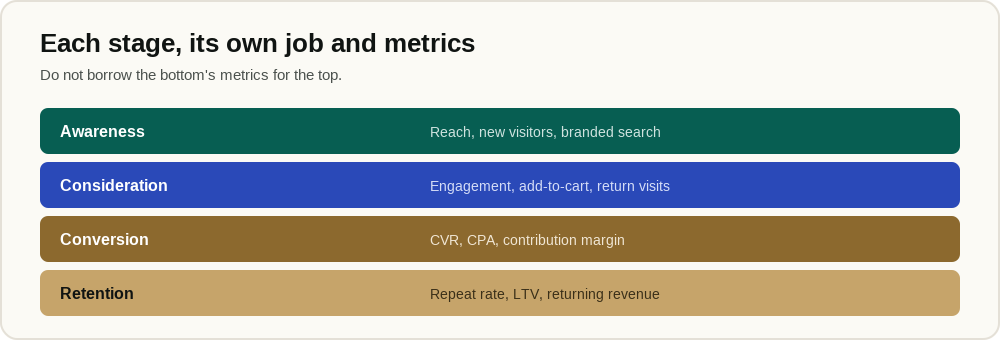
A useful ecommerce funnel has four broad stages, each with a different purpose. Awareness introduces you to people who do not know you. Consideration turns interest into intent. Conversion turns intent into a first order. Retention turns a first order into a lasting customer. Measuring the funnel means giving each stage metrics that reflect its actual job, not borrowing the bottom's metrics for the top.
Top of funnel: awareness
At the top, the job is to reach the right new people and earn attention. Judge it on reach and impressions among your target audience, new-visitor volume and quality, and branded search growth over time. Do not judge it on immediate ROAS, because its payoff shows up later and elsewhere. A rising tide of branded search and new visitors is the signal that awareness is working.
Middle of funnel: consideration
In the middle, the job is to move interested people towards buying. Metrics here are engagement with product and content, email signups, add-to-cart and begin-checkout rates, and return-visit behaviour. This is where you see whether attention is turning into intent. A healthy middle shows people coming back and progressing, not just arriving and leaving.
Bottom of funnel: conversion
At the bottom, the job is to convert intent efficiently and profitably. Here the familiar metrics belong: conversion rate, cost per acquisition, ROAS, and crucially contribution margin. This is also where demand-harvesting channels like branded search and retargeting do their work, which is exactly why they should not get credit for demand the top of the funnel created.
After purchase: retention
Beyond the first order, the job is to keep customers and grow their value. Measure repeat purchase rate, customer lifetime value, and the share of revenue from returning customers. Retention is where ecommerce profit actually compounds, and it is invisible if your measurement stops at the first sale.
Reading the stages together
The point of full-funnel measurement is the relationships between stages, not the stages in isolation. If conversions are falling, the cause might be at the bottom, a worse offer or a broken checkout, or it might be at the top, fewer new people entering months ago. You can only tell if you measure both.
A simple discipline helps: when a bottom-of-funnel number moves, look up the funnel before you react. Scaling conversion spend to fix a shortage that is really an awareness problem just bids up the cost of the demand you already have.
Do not demand last-click proof from the top
The hardest part of full-funnel measurement is cultural. Top-of-funnel activity will never show strong last-click returns, because that is not its job. If you demand last-click proof from awareness, you will always conclude it does not work and cut it. Judge each stage by the job you gave it, and use blended metrics and the occasional incrementality test to confirm the top is genuinely contributing.
FAQ
Frequently asked questions
It is measuring marketing performance across the entire customer journey, from awareness to retention, with metrics suited to each stage, rather than judging all activity on last-click conversions. It reveals how stages feed each other so you can keep the whole system healthy.
Because those are bottom-of-funnel outcomes. Judging everything by them under-credits awareness and consideration, which do not get last-click credit, leading teams to cut the activity that fills the top of the funnel and ultimately feeds those conversions.
Reach and impressions among your target audience, new-visitor volume and quality, and branded search growth over time. These reflect the awareness job. Immediate ROAS is the wrong yardstick for this stage.
Look up the funnel. Check whether new-visitor and awareness metrics fell in prior weeks or whether something at the bottom changed, such as the offer, price, or checkout. Measuring both stages is what lets you tell the difference.
After the first purchase. Retention metrics such as repeat purchase rate, lifetime value and returning-customer revenue share are where ecommerce profit compounds. Full-funnel measurement includes them rather than stopping at acquisition.
Similar posts
Measurement
Attribution Models in 2026: What Still Works
Attribution is less precise than dashboards suggest. What the common models still tell you, where they now mislead, and how to layer platform data, blended metrics and lift tests.
5 min read
Measurement
Ecommerce Marketing Attribution: How to Understand Which Channels Drive Growth
Learn how to interpret ecommerce attribution across Google Ads, Meta Ads and GA4 without confusing attributed revenue with incremental growth.
10 min read
Performance Marketing
The Modern Ecommerce Marketing Funnel
The classic funnel still names the jobs marketing must do, but customers no longer move through it in order. How to treat the funnel as jobs to serve at any moment, not a one-way path.
5 min read
Related services