Ecommerce Growth
Ecommerce Retention Marketing: How to Turn First-Time Buyers into Repeat Customers

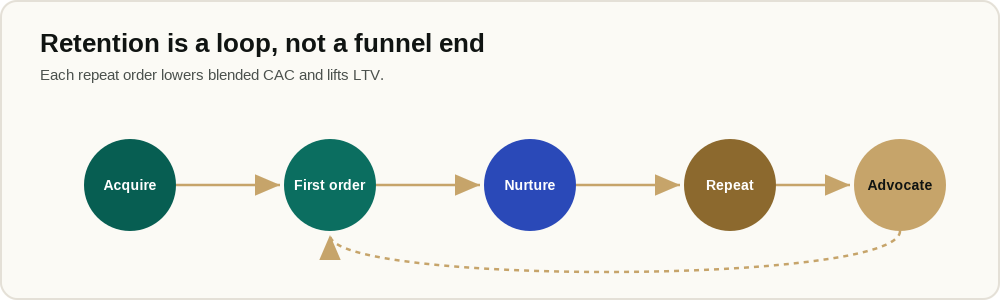
Acquiring a customer is only one part of ecommerce growth. The next question is whether that customer has a useful reason to return. Retention marketing is the work of helping existing customers discover relevant products, get value from their purchase, and buy again when the timing and need make sense. It can include post-purchase education, replenishment reminders, product recommendations, email and SMS journeys, loyalty programmes, customer service, and carefully timed win-back campaigns. It is not simply sending more promotional messages. Poorly timed discounts can train customers to wait for sales, while excessive messaging can increase unsubscribes and weaken trust. Effective retention starts with understanding what customers bought, what they may need next, and what experience will make a second purchase worthwhile. My growth framework is Diagnose → Acquire → Convert → Scale → Compound. Retention is one of the ways growth can compound: a brand learns from each order, improves the customer experience, and creates more opportunities for repeat business without assuming that every customer will behave the same way.
Quick answer
It is the set of customer experiences and communications designed to help existing customers get value from a brand and return when there is a relevant need. It can include post-purchase education, lifecycle messaging, recommendations, loyalty experiences, and customer service.
Key takeaways
- Ecommerce retention marketing is the set of experiences and communications designed to encourage appropriate repeat engagement and purchases after the first order.
- Start with a baseline.
- A simple repeat purchase rate for a defined period is:
- Measure the elapsed time between a customer's first and second completed orders.
What ecommerce retention marketing means
Ecommerce retention marketing is the set of experiences and communications designed to encourage appropriate repeat engagement and purchases after the first order. It should help customers get more value from the brand, not just generate another transaction.
Retention is especially relevant when a product naturally supports repeat buying, replenishment, complementary purchases, seasonal refreshes, or an ongoing relationship. It still matters for lower-frequency categories, but the journey must reflect the product's actual replacement cycle. A customer who buys a mattress should not receive the same cadence as a customer who regularly replenishes skincare or household essentials.
A useful retention system connects five areas:
Retention does not replace acquisition. It helps a business understand how customers behave after acquisition and whether the overall model can support sustainable growth.
- Product experience: Does the item meet expectations, and does the customer understand how to use or care for it?
- Customer service: Are delivery issues, returns, questions, and product problems handled clearly?
- Lifecycle communication: Does each message match the customer's stage and likely needs?
- Merchandising: Are recommendations relevant to the original purchase and customer preferences?
- Measurement: Can the business distinguish repeat revenue from profitable, incremental improvement?
Measure retention before launching campaigns
Start with a baseline. If the business does not know its current repeat-purchase behaviour, it cannot reliably assess whether a new flow or offer improved it.
1. Repeat purchase rate
A simple repeat purchase rate for a defined period is:
Repeat purchase rate = Customers with at least two purchases in the period ÷ Customers who purchased in the period × 100
The definition and reporting window must remain consistent. A repeat purchase rate calculated using all customers acquired historically is not directly comparable with one calculated only among customers who purchased this month.
2. Time to second purchase
Measure the elapsed time between a customer's first and second completed orders. Review the distribution rather than relying only on an average: a small number of long gaps can distort the mean.
Use this insight to inform follow-up timing. Do not set reminders solely because a particular number of days has passed; product type, usage, seasonality, and purchase history all matter.
3. Repeat revenue and contribution
Track revenue from returning customers, but do not treat revenue alone as proof of profitable retention. Consider discounts, refunds, fulfilment, payment fees, shipping subsidies, and product costs where those data are available.
A returning customer buying a heavily discounted item may contribute less profit than a new customer buying at full price. The goal is not repeat orders at any cost; it is valuable customer relationships.
4. Cohort retention
Group customers by a shared starting point, such as first-purchase month, acquisition channel, product category, or first-order value. Then compare how those groups return over time.
For example, a cohort table might show the percentage of customers from each first-purchase month who make another purchase within 30, 60, or 90 days. These windows are examples, not universal standards. Select windows that make sense for the category's natural buying cycle.
5. Customer lifetime value
Customer lifetime value (LTV or CLV) estimates the value a customer generates over a defined relationship period. State whether the calculation uses revenue, gross profit, or contribution margin. Those measures answer different questions.
Avoid using a broad lifetime-value estimate to justify unlimited acquisition spending. Estimates depend on assumptions about repeat behaviour, margin, retention period, and future purchases. Use observed cohort data and update assumptions as new orders arrive.
Segment customers by behaviour and need
A single newsletter sent to every customer is easy to operate, but often ignores meaningful differences in purchase intent and timing.
Build useful segments from data the business can access and lawfully use. Start simple:
Avoid labelling customers “at risk” based on an arbitrary universal number of days. A long gap may be normal for furniture and unusual for a frequently replenished item. Let category behaviour and actual cohort data inform the rule.
Use the smallest number of segments that meaningfully changes the message or action. A complicated segmentation model is not useful if the team cannot maintain it or if the data are unreliable.
| Segment | Possible signal | Useful experience |
|---|---|---|
| First-time buyer | One completed order | Product education, support, and relevant next steps |
| Repeat customer | Two or more completed orders | Recognition, relevant discovery, and early access where appropriate |
| Category-specific buyer | Purchased from a defined category | Complementary products or category guidance |
| Replenishment candidate | Product is plausibly consumed or replaced over time | A timely reminder based on product use and customer history |
| High-value customer | Strong contribution or repeat behaviour under a documented rule | Better service and relevant benefits, not just more discounts |
| At-risk customer | No purchase within a category-informed window | Useful re-engagement or a preference check |
| Recently dissatisfied customer | Open complaint, return, or negative service outcome | Service recovery before promotional selling |
Build the core retention journeys
Lifecycle journeys are automated or scheduled communications triggered by a customer event, product context, or a defined period of inactivity. The following are starting points; test the timing and content against your own category and customer behaviour.
1. Post-purchase reassurance and education
The first messages after purchase should reduce uncertainty and help the customer get value from the order.
Possible content:
Do not confuse a transactional confirmation with promotional consent. Follow applicable laws, platform policies, and the customer's communication preferences.
- Order and delivery information, handled through the appropriate transactional channel.
- Product setup, usage, sizing, care, or maintenance guidance.
- Answers to common questions.
- A clear path to support, returns, or exchanges.
- Relevant recommendations only when they add genuine value.
2. Product education and care
For products that benefit from guidance, share useful instructions after delivery. For example, bedding may benefit from washing and care guidance; furniture may need assembly or maintenance instructions; apparel may benefit from sizing, styling, or garment-care content.
Useful education can reduce avoidable confusion and create a better brand experience. Do not claim that an educational flow reduces returns unless your own measurement supports that conclusion.
3. Complementary product discovery
Recommend products that naturally relate to the first purchase. Relevance matters more than the number of products shown.
Use the original order, browsing signals, product compatibility, inventory, and customer preferences where available. Suppress recommendations for items already purchased and avoid suggesting incompatible products.
4. Replenishment reminders
For genuinely consumable or regularly replaced products, estimate a sensible reminder window from usage patterns or observed reorder data. Give customers an easy way to skip, adjust preferences, or manage subscriptions if offered.
Do not send replenishment reminders for durable products without a clear reason. The goal is to be helpful, not to manufacture urgency.
5. Review and feedback request
Invite customers to share honest feedback after they have had a reasonable opportunity to experience the product. Make the request simple and accessible.
Do not condition incentives on positive reviews or selectively request reviews only from customers expected to be happy. Follow the policies of the review platform and applicable consumer-protection rules.
6. Win-back journey
A win-back journey addresses customers who have not returned within a relevant period. Start with a useful reason to re-engage: a new collection, helpful product information, a category update, or a reminder of relevant benefits.
A discount can be tested when commercially sensible, but it should not be the automatic first response. Consider a no-discount message, a preference update, or a service check before offering a price reduction.
7. Loyalty and VIP experience
A loyalty programme may recognise repeat purchases, engagement, referrals, or other actions that align with the business model. Keep the value exchange clear and the rules easy to understand.
VIP treatment does not have to mean a points scheme. It can include better service, early access, useful content, or appropriate recognition. Model the cost of benefits and monitor whether the programme changes customer behaviour rather than simply rewarding purchases that would have happened anyway.
Choose channels without over-messaging
Retention can involve email, SMS, messaging apps, onsite personalisation, loyalty experiences, customer service, and paid media. Use each channel for a clear purpose and respect consent and channel rules.
Email is useful for richer product education, editorial content, recommendations, and lifecycle campaigns.
SMS or messaging can be effective for concise, time-sensitive communication where customers have validly opted in. It is intrusive when used too frequently or without clear permission.
Onsite personalisation can help returning visitors find relevant products, recently viewed items, or category content. Make sure personalisation does not create confusing or inaccurate experiences.
Paid media can support customer re-engagement, but audience eligibility, consent, platform rules, match rates, and measurement limitations must be considered. Exclude recent purchasers from campaigns when the offer or product is not relevant to them.
Customer service is part of retention even when it is not a marketing channel. A fast, fair resolution can matter more to a customer relationship than another promotional email.
Coordinate channels with a simple contact policy. Define which messages take priority, how often promotional communication can be sent, which events suppress campaigns, and how customers can change preferences or unsubscribe.
Make retention commercially useful
A retention programme should be evaluated as a business system, not as a collection of email open rates.
Separate activity metrics from outcomes
Activity metrics include delivery, click-through, and message engagement. These can help diagnose execution, but they are not the final business result.
Outcome metrics may include:
- Repeat purchase rate over a defined window.
- Time to second purchase.
- Returning-customer revenue and contribution.
- Cohort retention.
- Unsubscribe, complaint, and suppression rates.
- Incremental orders or contribution compared with a credible control group, when feasible.
Use holdouts where practical
If every eligible customer receives a new retention flow, a simple before-and-after comparison cannot establish how much of the observed change the flow caused. Customers may have returned anyway because of seasonality, product need, or other marketing.
Where volume and operational setup permit, reserve a suitable holdout group that does not receive the intervention and compare outcomes over the same period. Random assignment is often stronger than comparing unrelated groups. Document the test window, eligibility rules, and primary metric before launch.
Protect margin and customer trust
Evaluate discounts against incremental contribution, not just attributed revenue. Include the cost of the offer and consider whether the campaign merely shifted a purchase forward or discounted an order that would have occurred at full price.
Monitor negative signals as well: rising unsubscribes, complaints, returns, or customer-service contacts may indicate that the journey is mistimed or irrelevant.
Connect retention to the wider growth framework
- Diagnose: Establish the baseline, data quality, product buying cycle, and customer pain points.
- Acquire: Record acquisition source and first-order context consistently.
- Convert: Deliver a clear first-purchase experience and remove avoidable friction.
- Scale: Automate journeys that show useful results and can be maintained.
- Compound: Use cohort learning, feedback, and repeat behaviour to improve future customer experiences.
A practical 30-day implementation plan
Week 1: Diagnose
- Agree on the definition of a repeat customer and the reporting windows.
- Audit order, customer, product, refund, and communication-consent data.
- Review first-to-second-purchase timing by major category where data permit.
- Establish a baseline for repeat purchase rate, returning-customer contribution, and unsubscribes or complaints.
Week 2: Build the first journeys
- Prioritise post-purchase education and a relevant second-purchase journey.
- Draft messages that solve a real customer need.
- Define eligibility, suppression, frequency, and consent rules.
- Confirm that product recommendations, links, tracking, and unsubscribe controls work.
Week 3: Launch carefully
- Test journeys internally and check edge cases.
- Launch to an appropriate audience rather than activating every segment at once.
- Monitor delivery, errors, customer responses, and negative signals.
- Record the launch date and any simultaneous promotions that could affect results.
Week 4: Measure and improve
Thirty days is enough to establish a measurement foundation and launch initial journeys; it may not be enough to observe a full repeat-purchase cycle. Keep evaluating cohorts as more data accumulate.
- Compare outcomes with the baseline, accounting for the limited observation period.
- Use a holdout when feasible to estimate incremental impact.
- Review performance by cohort and product category instead of relying only on an overall average.
- Decide what to retain, revise, pause, or test next.
Common retention mistakes
- 01Treating every customer the same. Product needs and reorder cycles differ.
- 02Discounting too early. Offers can reduce margin or teach customers to wait for a sale.
- 03Ignoring service problems. Promotional messages are poorly timed when a customer is still waiting for a resolution.
- 04Over-messaging. Too many contacts can create fatigue and damage trust.
- 05Using revenue as a proxy for profit. Measure costs and contribution where possible.
- 06Assuming attributed orders are incremental. Use holdouts or other credible testing where feasible.
- 07Over-segmenting. Complex rules can be difficult to maintain and explain.
- 08Ignoring consent and privacy. Collect and use customer data transparently, with appropriate permissions and controls.
- 09Judging too quickly. A short reporting window may not capture a product's natural repeat cycle.
- 10Automating without quality checks. Incorrect product recommendations, broken links, or mistimed messages can erode trust.
Credible reference points
Use official documentation for implementation details and re-check current guidance before publishing:
Platform features and policies change. Treat these as starting points for verification, not as a substitute for checking the current documentation relevant to your implementation.
---
Editorial note: This draft is intended for review before publication. Confirm any platform-specific claims, the site's live internal URLs, author details, and current privacy/consent requirements. Add original examples only when supported by verified data.
- Google Analytics Help, ecommerce measurement and reporting: https://support.google.com/analytics/
- Google Search Central, structured data and Article guidance: https://developers.google.com/search/docs/appearance/structured-data/article
- Google Search Central, general SEO guidance: https://developers.google.com/search/docs/fundamentals/seo-starter-guide
- Shopify Help Center, customer segmentation and marketing features (where relevant to a store's platform): https://help.shopify.com/
- Meta Business Help Center, customer audience and advertising guidance: https://www.facebook.com/business/help
FAQ
Frequently asked questions
It is the set of customer experiences and communications designed to help existing customers get value from a brand and return when there is a relevant need. It can include post-purchase education, lifecycle messaging, recommendations, loyalty experiences, and customer service.
First define the cohort and time window. One common approach is to measure the share of customers in a starting cohort who make another purchase within a chosen period. State the cohort, qualifying purchase, and window so the result can be interpreted consistently.
There is no single rate that is appropriate for every ecommerce business. It varies with category, price, product lifespan, replenishment cycle, customer mix, and the measurement window. Compare like-for-like cohorts and track changes over time.
Use observed buying patterns and category-specific inactivity windows rather than a universal number of days. The message should be relevant, permitted, and easy to opt out of. Test timing and offers where feasible.
No. Product education, relevant recommendations, better service, early access, replenishment convenience, and loyalty benefits can all support retention. Discounts should be tested against contribution and incremental outcomes.
The best mix depends on customer preferences, product type, consent, and the message. Email supports detailed content; SMS and messaging are better suited to concise communication with appropriate permission; onsite experiences and customer service can also play important roles.
A campaign-attributed order does not automatically mean the campaign caused the order. When practical, use a suitable holdout or randomised test, compare outcomes over the same period, and document eligibility and measurement rules.
Similar posts
Ecommerce Growth
Customer Lifetime Value (LTV) for Ecommerce: How to Measure and Use It
Learn how to calculate ecommerce customer lifetime value, distinguish revenue from contribution, compare LTV with CAC, and use cohorts to guide profitable growth.
11 min read
Ecommerce Growth
Ecommerce Email Marketing Automation: Lifecycle Flows That Support Profitable Growth
Learn how to plan ecommerce email automation, build useful lifecycle flows, measure results, and improve customer experiences without over-messaging.
14 min read
Measurement
Ecommerce Customer Acquisition Cost (CAC): How to Calculate and Improve It
Learn how to calculate ecommerce CAC, distinguish paid and blended acquisition costs, evaluate profitability, and improve customer acquisition with a practical framework.
14 min read
Related services
Related work