Technical SEO
Mobile-First Ecommerce SEO


Mobile-first indexing changed a long-standing assumption. For years the desktop site was the canonical version and mobile was an adaptation. Now search engines primarily crawl, index and rank based on the mobile version. If your mobile pages are missing content, slower, or harder to use than desktop, that weaker version is what search engines judge you on. For ecommerce this is doubly important because most shopping traffic is already mobile. So mobile-first is not just an SEO compliance matter; it is where most of your customers actually are. This piece explains what mobile-first indexing requires and how to make sure your mobile experience is a strength rather than a liability.
Quick answer
Mobile-first means search engines predominantly use the mobile version of your site to index and rank it, so your mobile experience is your SEO, not a scaled-down afterthought. For ecommerce this demands that mobile pages contain the same content and structured data as desktop, that they load fast and respond smoothly on real phones, and that the mobile shopping experience, navigation, search, and checkout, actually works well. Most ecommerce traffic is mobile anyway, so this is a commercial priority as much as a technical one.
Key takeaways
- Mobile-first indexing means search engines primarily use your mobile version to index and rank, so mobile is your SEO, not an afterthought.
- Content, links, images and structured data missing from mobile may not be counted; parity with desktop is the first rule.
- Keep important content on mobile even if presented differently, in accordions or tabs, so it stays in the HTML.
- Performance matters more on mobile because phones face slower networks and weaker hardware; test on real mid-range devices.
- The mobile shopping experience, navigation, search, product pages, checkout, must genuinely work, as most purchases happen there.
- Audit and optimise your mobile site as the primary version, for both search engines and the majority of your customers.
What mobile-first indexing means
Search engines use the mobile version of your pages as the primary basis for indexing and ranking. The practical implication is stark: content, links, images and structured data that exist on your desktop site but not on mobile may not be counted. If your mobile pages are a stripped-down version, you are effectively telling search engines to ignore what you left out.
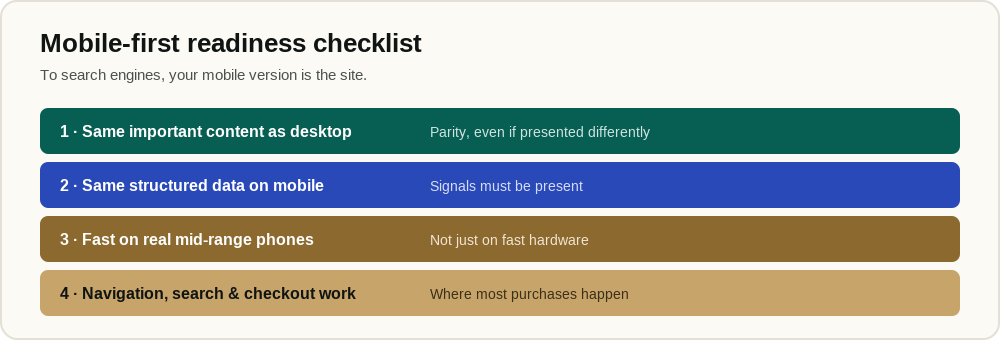
So the first rule of mobile-first SEO is parity: the mobile version must contain the same important content and signals as the desktop version. Not an identical layout, phones and desktops differ, but the same substance. Anything that matters for ranking must be present on mobile.
Performance on real devices
Mobile-first makes performance even more central, because phones are more constrained than desktops: slower networks, less powerful hardware, variable conditions. A page that feels fine on a developer's desktop can be sluggish on a mid-range phone on a patchy connection, which is how many real shoppers browse.
So mobile performance, fast loading, smooth interaction, stable layout, is a core part of mobile-first SEO and of conversion. Optimise images, control scripts, and test on realistic devices and networks rather than only on fast hardware. The Core Web Vitals that matter for ranking are measured on real users, most of whom are on mobile.
The mobile experience must actually work
Beyond content and speed, the mobile shopping experience itself must be genuinely good, because it is where most purchases happen and because usability feeds into the signals search engines care about.
Navigation must work on a small touchscreen: menus that are usable with a thumb, categories that are easy to reach. On-site search must be easy to invoke and use. Product pages must present images, variants and key information clearly on a narrow screen. And checkout, the step where mobile stores most often lose sales, must be smooth: minimal friction, easy input, trusted payment. A mobile experience that frustrates shoppers costs conversions directly and undercuts the engagement signals that support SEO.
Practical approach
Audit your mobile site as the primary version, because to search engines it is. Check content and structured-data parity with desktop, fix anything missing. Test performance on real mid-range devices and realistic networks, not just fast hardware. Walk through the full mobile journey, browse, search, product page, checkout, as a customer would, and fix the friction. Treat the mobile experience as the main event, because for both search engines and your customers, it is.
FAQ
Frequently asked questions
It means search engines predominantly use the mobile version of your pages as the basis for crawling, indexing and ranking, rather than the desktop version. In practice, the content and signals present on your mobile site are what you are judged on, so a weaker mobile version weakens your SEO.
Content that is genuinely absent from the mobile version may not be counted, since mobile is the primary version. Content that is present but visually collapsed, in accordions or tabs, still exists in the HTML and generally counts. The danger is omitting content on mobile to save space, which weakens those signals.
Because mobile is the primary version search engines judge, because Core Web Vitals are measured on real users who are mostly on mobile, and because phones face slower networks and weaker hardware that expose performance problems. Slow mobile pages hurt both rankings and conversions, so performance is central.
No. Most ecommerce traffic and purchases are already mobile, so the mobile experience is where most of your revenue is won or lost. Mobile-first is therefore a commercial priority as much as a technical one; a poor mobile experience costs sales directly, not just rankings.
Ensure content and structured-data parity with desktop, keeping important content on mobile even if collapsed; optimise performance and test on real mid-range devices and networks; and make the mobile journey, navigation, search, product pages and especially checkout, genuinely smooth. Audit the mobile site as the primary version, because to search engines and customers it is.
Similar posts

SEO
Ecommerce SEO: The Complete Guide to Growing Organic Revenue
Learn how to grow ecommerce organic revenue with category SEO, product pages, technical SEO, structured data, internal linking, content strategy and measurement.
24 min read

Performance Marketing
Core Web Vitals for Ecommerce
Core Web Vitals measure loading, responsiveness and stability on real users. What LCP, INP and CLS mean for ecommerce, why they matter for revenue, and where to focus to improve them.
5 min read

Technical SEO
Ecommerce Site Architecture for SEO
Good ecommerce architecture is shallow and logical, so authority and crawlers reach every product. How to structure categories, internal links and URLs, and tame large-catalogue problems.
5 min read
Related services