Technical SEO
Ecommerce Site Architecture for SEO


Site architecture is the least glamorous and most consequential part of ecommerce SEO. It is the structure underneath everything: how your pages relate, how they link, how deep they sit, how authority moves between them. Shoppers experience it as navigation; search engines experience it as a crawlable graph. When it is good, both find what they need easily. When it is bad, products get buried, authority pools in the wrong places, and no amount of content or link building fully compensates. This piece explains how to think about ecommerce architecture for SEO, the principles that make a structure work, and the specific problems large catalogues create. It is foundational because everything else, rankings, discovery, AI visibility, sits on top of it.
Quick answer
Good ecommerce site architecture organises your pages into a shallow, logical hierarchy so that both shoppers and search engines can find any product in a few clicks, and so that authority flows cleanly from your homepage to your category and product pages. The priorities are a flat structure, sensible category grouping, strong internal linking, clean URLs, and resolving the duplication and thin-page problems that large catalogues create. Architecture is foundational: get it wrong and every other SEO effort works harder for less.
Key takeaways
- Site architecture is foundational: a poor structure makes every other SEO effort work harder for less.
- Keep it shallow and logical so important pages are reachable in a few clicks and authority flows to product pages.
- Group products into categories that match real shopping intent, with subcategories only where they genuinely help.
- Use strong internal linking to distribute authority and help crawlers discover everything; avoid orphaned pages.
- Keep URLs clean, readable and stable, reflecting the hierarchy and not changing without redirects.
- Manage the large-catalogue failure modes: duplication (canonicals, URL control), thin pages, and faceted navigation (decide what is indexable).
The core principle: shallow and logical
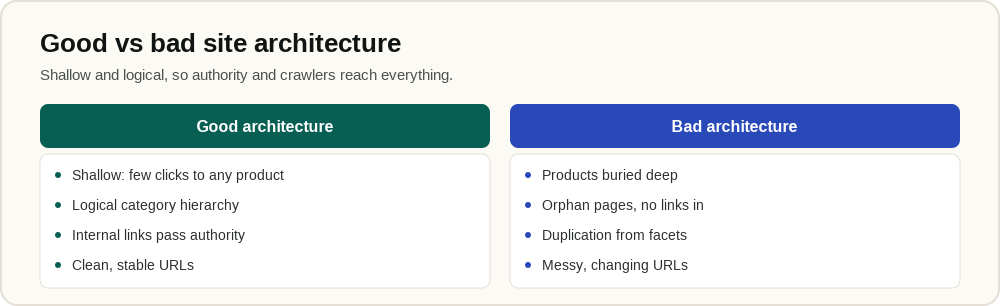
The single most important idea is that important pages should be reachable in few clicks from the homepage. A flat architecture, where any product is three or so clicks deep rather than six or seven, means search engines crawl your catalogue more thoroughly and authority reaches your product pages more strongly. Deep burial is where ecommerce SEO quietly fails: products so many clicks down that crawlers rarely reach them and little authority flows to them.
Logical grouping supports this. Products belong in categories that match how people actually think about them, with subcategories only where they genuinely help. A clean hierarchy, home to category to subcategory to product, that mirrors real shopping intent is both good UX and good SEO, because the two are the same thing here.
Clean, stable URLs
URLs are part of architecture. They should be clean, readable, and stable: reflecting the hierarchy, using words not parameters where possible, and not changing without redirects. A URL that describes the page and sits logically in the structure helps both users and search engines understand where a page fits. Chaotic, parameter-heavy, or frequently changing URLs create confusion and lost authority.
The problems large catalogues create
Ecommerce architecture has failure modes that content sites rarely face, and handling them is most of the technical work.
Duplication
Large catalogues generate duplicate and near-duplicate pages: the same product reachable through multiple category paths, filtered and sorted views, parameter variations. Left unmanaged, this splits authority and wastes crawl budget. Canonical tags, consistent URL handling, and careful control of which variations are indexable keep duplication from undermining the structure.
Thin and near-empty pages
Catalogues produce thin pages: categories with one or two products, empty filter combinations, out-of-stock items. Too many thin pages dilute the site's overall quality in search engines' eyes. Architecture should avoid creating indexable thin pages in the first place, and handle the ones that arise, consolidating, noindexing, or improving them.
Faceted navigation
Filters and facets can generate near-infinite URL combinations, a classic ecommerce crawl problem. The architecture must decide which facet pages deserve to be indexable, because they match real demand, and which should be blocked or noindexed to avoid drowning the site in low-value URLs. This is one of the highest-stakes architectural decisions a large store makes.
How to approach it
Start by mapping your current structure: how deep products sit, how categories are organised, how pages link. Flatten where products are buried, regroup categories to match real intent, strengthen internal linking to important pages, and address duplication and thin pages systematically. Treat architecture as the foundation you fix first, because improvements here multiply the return on all your other SEO work.
FAQ
Frequently asked questions
It is how your pages are organised and linked: the category hierarchy, how deep products sit, the internal linking, and the URL structure. Search engines experience it as a crawlable graph and shoppers as navigation. Good architecture lets both find any product easily and lets authority flow to the pages that matter.
As shallow as is sensible, ideally reachable in around three clicks from the homepage rather than six or seven. Deeply buried products are crawled less thoroughly and receive less authority. A flat structure with logical categories keeps important pages close to the surface.
Internal links distribute authority through the site and help search engines discover pages and understand their relationships. Strong linking to important category and product pages strengthens them; orphaned or weakly linked pages struggle regardless of quality. Internal linking is part of architecture, not an add-on.
Because they generate duplication (the same product via multiple paths, filtered views, parameters), thin pages (near-empty categories, out-of-stock items), and faceted-navigation URL explosions. Unmanaged, these split authority, waste crawl budget and dilute site quality. Handling them is most of the technical architecture work.
Faceted navigation is the filters and facets that let shoppers refine listings. It can generate near-infinite URL combinations, overwhelming crawlers with low-value pages. The architectural decision is which facet pages to make indexable, because they match real demand, and which to block or noindex, which is one of the highest-stakes calls a large store makes.
Similar posts

SEO
Ecommerce SEO: The Complete Guide to Growing Organic Revenue
Learn how to grow ecommerce organic revenue with category SEO, product pages, technical SEO, structured data, internal linking, content strategy and measurement.
24 min read
SEO
Ecommerce Internal Linking Strategy: A Practical Framework for SEO and Product Discovery
Build a stronger ecommerce internal linking strategy with practical guidance for categories, products, buying guides, breadcrumbs, and crawlable site architecture.
10 min read
Technical SEO
Ecommerce SEO for Large Catalogues: Managing Faceted Navigation, Crawl Budget, and Indexation
10 min read
Related services