Performance Marketing
Core Web Vitals for Ecommerce


Core Web Vitals are often discussed as an SEO ranking factor, which undersells them for ecommerce. Yes, they are part of how Google assesses page experience, but their bigger impact is commercial: shoppers abandon slow pages, mis-tap shifting layouts, and lose patience with unresponsive interfaces, and every one of those is lost revenue. For a store, performance is a conversion lever that happens to also help SEO. This piece explains what the three Core Web Vitals measure, why they matter for ecommerce specifically, and how to approach improving them without getting lost in synthetic scores that do not reflect what real users experience.
Quick answer
Core Web Vitals are Google's measures of real-world page experience: loading (Largest Contentful Paint), interactivity (Interaction to Next Paint), and visual stability (Cumulative Layout Shift). For ecommerce they matter twice over, as a modest ranking factor and, more importantly, because slow, janky pages cost conversions directly. Focus on real-user data, fix the biggest offenders first, usually images, scripts and layout shift, and treat speed as a revenue issue, not just an SEO checkbox.
Key takeaways
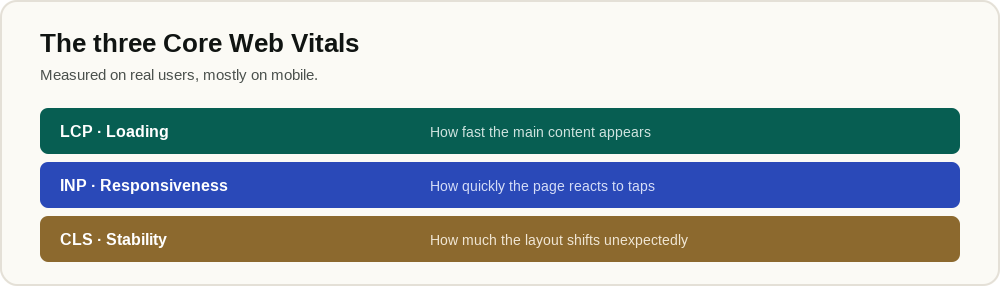
- Core Web Vitals measure real page experience: LCP (loading), INP (responsiveness) and CLS (visual stability).
- They matter for ecommerce twice: a modest ranking factor and, more importantly, a direct conversion lever.
- Treat performance as a revenue issue, not an SEO checkbox; that reframing leads to proper investment and the SEO benefit follows.
- Judge yourself on real-user field data, not only synthetic lab scores; optimising a lab number while real users suffer is pointless.
- The usual culprits: images for LCP, heavy third-party scripts for INP, and unreserved space and injected content for CLS.
- Fix the biggest offender first; ecommerce performance problems are usually concentrated, not spread evenly.
What the three metrics measure
Largest Contentful Paint (LCP): loading
LCP measures how long it takes for the largest visible element, often a hero image or product photo, to load. It is a proxy for "how quickly does the page feel loaded". For ecommerce, the main product image and above-the-fold content dominate LCP, so image handling is usually the biggest lever.
Interaction to Next Paint (INP): responsiveness
INP measures how quickly the page responds to user interactions, taps, clicks, input, across the visit. A page that freezes when you tap "add to cart" or filter a listing has poor INP. For ecommerce, where shoppers interact constantly with filters, variants and carts, responsiveness directly shapes the experience.
Cumulative Layout Shift (CLS): stability
CLS measures unexpected movement of page elements as things load, the maddening jump where a button moves just as you tap it. On ecommerce pages full of images, ads and dynamically loaded content, layout shift is common and costly: a shopper who taps the wrong thing because the layout jumped is a frustrated shopper.
Why they matter for ecommerce
The ranking effect is real but modest; page experience is one factor among many. The conversion effect is larger and more direct. Slow loading loses shoppers before they see your products. Poor responsiveness frustrates them during the interactions that lead to purchase. Layout shift causes mis-taps and erodes trust. These are revenue problems first and SEO problems second, which is actually good news: fixing them pays back in conversions even beyond any ranking benefit.
This reframing matters because it changes how you prioritise. If you treat Core Web Vitals as an SEO checkbox, you do the minimum. If you treat them as a conversion lever, you invest properly, and the SEO benefit comes along for free.
Measure real users, not just lab scores
A crucial discipline: judge your performance on real-user (field) data, not only synthetic lab tests. Lab tools are useful for diagnosis but run in controlled conditions that may not match your actual visitors on real devices and networks. Google's ranking signal and the truest picture both come from field data reflecting what real people experience. Optimising a lab score while real users still suffer is a common and pointless trap.
Where to focus
For most ecommerce sites, a few culprits dominate.
Images are usually the biggest LCP issue: large, unoptimised product photos. Properly sized, compressed, modern-format images with sensible loading behaviour fix much of LCP. Scripts, especially heavy third-party tags, are usually the biggest INP issue: too much JavaScript blocking the main thread when users interact. Auditing and trimming third-party scripts helps responsiveness. And layout shift usually comes from images without reserved space, injected content and ads, and late-loading elements; reserving space and controlling how things load addresses CLS.
Fix the biggest offender first rather than chasing marginal gains everywhere. Most ecommerce performance problems are concentrated, and targeting the dominant cause gives the best return.
FAQ
Frequently asked questions
They are Google's metrics for real-world page experience: Largest Contentful Paint (how quickly the main content loads), Interaction to Next Paint (how quickly the page responds to interactions), and Cumulative Layout Shift (how much the layout unexpectedly moves). Together they approximate how fast and stable a page feels to real users.
Yes, but modestly; page experience is one ranking factor among many and will not outweigh relevance and authority. Their bigger impact for ecommerce is on conversion, since slow, unresponsive or unstable pages lose shoppers directly. That is why they are worth fixing even beyond the ranking benefit.
Because ecommerce pages are image-heavy and interaction-heavy, exactly the conditions that stress loading, responsiveness and stability, and because every lost or frustrated shopper is lost revenue. A slow or janky store leaks sales at every step, so performance is a direct commercial lever, not just an SEO concern.
Both, for different jobs. Lab tools help diagnose problems in controlled conditions, but you should judge actual performance on real-user field data, which reflects what your visitors experience on real devices and networks and aligns with Google's signal. Optimising a lab score while real users still struggle is a common trap.
Most often: large unoptimised images hurting LCP, heavy third-party scripts blocking the main thread and hurting INP, and images or injected content without reserved space causing layout shift and poor CLS. These problems are usually concentrated, so fixing the biggest offender first gives the best return.
Similar posts

SEO
Ecommerce SEO: The Complete Guide to Growing Organic Revenue
Learn how to grow ecommerce organic revenue with category SEO, product pages, technical SEO, structured data, internal linking, content strategy and measurement.
24 min read

Technical SEO
Ecommerce Site Architecture for SEO
Good ecommerce architecture is shallow and logical, so authority and crawlers reach every product. How to structure categories, internal links and URLs, and tame large-catalogue problems.
5 min read

Technical SEO
JavaScript SEO for Ecommerce
Search engines render JavaScript, but imperfectly and with delay, so JS-only content and links are a risk. The pragmatic rule: put what matters for SEO in the HTML crawlers first receive.
5 min read
Related services