Meta Ads
Meta Ads Campaign Structure for Ecommerce in 2026

Learn how to structure Meta Ads campaigns for ecommerce, from objectives and budget allocation to creative testing, retargeting, measurement, and scaling.
Quick answer
There is no universal best structure. Start with the business objective, conversion event, product economics, market requirements, and measurement plan. Use the simplest structure that provides the budget control and reporting the business genuinely needs.
Key takeaways
- A Meta Ads account does not become effective simply because it contains more campaigns, ad sets, and audience segments.
- Meta Ads campaign structure is the way campaigns, ad sets, and ads are organised in Ads Manager.
- Before creating campaigns, define the outcome the business needs.
- Use the campaign level to separate genuinely different objectives or business requirements.
Introduction
A Meta Ads account does not become effective simply because it contains more campaigns, ad sets, and audience segments. For ecommerce, a useful structure makes it clear what each campaign is meant to achieve, how budgets are controlled, which creatives are being tested, and how results are evaluated against business economics.
Too much fragmentation can divide conversion data and budget across overlapping ad sets. Too little separation can make it difficult to manage genuinely different products, markets, objectives, or commercial constraints. The right structure is therefore not a universal template. It is the simplest structure that gives the business enough control to make reliable decisions.
This guide explains how to build a practical Meta Ads campaign structure for an ecommerce brand in 2026. It covers the campaign hierarchy, consolidated and separated setups, prospecting and retargeting, creative testing, budget allocation, tracking, reporting, and troubleshooting. Platform features and naming may change, so confirm current settings in Meta Ads Manager and official Meta documentation before implementation.
Table of contents
- 01What campaign structure means
- 02Start with the business objective
- 03Understand the campaign hierarchy
- 04Consolidated versus fragmented structures
- 05A practical ecommerce structure
- 06When separate campaigns make sense
- 07Prospecting and retargeting
- 08Creative testing within the structure
- 09Budget and measurement
- 10Tracking and attribution
- 11Common structural mistakes
- 12How to audit an existing account
- 13A 30-day implementation plan
- 14FAQs
- 15Recommended visuals and publishing checklist
1. What does Meta Ads campaign structure mean?
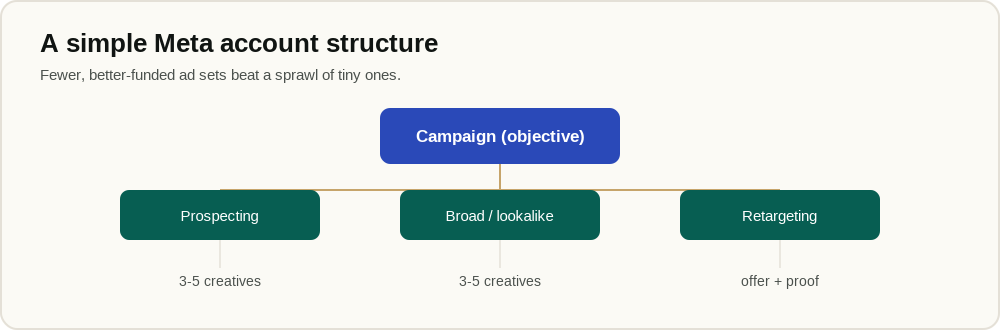
Meta Ads campaign structure is the way campaigns, ad sets, and ads are organised in Ads Manager. The structure influences how budgets are allocated, which settings are controlled at each level, how creative variations are grouped, and how performance is reviewed.
The hierarchy has three main levels:
The exact options available depend on the campaign objective, account setup, and current Meta interface. Do not assume every setting appears in every campaign type.
A strong structure answers five questions:
If the team cannot answer these questions from the account structure and reporting, the setup may be too complicated, too ambiguous, or both.
- Campaign: defines the advertising objective and may include campaign-level budget or other objective-related settings.
- Ad set: contains delivery settings such as audience, placements, schedule, optimisation event, and budget when budget is managed at this level.
- Ad: contains the creative and message delivered to the audience, including formats, copy, media, destination, and call to action.
- 01What business outcome is this campaign designed to support?
- 02Which products, markets, or customer groups does it serve?
- 03Where is the budget controlled?
- 04How are new creative ideas tested?
- 05Which business metrics determine whether the campaign should be maintained, changed, or scaled?
2. Start with the business objective, not the campaign count
Before creating campaigns, define the outcome the business needs. Ecommerce brands may need to acquire new customers, generate purchases for a product range, promote a seasonal collection, recover qualified shopping intent, or test a new market. These needs are not interchangeable.
Translate the business goal into a measurable brief:
The example is illustrative, not a performance benchmark. Replace it with the brand’s actual margin, market, fulfilment conditions, and measurement rules.
Choose a campaign objective that aligns with the intended action. If purchases are the goal and purchase tracking works correctly, do not optimise for a much easier intermediate action merely because it produces a larger number of conversions. An intermediate event may still be useful for a specific diagnostic or lead-generation purpose, but it should not be confused with revenue.
Practical rule: define the business outcome and conversion event first. Then choose the campaign type and structure that can support them.
| Planning question | Example of a useful answer |
|---|---|
| Business goal | Acquire profitable first-time customers |
| Market | Pakistan, with delivery available in selected cities |
| Product scope | Core bedding range |
| Commercial constraint | Contribution margin must remain above the approved floor |
| Primary measurement | New-customer acquisition cost, alongside purchase value |
| Supporting measures | Conversion rate, average order value, cancellation rate |
| Decision rule | Evaluate results after sufficient data and against a pre-agreed business threshold |
3. Understand the campaign hierarchy
Campaign level: purpose and budget strategy
Use the campaign level to separate genuinely different objectives or business requirements. A campaign name should make its purpose understandable without opening every setting.
Depending on the campaign setup, budget can be managed at the campaign level or the ad set level. Campaign-level budget allocation can allow delivery to shift budget among eligible ad sets, while ad set budgets can offer more direct control over the amount assigned to a particular audience or test. The available controls depend on current campaign settings.
Choose based on the decision you need to make. If the business needs flexible allocation across comparable ad sets, campaign-level budgeting may fit. If a controlled experiment requires a defined allocation, an ad set-level budget or a dedicated test setup may be more appropriate, subject to available features.
Ad set level: delivery controls
Ad sets should be separated when a meaningful delivery or business difference needs separate management. Examples include different countries with different economics, distinct conversion events, a material product or catalogue distinction, or a test that requires controlled budget allocation.
Avoid creating an ad set for every small audience variation simply because the interface permits it. Extra ad sets add operational overhead and can fragment delivery and reporting without creating useful insight.
Ad level: creative and message
Ads are where the audience encounters the proposition. Variations may test:
Change one major variable at a time when you need to understand why a result changed. In real-world creative work, several elements may differ together; when they do, treat the result as a broader creative concept test rather than attributing the outcome to one isolated element.
- Product demonstration versus lifestyle storytelling
- Customer problem versus product benefit
- Short-form video versus static imagery
- Creator-style content versus polished brand production
- Different offers, hooks, or calls to action
- Product-specific versus collection-level messaging
4. Consolidated versus fragmented campaign structures
Why consolidation often helps
A consolidated setup groups comparable activity so that budgets and conversion signals are not spread unnecessarily across many small units. It can make the account easier to manage and may give the delivery system more room to allocate spend among eligible ads or ad sets.
Consolidation is often worth considering when:
- The same business objective applies across the products or audiences.
- Markets have similar fulfilment, pricing, and economics.
- Creative can be assessed within one coherent testing plan.
- Separate ad sets do not have a clear operational purpose.
- The account has many low-spend segments that rarely produce enough evidence for decisions.
When separation is justified
Separate campaigns or ad sets can make sense when the distinction changes the business decision, the delivery requirements, or the reporting needed. Examples include:
Do not separate activity only to make a dashboard look organised. Separation should serve a real decision.
- Different countries or regions with materially different pricing, margins, or delivery promises
- Separate brands or product lines with different budgets and goals
- Different conversion events or funnel objectives
- A campaign with a distinct seasonal deadline
- A controlled test that needs a clearly defined budget
- Different catalogue or product eligibility requirements
- Separate teams or business units that require independent budget ownership
The decision test
Before creating a new campaign or ad set, ask:
If there is no clear answer, start simpler and add complexity only when evidence or business requirements justify it.
- 01What decision will this separation make possible?
- 02Is the difference material to delivery, economics, or reporting?
- 03Could the same insight be obtained with ad-level creative variations or reporting breakdowns?
- 04Will the new segment receive enough budget and conversion activity to evaluate it responsibly?
- 05Who will maintain it, and what is the review rule?
5. A practical ecommerce campaign structure
There is no single correct account architecture for every brand. The following is an illustrative starting point for a store whose main objective is online purchases and whose tracking is functioning.
Example A: one main market, one primary purchase objective
Campaign 1: Sales / Core Acquisition
Campaign 2: Sales / Dedicated Retargeting, only if justified
Campaign 3: Sales / Product or Seasonal Priority, when needed
Creative testing process
This is not a required three-campaign formula. A smaller store may need fewer campaigns. A larger store may need more separation because of market, catalogue, brand, or budget requirements.
- Use a suitable current sales campaign setup.
- Include a coherent range of products with similar economics and fulfilment.
- Use a planned mix of proven creative concepts and new creative tests.
- Review new-customer acquisition and total performance separately where reliable data is available.
- Create this only when the brand has a clear reason to control or evaluate retargeting separately.
- Define the eligible audiences and exclusions carefully using current platform options.
- Assess incremental business value rather than assuming all attributed conversions were caused by retargeting.
- Use for a product range, launch, or seasonal offer that genuinely requires a separate budget or schedule.
- Keep it separate only while the commercial distinction remains meaningful.
- Develop creative concepts in a planned queue.
- Introduce a manageable number of variations that the budget can support.
- Document the hypothesis and the outcome.
- Move proven concepts into the appropriate ongoing setup according to the account’s operating process.
Example B: multiple countries with different economics
Where markets differ in currency, shipping costs, return rates, prices, margins, or conversion behaviour, separate campaigns or ad sets may be appropriate so the team can control budgets and assess performance by market. Do not combine markets just to reduce the campaign count if doing so hides important commercial differences.
Conversely, do not split every country into its own campaign automatically. If several markets have similar economics and operational requirements, a consolidated structure may be viable. Decide from the real reporting and controls required.
Example C: large catalogue
For a broad catalogue, organise activity around meaningful commercial groups: for example, distinct product categories, margins, stock status, or promotional priorities. Ensure product sets and catalogue eligibility are accurate. Do not build dozens of campaigns just because the catalogue contains many SKUs.
The structure should reflect how the business manages products, not simply mirror every category in the website navigation.
6. When should you use separate campaigns?
Use separation when it provides a specific advantage. Common cases include:
Different objectives
A purchase campaign and a lead-generation campaign are pursuing different actions and generally need distinct objectives and reporting.
Different economics
If one product group has a much lower margin or different average order value, combining it with a high-margin group can conceal whether each is commercially viable. Consider separation when the difference changes the acceptable acquisition cost or budget decision.
Different markets
Different currencies, shipping commitments, tax treatment, returns, and payment methods can change conversion rate and contribution margin. Separate reporting is essential; campaign separation may be useful when separate controls are needed.
Different time constraints
A limited-time promotion may require a distinct schedule and budget. Make the end date, offer terms, stock constraints, and post-promotion plan explicit.
Genuine experiments
A test should have a hypothesis, a defined comparison, a suitable measurement method, and a decision rule. Avoid running many simultaneous tests that overlap or change multiple variables, then trying to infer which change caused the outcome.
7. Prospecting and retargeting: structure with care
Prospecting generally refers to reaching people who may not yet know the brand or have not demonstrated recent intent. Retargeting generally refers to reaching people who have already interacted with the brand, such as site visitors or product viewers, where the relevant audience and consent requirements allow it.
The distinction is useful for planning, but it does not automatically mean every account needs separate prospecting and retargeting campaigns.
When separate retargeting may help
A dedicated retargeting campaign can be useful when the business needs to:
- Set a distinct budget for a specific audience pool
- Control a message or offer for a clearly defined stage of intent
- Measure the segment with a consistent reporting approach
- Apply a specific exclusion or schedule
- Coordinate activity around a product launch or limited offer
When separate retargeting may not help
A separate campaign may add little value when the eligible audience is small, the spend is limited, the same creative and offer work across the account, or the setup mainly duplicates activity that could be handled in a simpler structure.
Retargeting can also appear unusually efficient because it reaches people already likely to buy. Platform-attributed purchases are not automatically incremental purchases. Where possible, use suitable experiments, holdouts, or broader business analysis to assess incrementality rather than treating attributed ROAS as proof of causal impact.
Audience and exclusion hygiene
Review audience definitions, windows, exclusions, and overlap using the current Meta tools. Keep customer lists and tracking practices consistent with applicable privacy laws, platform terms, consent requirements, and the brand’s own privacy policy. Do not upload or use data without the required rights and permissions.
8. Build creative testing into the structure
Creative quality and variety can be major performance drivers, but the account structure must make learning possible. Testing should be an ongoing process, not a one-time campaign launch task.
Create a creative hypothesis
A useful creative brief states:
For example, a bedding brand could test a product-detail demonstration against a room-styling concept. This is an illustrative test idea, not a claim about which concept will win.
- Audience problem: what need, concern, or desire is being addressed?
- Product truth: what can the product genuinely deliver?
- Message angle: what is the main reason to consider it?
- Format: how will the message be communicated?
- Expected signal: which early and final metrics will help assess the concept?
- Guardrails: which claims, discounts, visuals, or customer data must not be used?
Separate concepts from minor variations
A new opening hook, a new visual concept, and a different offer are not equivalent changes. Keep a creative log that records the concept, launch date, spend, audience context, and outcome. This helps prevent teams from repeatedly producing near-identical ads without learning.
Avoid premature conclusions
A small amount of spend or a handful of purchases may not provide enough evidence to declare a winner. Evaluate results in context: purchase volume, cost, conversion lag, margin, stock, and the variability of the account. Do not use an arbitrary universal spend threshold as a substitute for a clear test design.
Do not over-fragment creative testing
If every creative idea is placed in its own low-budget campaign, the team can lose a coherent view of performance and spend too much time managing the account. Group comparable tests in a way that allows meaningful comparison and sufficient delivery, while preserving separation for genuinely different commercial requirements.
9. Budget allocation and measurement
The campaign structure should make budget decisions easier, not obscure them. Allocate spend based on business priorities, available evidence, risk, and the ability to fulfil demand.
Establish the economic guardrails
Before scaling, know the difference between:
ROAS is not profit. The acceptable acquisition cost depends on gross margin, discounts, payment fees, shipping subsidies, returns, cancellations, and other variable costs.
- Revenue: the value of sales under the reporting definition being used
- Ad spend: the media cost
- ROAS: attributed or measured revenue divided by ad spend, using a clearly stated revenue source
- CAC: customer acquisition cost, with the scope of included costs explicitly defined
- MER: total business revenue divided by total marketing spend, when calculated using consistent periods and definitions
- Contribution margin: revenue remaining after the relevant variable costs are accounted for
Example calculation (illustrative only)
Suppose a store reports PKR 1,000,000 in revenue attributed to Meta Ads against PKR 200,000 in ad spend. Reported ROAS is 5.0x.
That ratio alone does not show profit. The business still needs to account for product costs, discounts, fulfilment, payment charges, returns, cancellations, and any other relevant costs. It should also check whether the platform’s attribution window and revenue definition align with the business reporting system.
Make budget changes with a decision rule
Before increasing a budget, define:
Large, frequent changes can make it harder to understand what drove a performance shift. At the same time, avoid treating every short-term fluctuation as a reason to freeze an otherwise sound plan. Use a consistent review cadence and account for conversion lag and seasonality.
- 01The business outcome that must remain healthy
- 02The period and data source used for evaluation
- 03The amount of volatility the business can tolerate
- 04The stock and fulfilment capacity available
- 05The review date and conditions for reversing the change
10. Tracking, attribution, and reporting
Campaign structure cannot compensate for unreliable measurement. Before judging the account, confirm that the purchase event fires correctly and that values, currency, deduplication, and event matching are configured as intended.
Tracking checklist
Conversions API is not a guarantee of perfect attribution, nor does it remove the need to comply with privacy requirements. It can help send eligible events through a server connection, but the quality of the data and the permitted use of that data still matter.
- Verify the Pixel and any server-side Conversions API setup.
- Check that browser and server events are handled correctly, including deduplication where applicable.
- Confirm purchase value and currency.
- Test the complete checkout journey.
- Review event quality and diagnostics in the current interface.
- Document attribution settings and compare platform reporting with the business’s order and revenue records.
- Account for cancellations, returns, refunds, and failed deliveries where relevant.
- Follow applicable privacy, consent, and data-protection requirements.
Build a useful reporting view
At minimum, report the metrics needed to make decisions at the campaign and business levels:
Do not force every metric into a single blended score. Use platform metrics for operational diagnostics and business records for commercial decisions.
| Metric | What it helps answer | Caution |
|---|---|---|
| Spend | How much media budget was used? | Does not indicate efficiency by itself |
| Purchases | How many tracked purchases were recorded? | Compare with valid orders and attribution context |
| Purchase value | What value was reported? | Check currency, returns, cancellations, and attribution |
| ROAS | What reported revenue was generated per unit of ad spend? | Not a profit metric |
| CAC | What did it cost to acquire a customer under the chosen definition? | State whether it includes media only or broader costs |
| Conversion rate | How efficiently did visits or clicks turn into purchases? | Define the denominator consistently |
| Average order value | What was the average value per order? | Mix and discounts can change it |
| MER | How does total revenue compare with total marketing spend? | Use aligned time periods and consistent definitions |
| Contribution margin | Does the activity support profitable growth? | Requires reliable cost data |
11. Common Meta Ads structure mistakes
Mistake 1: copying another brand’s account structure
A structure that suits a high-volume global store may be unsuitable for a smaller local brand. Product range, conversion volume, margins, stock, team capability, and budget all affect the appropriate setup.
Mistake 2: creating too many small ad sets
Audience fragmentation can make budgets and learning less efficient. Each ad set should have a clear purpose that justifies its existence.
Mistake 3: separating every creative into a new campaign
Creative testing belongs in a coherent testing process. Campaign-level separation should be reserved for meaningful objectives, controls, or business differences.
Mistake 4: treating retargeting as guaranteed incremental revenue
People who have already visited a store may have purchased anyway. Assess incrementality where practical and review total business performance alongside attributed platform results.
Mistake 5: scaling based on ROAS alone
A high ROAS can coexist with low profit, low order volume, or limited scale. Check contribution margin, new-customer acquisition, stock, fulfilment, and blended marketing performance.
Mistake 6: changing too many variables at once
If audience, budget, creative, offer, and landing page all change together, it becomes difficult to identify the cause of the outcome. Prioritise changes and document them.
Mistake 7: ignoring the website
Slow pages, unclear delivery information, unexpected checkout costs, weak product pages, and payment friction can limit campaign performance. Review the full customer journey before restructuring campaigns repeatedly.
Mistake 8: relying only on Ads Manager
Platform reporting is important, but it is not the complete business ledger. Reconcile performance with order data, cancellation and return rates, revenue, and margin.
12. How to audit an existing account
Use this sequence before rebuilding campaigns.
Step 1: document the current structure
Export or record campaign names, objectives, budgets, delivery status, ad sets, ads, and the purpose of each unit. Identify inactive, duplicated, or unexplained items.
Step 2: group by business purpose
Map campaigns to goals, markets, product groups, and measurement requirements. Flag campaigns that have no clear business owner or decision rule.
Step 3: validate tracking
Check the purchase event, value, currency, deduplication, attribution settings, and order reconciliation. Resolve measurement problems before interpreting small differences between campaigns.
Step 4: review economics
Calculate the acceptable acquisition cost and break-even conditions using actual variable costs. If the cost data is unavailable, state the limitation rather than using ROAS as a proxy for profit.
Step 5: inspect fragmentation
Look for low-spend ad sets, overlapping audiences, duplicate objectives, and repeated creative tests. Do not merge everything automatically; identify which distinctions are commercially meaningful.
Step 6: review creative coverage
Check whether the account tests distinct concepts, formats, benefits, and objections. Identify gaps in the creative pipeline and document what each new test is intended to learn.
Step 7: propose the smallest useful change
Prioritise changes that solve a clear problem. Avoid rebuilding the entire account just to make the structure look cleaner. Preserve a record of what changed and why.
Step 8: set a review plan
Assign an owner, define the metrics and evaluation window, and agree on the conditions for keeping, changing, or reversing the new setup.
13. A 30-day implementation plan
This plan is a practical framework, not a promise of results. Adapt it to the account’s conversion volume, campaign complexity, and available team capacity.
Week 1: diagnose
Deliverable: a current-state map and prioritised issue list.
- Document current campaign, ad set, and ad structure.
- Confirm the business objective and conversion event.
- Audit tracking and reconcile purchase data.
- Gather product margins, order values, fulfilment costs, and stock constraints.
- Identify duplicated structures and unexplained campaign separation.
Week 2: design
Deliverable: a campaign map, naming convention, and measurement plan.
- Define the minimum useful campaign structure.
- Decide which differences need separate budget control or reporting.
- Establish a creative testing queue.
- Define reporting metrics and decision rules.
- Confirm the current platform options and settings before implementation.
Week 3: implement carefully
Deliverable: a documented, quality-checked account setup.
- Make the highest-priority structural changes.
- Check audiences, exclusions, product sets, URLs, and tracking.
- Launch or refresh creative tests according to the plan.
- Record launch dates, budgets, and changes.
- Avoid unnecessary simultaneous edits.
Week 4: evaluate and improve
Deliverable: a decision log and next-cycle action plan.
- Review delivery, purchases, cost, revenue, and business economics.
- Check creative learnings and audience coverage.
- Reconcile platform results with store records.
- Identify issues that need more data instead of drawing premature conclusions.
- Set the next month’s creative and optimisation priorities.
Final takeaway
The best Meta Ads campaign structure is not the one with the most campaigns or the most detailed segmentation. It is the structure that aligns with the business objective, preserves useful budget and measurement controls, supports a consistent creative testing process, and makes profitable decisions easier.
Start with the simplest setup that fits the brand’s real requirements. Separate activity only when the distinction changes delivery, economics, or a decision. Validate tracking, assess results against business data, and add complexity only when it earns its place.
FAQ
Frequently asked questions
There is no universal best structure. Start with the business objective, conversion event, product economics, market requirements, and measurement plan. Use the simplest structure that provides the budget control and reporting the business genuinely needs.
Use multiple campaigns when objectives, markets, product economics, schedules, or budget ownership require meaningful separation. Consolidate comparable activity when extra separation does not improve a decision.
Not always. Separate them when you need distinct budget control, messaging, or measurement. If the audience is small or separation adds complexity without useful control, a simpler setup may be more appropriate.
No. Separate categories when their economics, stock, promotional priorities, or budget requirements are materially different. Otherwise, use an arrangement that keeps comparable products manageable without unnecessary fragmentation.
Neither is universally better. Campaign-level budgets can provide flexible allocation across eligible ad sets. Ad set-level budgets can be useful when the business needs more direct allocation control. Choose based on the test design and current platform settings.
There is no fixed number that works for every account. The number should fit the available budget, creative testing goal, and ability to generate enough evidence to compare concepts. Too many ads with insufficient spend can make evaluation difficult.
Usually not. Group comparable creative tests within a coherent process unless the test needs separate budget control or another material distinction. Keep a record of the hypothesis and results.
Change it when the current setup prevents a meaningful business decision, wastes operational effort, or no longer fits the business. Avoid restructuring simply because performance moved for a short period; investigate tracking, creative, offer, website, stock, and seasonality first.
No. ROAS compares reported revenue with ad spend. Profitability also depends on product costs, discounts, shipping, payment fees, returns, cancellations, and other relevant costs.
Similar posts
Meta Ads
Meta Ads for Ecommerce: The Complete 2026 Growth Guide
Learn how to build, measure and scale Meta Ads for ecommerce in 2026, from campaign structure and creative testing to tracking, ROAS and profitable growth.
16 min read
Meta Ads
Meta Ads Creative Testing for Ecommerce: A Practical Framework for 2026
Learn how to test Meta Ads creatives for ecommerce with clear hypotheses, useful variations, reliable measurement, and a repeatable optimisation process.
18 min read
Meta Ads
How to Scale Meta Ads Without Destroying ROAS or Profitability
Learn how to scale Meta Ads with disciplined budget increases, creative testing, measurement checks, and profitability guardrails for ecommerce.
13 min read
Related services
Related work