Measurement
Measuring Sales from AI Channels

As more discovery runs through AI assistants and answer engines, a natural question follows: how much of my revenue comes from these channels? It is the right question, and the honest answer is that you cannot measure it precisely today. AI-mediated discovery often happens with no click to track, across the invisible part of the customer journey, so the clean attribution marketers are used to simply does not exist for it. That does not make measurement pointless. It makes it a matter of triangulation rather than counting. This piece sets out why AI channels resist tracking, what signals you can actually use, and how to build a defensible picture of AI-driven demand without pretending to a precision you do not have.
Quick answer
Measuring sales from AI channels, assistants, answer engines and agent-mediated discovery, is genuinely hard because much of it leaves no clean click trail. You will not get a tidy "AI sent this sale" line. The workable approach is to combine the imperfect signals you can see, identifiable AI referrals, growth in branded and direct demand, and customers telling you how they found you, with blended business metrics, and to treat AI influence as a measured estimate rather than a precise count.
Key takeaways
- AI-channel sales resist precise measurement because much AI-mediated discovery leaves no trackable click.
- Clean "AI sent this sale" attribution does not exist today; measurement is triangulation, not counting.
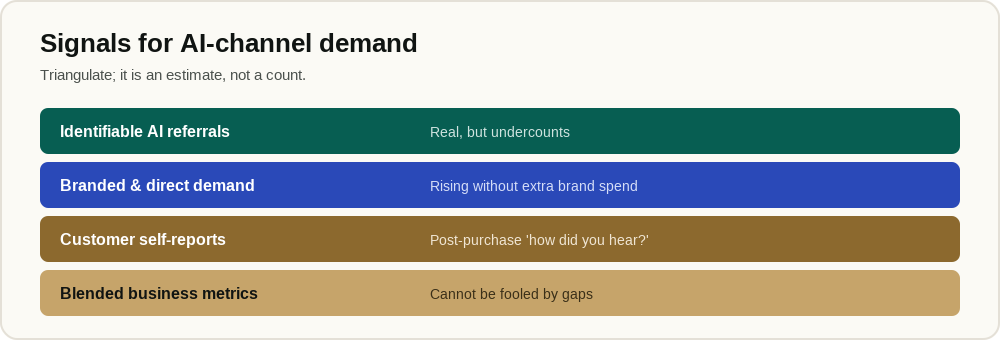
- Use the signals you can see: identifiable AI referrals, growth in branded and direct demand, and customer self-reports.
- Underpin everything with blended business metrics, which cannot be fooled by attribution gaps.
- Combine signals into a clearly labelled estimate; converging imperfect signals beat one false-precise number.
- Do not force false precision, do not ignore AI channels for being hard to measure, and do not over-trust the single referral figure you can see.
Why AI channels resist tracking
Conventional attribution relies on a click you can tag and follow. Much AI-mediated discovery breaks that chain. Someone asks an assistant, gets a recommendation, and later arrives at your site directly or via a branded search, with no trackable link from the assistant to the visit. An answer engine may mention you without sending a click at all. The influence is real, but it happened in a conversation you never saw.
This is the same invisibility that affects AI search and GEO generally. The practical consequence is that a growing share of what influences purchases is undetectable by click-based analytics, so measuring only what you can click-track increasingly understates reality.
The signals you can actually use
Rather than one clean number, assemble a picture from several partial signals.
Identifiable AI referrals
Some AI surfaces do send referral traffic that appears in your analytics. Where it is identifiable, track it. It will undercount total AI influence, because much discovery produces no referral, but it is a real, visible signal and a useful floor.
Branded and direct demand
When people discover you through an AI conversation and then come to you directly or via a branded search, that shows up as growth in branded search volume and direct traffic. Watching these trends, especially rising branded demand without a corresponding increase in your own brand marketing, is one of the better proxies for discovery you cannot see directly.
Ask your customers
The most underused measurement tool is simply asking. A post-purchase "how did you hear about us?" survey, or similar prompts, captures AI-influenced discovery that no analytics tool records. Self-reported attribution is imperfect, but for invisible channels it is often the clearest signal you have.
Blended business metrics
Underpinning all of this, watch total revenue, new-customer cost and overall efficiency. These cannot be fooled by attribution gaps because they come from your actual results. If AI channels are genuinely driving growth, it shows up in the blended picture even when you cannot isolate the channel.
Building a defensible picture
Combine these signals into an estimate, and be honest that it is an estimate. Triangulate: if identifiable AI referrals are rising, branded and direct demand is growing without extra brand spend, and customers increasingly mention AI assistants in surveys, you have converging evidence that AI channels are contributing, even without a precise figure. Converging imperfect signals are more trustworthy than one false-precise number.
Set expectations accordingly with stakeholders. Promising exact AI-channel attribution invites disappointment and bad decisions. Presenting a reasoned estimate from multiple signals, clearly labelled as such, is both more honest and more useful.
What not to do
Do not force AI channels into a false-precision attribution model and then manage to the resulting number as if it were fact; you will be optimising towards an artefact. Do not ignore AI channels because they are hard to measure, that just guarantees you under-invest in a growing source of discovery. And do not over-rotate on the one AI referral number you can see, since it undercounts the real influence. The discipline is to measure honestly at the resolution the channel actually allows.
FAQ
Frequently asked questions
Only partially. Some AI surfaces send identifiable referral traffic you can track, but much AI-mediated discovery produces no click, so a large share is invisible to analytics. You cannot get a precise "AI sent this sale" figure today; you estimate AI influence by combining several partial signals.
Because conventional attribution relies on a trackable click, and much AI discovery breaks that chain: someone gets a recommendation in a conversation, then arrives directly or via branded search with no link from the assistant to the visit. The influence is real but happened where your analytics could not see it.
There is no single best proxy, but growth in branded search and direct traffic without a corresponding increase in your own brand marketing is one of the stronger ones, alongside customer self-reports in post-purchase surveys. Combining them with identifiable AI referrals and blended metrics gives the most trustworthy picture.
Yes. Asking "how did you hear about us?" captures AI-influenced discovery that no analytics tool records. Self-reported attribution is imperfect and should not be treated as exact, but for invisible channels it is often the clearest signal available and well worth collecting.
As a reasoned estimate built from converging signals, clearly labelled as an estimate rather than a precise count. Promising exact attribution invites bad decisions when it proves unreliable. Honest triangulation, identifiable referrals, branded demand trends, surveys and blended metrics, is both more truthful and more useful.
Similar posts
Agentic Commerce
The Agentic Commerce Guide: Selling When AI Does the Shopping
A practitioner's guide to agentic commerce: what it is, what is real versus hype, and the no-regret work, structured data, feeds, trust and frictionless buying, that makes a store ready.
7 min read
Measurement
Measuring ROAS in a Zero-Click World
Platform ROAS tells you less as click paths break. Use blended business metrics, incrementality tests and modelling to measure real return, not platform self-attribution.
3 min read
Measurement
How to Measure AI Search Visibility and Citation Share
Measure AI visibility with a fixed prompt set and citation share, plus referral traffic, branded search and sentiment. A practical method you can run without paid tools.
4 min read
Related services