Measurement
Measuring ROAS in a Zero-Click World

ROAS used to feel precise: spend here, clicks there, revenue attributed back. That precision was always partly an illusion, and it is fading fast. Tracking gaps, privacy rules and zero-click journeys mean platform-reported ROAS increasingly overstates and misattributes. This guide explains why, and how to measure return honestly when the click path is broken.
Quick answer
As more buying journeys happen without trackable clicks, platform-reported ROAS tells you less of the truth. Cookie loss, privacy changes, dark social and AI search all break the clean click path attribution assumes. The fix is not one perfect number but a blend: trust business-level metrics like total revenue and blended ROAS, validate platform claims with incrementality tests and lightweight modelling, and use post-purchase surveys to catch what tracking misses. Manage to real profit, not to a platform's self-reported return.
Key takeaways
- Zero-click journeys and privacy changes make platform ROAS less trustworthy.
- Platforms often over-credit, so reported returns can exceed real revenue.
- Make business-level metrics, blended ROAS and profit your primary scoreboard.
- Validate platform claims with incrementality testing.
- Use lightweight modelling and surveys to capture untracked influence.
Why click-based ROAS is breaking
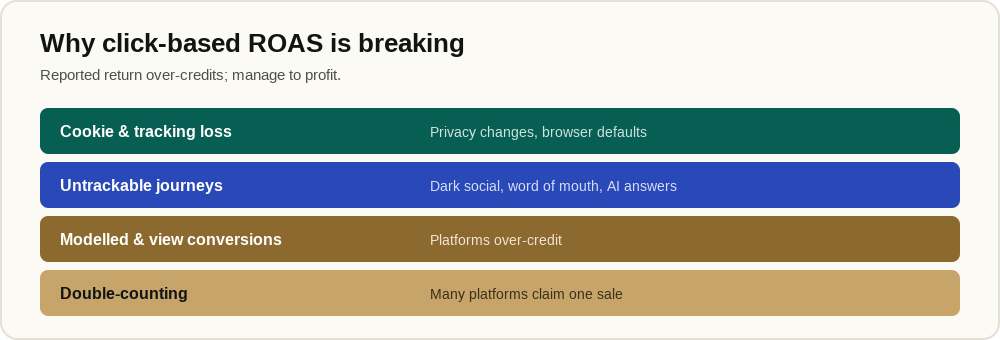
Several forces undermine the tidy attribution model:
The result: add up every platform's reported revenue and you often exceed your actual revenue. Something is being over-counted.
- Cookie and tracking loss from privacy changes and browser defaults.
- More journeys that never produce a trackable click: dark social, word of mouth, AI answers.
- Platforms increasingly reporting modelled and view-based conversions, which can over-credit.
- Multiple platforms each claiming the same sale.
Start from the business, not the platform
The most reliable numbers sit in your own accounts: total revenue, total ad spend, blended ROAS (revenue divided by all spend), new-customer revenue and contribution margin. These cannot be inflated by platform self-attribution. Make business-level metrics your primary scoreboard and treat platform ROAS as a directional input, not truth.
Validate with incrementality
Platform ROAS answers "what did the platform take credit for", not "what would have happened anyway". Incrementality testing, such as geo tests or holdouts, measures true lift: the sales you would not have made without the spend. Even occasional incrementality checks recalibrate how much to trust each channel's reported numbers.
Fill gaps with modelling and surveys
- Lightweight marketing mix modelling estimates each channel's contribution from aggregate data, without per-user tracking.
- Post-purchase "how did you hear about us" surveys capture untracked influence, especially dark social and AI search.
- Together they catch what deterministic tracking now misses.
A practical measurement blend
- Primary: business-level revenue, blended ROAS, new-customer revenue, contribution margin.
- Validation: periodic incrementality tests.
- Context: lightweight modelling plus post-purchase surveys.
- Directional: platform-reported ROAS, treated with healthy scepticism.
FAQ
Frequently asked questions
Yes, but as one input, not the truth. Platform-reported ROAS is directional and often over-credits. Pair it with blended, business-level ROAS and profit to manage reality rather than platform self-attribution.
Total revenue divided by total marketing spend across all channels. Because it uses your own revenue and all spend, it cannot be inflated by any single platform's attribution, which makes it a more honest headline number.
Deterministic tracking misses these. Use post-purchase surveys ("how did you hear about us") and lightweight marketing mix modelling to estimate untracked influence, and incrementality tests to confirm channel lift.
Because multiple platforms, and modelled or view-based conversions, credit the same sales. Over-counting is normal now. It is the clearest sign to manage to blended, business-level numbers.
Shift your primary scoreboard from platform ROAS to business-level profit and blended ROAS, then validate channels with incrementality. No single tracking tweak restores the old precision.
Similar posts
Measurement
Incrementality Testing Explained
Incrementality testing measures the sales your marketing actually caused, not what a platform credits. Why it matters, the main test types, and how to run one simply.
3 min read
Measurement
ROAS vs CAC vs MER: Which Metrics Actually Measure Marketing Performance?
Understand ROAS, customer acquisition cost and marketing efficiency ratio, when each metric helps, and how to use them together for better growth decisions.
11 min read

Measurement
Lightweight Marketing Mix Modelling for Ecommerce
Marketing mix modelling estimates channel contribution from aggregate data, with no per-user tracking. Why it fits a privacy-first world, and how a lightweight version works.
3 min read
Related services