Measurement
Lightweight Marketing Mix Modelling for Ecommerce


As deterministic tracking erodes, marketers need a way to understand channel contribution that does not depend on cookies or clicks. Marketing mix modelling is that method, and it is older than digital attribution. Once the preserve of big brands, lightweight versions are now practical for ecommerce teams. This guide explains what MMM is, why it fits the current moment, and how to approach a simple version.
Quick answer
Marketing mix modelling (MMM) estimates how much each channel contributes to sales using aggregate data, with no per-user tracking. That makes it well suited to a privacy-first, zero-click world where click attribution is breaking. You do not need an enterprise project to benefit: a lightweight MMM, built from your own weekly spend and revenue data, can show which channels move the business and help allocate budget. It is directional, not perfect, and works best alongside incrementality tests and business-level metrics.
Key takeaways
- MMM estimates channel contribution from aggregate data, with no per-user tracking.
- That makes it naturally privacy-safe and robust to zero-click journeys.
- Lightweight versions are now practical for ecommerce teams, not just big brands.
- It is directional guidance for allocation, not precise or real-time truth.
- Use it alongside incrementality testing and business-level metrics.
What marketing mix modelling is
MMM uses statistics to relate your sales over time to your marketing activity and other factors, estimating how much each channel contributes. Crucially, it uses aggregate data, spend and revenue over time, not individual user journeys. That sidesteps the privacy and tracking problems that undermine click attribution.
Why it fits a privacy-first world
Because MMM needs no per-user data, it is unaffected by cookie loss, consent limits and zero-click journeys. It can also capture channels that click attribution misses entirely, such as offline, brand and hard-to-track media. In a world where the clean click path is gone, a method built on aggregates is an advantage, not a compromise.
What a lightweight version looks like
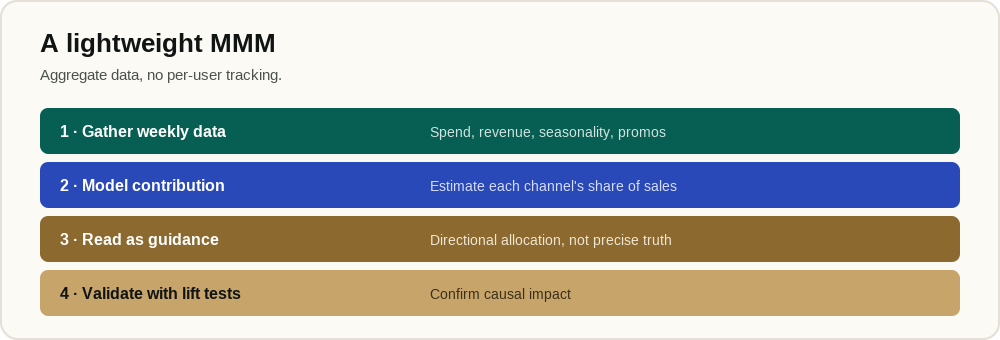
You do not need an enterprise engagement. A lightweight MMM typically involves:
Modern tooling and open approaches have made simple versions accessible to smaller teams.
- Gathering consistent weekly data: spend by channel, revenue, and major external factors like seasonality and promotions.
- Using a model to estimate each channel's contribution to sales.
- Reading the results as directional guidance on allocation, not precise truth.
Strengths and limits
Strengths
- Privacy-safe and robust to tracking loss.
- Captures hard-to-track and offline channels.
- Gives a top-down view of what actually moves sales.
Limits
Use it to guide budget allocation, then confirm with incrementality tests.
- Directional, not precise, and sensitive to data quality.
- Needs enough history and variation to find signal.
- Not a real-time optimisation tool.
How it fits your measurement stack
MMM is one layer, not the whole answer. Pair it with business-level metrics as your scoreboard and incrementality tests as validation. MMM suggests where budget should go; incrementality confirms causal lift; business metrics keep you honest on profit. Together they replace the false precision of click attribution with a more truthful, triangulated picture.
FAQ
Frequently asked questions
Not any more. Lightweight approaches and modern tooling make simple MMM practical for ecommerce teams. You need consistent historical data on spend and revenue, not an enterprise budget.
Attribution tracks individual user journeys and is breaking under privacy changes. MMM uses aggregate data over time to estimate channel contribution, so it needs no per-user tracking and captures channels attribution misses.
It is directional, not precise. It is sensitive to data quality and needs enough history and variation. Treat it as guidance on where budget should go, then validate with incrementality tests.
Consistent, usually weekly, data on spend by channel and total revenue, plus major external factors like seasonality and promotions. Clean, consistent history matters more than volume of fancy inputs.
No, they complement each other. MMM gives a top-down view of contribution; incrementality tests confirm causal lift for specific channels. Using both, with business-level metrics, gives the most honest picture.
Similar posts

Measurement
Measuring ROAS in a Zero-Click World
Platform ROAS tells you less as click paths break. Use blended business metrics, incrementality tests and modelling to measure real return, not platform self-attribution.
3 min read
Measurement
Incrementality Testing Explained
Incrementality testing measures the sales your marketing actually caused, not what a platform credits. Why it matters, the main test types, and how to run one simply.
3 min read

Measurement
Server-Side Tracking and the Cookieless Future
Server-side tracking collects data via your own server, improving accuracy as cookies and client-side tracking erode. What it solves, what it does not, and consent first.
4 min read
Related services