Measurement
Server-Side Tracking and the Cookieless Future

The browser is no longer a reliable place to measure. Third-party cookies are being removed, browser privacy features block scripts, and ad blockers drop tracking tags. Server-side tracking moves the collection point to infrastructure you control. This guide explains what it is, why it matters now, what it does and does not solve, and how to think about adopting it, without pretending it is a way around privacy rules.
Quick answer
Server-side tracking sends conversion and event data to platforms from your own server rather than only from the user's browser. It improves data accuracy and resilience as browsers block third-party cookies and limit client-side tracking, and it gives you more control over what data leaves and how. It is not a loophole around consent: you still need proper permission and privacy compliance. For ecommerce, server-side tracking is becoming a practical necessity to keep measurement and ad optimisation working as the cookieless shift continues.
Key takeaways
- Server-side tracking collects data via your server, not only the browser.
- It improves accuracy and resilience as cookies and client-side tracking erode.
- It gives more control over what data is shared and how.
- It does not remove the need for consent and privacy compliance.
- For ecommerce, it is becoming a practical necessity, done responsibly.
What server-side tracking is
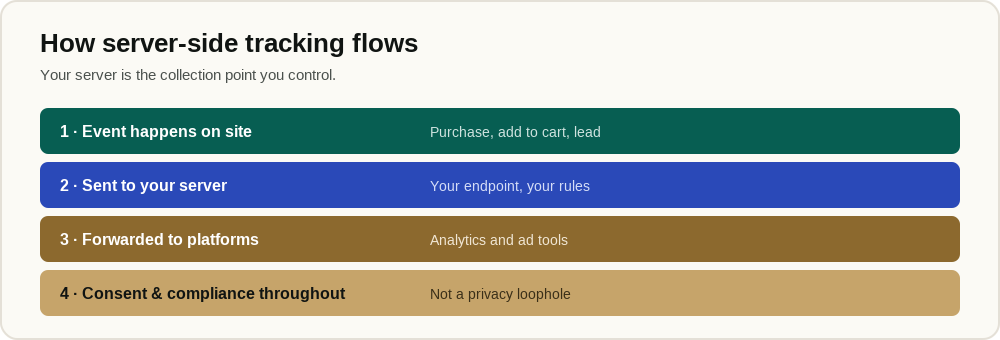
In traditional client-side tracking, the user's browser sends data directly to platforms like analytics and ad tools. In server-side tracking, data goes first to your own server endpoint, which then forwards it to those platforms. You control the middle step: what is collected, what is sent, and to whom.
Why it matters now
Client-side tracking is increasingly unreliable:
Server-side collection is more resilient to all of these, so conversion data is more complete and ad platforms optimise on better signal. As the cookieless shift deepens, this gap widens.
- Third-party cookies are being phased out.
- Browser privacy features and defaults block many tracking scripts.
- Ad blockers prevent tags from firing.
What it does and does not solve
What it helps with
- More accurate, complete conversion data.
- Resilience against browser restrictions and blockers.
- More control over what data is shared and how.
- Better signal for ad platform optimisation.
What it does not do
Server-side is a more robust pipe, not a licence to ignore privacy.
- It does not remove the need for consent or privacy compliance.
- It does not make tracking "invisible" in a way that dodges the rules.
- It does not fix bad measurement design or wrong goals.
Consent and compliance come first
Moving collection to your server does not reduce your obligations. You still need valid consent, honest disclosure, and compliance with applicable privacy law. Done right, server-side tracking can actually improve governance, because you decide what leaves your systems. Done wrong, it is the same tracking with less transparency, which is a risk, not a win.
How to approach adoption
- Treat it as infrastructure: plan it with data and, where needed, technical help.
- Keep consent management and privacy compliance central, not an afterthought.
- Start with your most important conversions and events.
- Validate that server-side data matches reality before trusting it for decisions.
FAQ
Frequently asked questions
Instead of the browser sending data straight to analytics and ad platforms, your own server receives the data first and forwards it. You control the middle step, which makes collection more accurate and more resilient to browser restrictions.
No. You still need valid consent and must comply with privacy law. It changes where data is collected, not whether you need permission. Treating it as a consent loophole is both wrong and risky.
Browsers are removing third-party cookies and blocking client-side scripts, and ad blockers drop tags. Client-side data is getting less complete, which hurts measurement and ad optimisation. Server-side collection is more resilient.
It is more involved than dropping a tag, and usually needs some technical help and planning. Start with your key conversions, keep consent management central, and validate the data before relying on it.
It improves data quality and completeness, which helps, but it does not restore the old click-based precision or fix wrong goals. Pair better data collection with blended metrics and incrementality testing.
Similar posts

Performance Marketing
A First-Party Data Strategy for Ecommerce
First-party data is your most valuable asset as cookies disappear. How to collect it with value and consent, unify it into one customer view, and activate it everywhere.
3 min read

Measurement
Measuring ROAS in a Zero-Click World
Platform ROAS tells you less as click paths break. Use blended business metrics, incrementality tests and modelling to measure real return, not platform self-attribution.
3 min read
Measurement
Ecommerce Marketing Attribution: How to Understand Which Channels Drive Growth
Learn how to interpret ecommerce attribution across Google Ads, Meta Ads and GA4 without confusing attributed revenue with incremental growth.
10 min read
Related services