Measurement
Incrementality Testing Explained

Most attribution answers the wrong question. It tells you what a channel took credit for, not what would have happened without it. Incrementality testing answers the question that matters for budget decisions: did this spend cause additional sales? This guide explains the idea, the main test types, and how to run one without a data science team.
Quick answer
Incrementality testing measures the sales your marketing actually caused, not the sales a platform takes credit for. You compare a group exposed to the ads against a comparable group that was not, and the difference is the true lift. It matters because platform-reported ROAS over-credits, especially for retargeting and branded search that often capture demand that would have converted anyway. Even simple incrementality tests, like geo holdouts, reveal which spend is genuinely driving growth and which is claiming credit it did not earn.
Key takeaways
- Incrementality measures the sales your marketing actually caused, not credited.
- It exists because platform ROAS over-credits, especially retargeting and branded search.
- The method is a comparison of exposed versus held-out groups.
- Geo holdouts are a practical, privacy-safe default.
- Even simple tests reshape budget decisions toward spend that truly drives growth.
The core idea
Incrementality compares two comparable groups: one exposed to your marketing, one held out from it. If the exposed group buys more, that extra is the incremental lift your spend caused. Everything else would have happened anyway. This causal comparison is what attribution models cannot give you, because they only see the paths of people who already converted.
Why it matters
Platform numbers systematically over-credit certain spend:
Incrementality cuts through this by measuring real lift. It is common for a channel with a glowing reported ROAS to show modest true incrementality, which changes where you should put the next dollar.
- Retargeting often reaches people already about to buy.
- Branded search frequently captures demand you created elsewhere.
- Multiple platforms claim the same conversions.
Main types of test
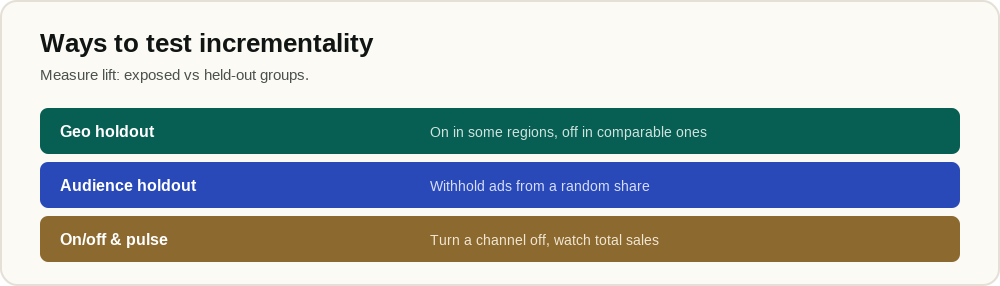
Geo holdout tests
Run ads in some regions and hold them out in comparable regions, then compare sales. Practical, privacy-safe and a good default for many businesses.
Audience holdouts
Withhold ads from a random share of users (where a platform supports it) and compare their behaviour with the exposed group.
On/off and pulse tests
Turn a channel off for a defined period, or run it in bursts, and watch what happens to overall sales. Blunter, but revealing when cleaner tests are not available.
How to run one without a data team
- Pick one important question, such as "is our retargeting incremental".
- Choose a method you can execute cleanly, often a geo holdout.
- Keep test and control as comparable as possible and run long enough for a real signal.
- Compare total sales between groups, not platform-reported conversions.
- Act on the result: reallocate away from spend that shows little true lift.
FAQ
Frequently asked questions
Attribution assigns credit among the touchpoints of people who converted. Incrementality asks whether the spend caused extra sales at all, by comparing exposed and held-out groups. It answers the budget question attribution cannot.
A geo holdout: run a channel in some regions and pause it in comparable ones, then compare total sales. It is privacy-safe, needs no user-level tracking, and works for most businesses.
Retargeting often reaches people already about to buy, so it takes credit for sales that would have happened anyway. High reported ROAS with low true lift is a classic pattern that incrementality testing exposes.
No. Geo holdouts and simple on/off tests are runnable by most teams. Keep groups comparable, run long enough for signal, and compare total sales rather than platform conversions.
Periodically, and especially before big budget shifts or when a channel's reported ROAS drives major decisions. Occasional tests are enough to recalibrate how much to trust each channel's numbers.
Similar posts

Measurement
Measuring ROAS in a Zero-Click World
Platform ROAS tells you less as click paths break. Use blended business metrics, incrementality tests and modelling to measure real return, not platform self-attribution.
3 min read

Measurement
Lightweight Marketing Mix Modelling for Ecommerce
Marketing mix modelling estimates channel contribution from aggregate data, with no per-user tracking. Why it fits a privacy-first world, and how a lightweight version works.
3 min read

Measurement
Ecommerce Marketing Attribution: How to Understand Which Channels Drive Growth
Learn how to interpret ecommerce attribution across Google Ads, Meta Ads and GA4 without confusing attributed revenue with incremental growth.
10 min read
Related services