Performance Marketing
How to Allocate a Marketing Budget Across Channels

Budget allocation is where marketing strategy becomes real. You can have the right ideas about every channel, but the money has to be divided somehow, and that division decides what actually happens. Most allocation is done badly: by last year's split, by whichever channel showed the best platform ROAS last month, or by whichever platform rep pushed hardest. There is a better way, and it is not complicated. It rests on measuring honestly, respecting diminishing returns, and holding a sensible balance between safety, growth and learning. This piece sets out a practical framework for dividing an ecommerce marketing budget across channels.
Quick answer
Allocate your marketing budget by balancing three things: protecting what reliably works, funding growth channels with headroom, and reserving a small share for testing. Use blended business metrics and incrementality rather than platform-reported ROAS to decide what deserves more, account for diminishing returns so you do not overfund a saturated channel, and keep retention funded because it is usually your cheapest return. Review and shift quarterly rather than chasing weekly noise.
Key takeaways
- Allocate by genuine contribution using blended metrics and incrementality, not platform-reported ROAS, which double-counts and over-credits demand harvesting.
- Think in three buckets: protect what reliably works, fund growth channels with headroom, and reserve roughly a tenth for testing.
- Respect diminishing returns and move money towards the best return on the next pound, not the best average return.
- Do not pour everything into your top channel once it saturates; the next pound is often more productive elsewhere.
- Keep retention funded, because selling to existing customers is usually the cheapest return available.
- Review allocation monthly or quarterly with blended data, not weekly, to avoid chasing noise and disrupting algorithms.
Decide on honest numbers, not platform ROAS
The first discipline is to allocate based on what channels genuinely contribute, not what they claim. Platform-reported ROAS double-counts across channels and over-credits demand harvesting, so allocating by it will reliably overfund branded search and retargeting, which mostly collect demand other activity created, and underfund the channels that create that demand.
Use blended metrics, total revenue and new-customer cost against total spend, as your top-line truth, and use incrementality tests to settle whether a channel is genuinely additive before you pour money into it. Allocation decisions are exactly the big calls that justify the effort of a holdout test.
Balance three buckets
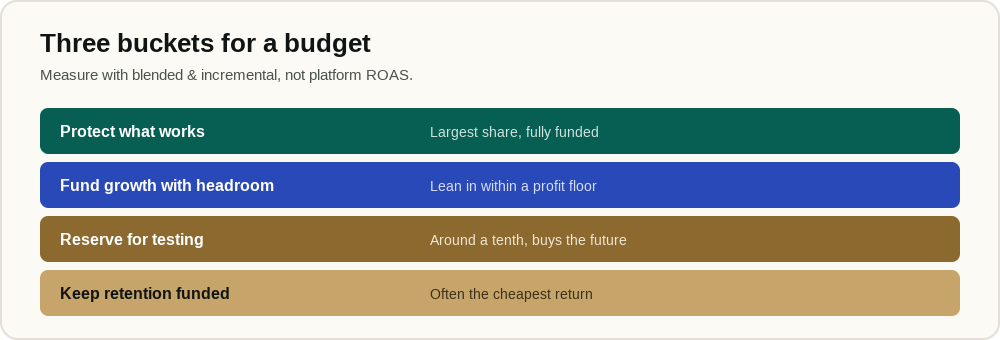
A useful way to structure allocation is to think in three buckets rather than one optimised number.
Protect what works
The largest share goes to channels you have evidence are genuinely profitable and reliable. This is the base of the business, and the job here is to fund it fully but not to overfund it past the point of diminishing returns. Reliability earns the money; it does not earn infinite money.
Fund growth with headroom
A second share goes to channels or tactics that are working and still have room to grow, where additional spend is likely to find profitable demand. This is where you lean in deliberately, accepting somewhat lower efficiency in exchange for volume, within a profit floor. Growth channels are where the business gets bigger, so starving them to protect a flattering blended ROAS is a slow mistake.
Reserve for testing
A small share, often around a tenth, is reserved for genuine experiments: new channels, new creative approaches, new audiences. Most tests will not pay off, which is the point; the reserve buys you the option to discover the next reliable channel before it becomes obvious and expensive. A budget with no testing bucket is a budget betting the future looks exactly like the present.
Respect diminishing returns
Within every channel, more spend buys less. A channel that is highly profitable at its current budget may be mediocre at double, because you exhaust the cheap demand first. Good allocation means moving money towards the channel with the best return on the next pound, not the best average return overall.
In practice this means you rarely pour everything into your best-performing channel. Once it approaches saturation, the next pound is often better spent elsewhere, even in a channel with a lower average return, because its next pound is more productive than your winner's next pound. Allocation is about the margin, not the average.
Keep retention funded
Acquisition dominates most budgets, but retention is usually the cheapest return available, because selling to an existing customer costs far less than winning a new one. Email and lifecycle marketing, loyalty, and post-purchase experience rarely compete for budget as loudly as paid acquisition, which is exactly why they get underfunded. Protect a share for retention; it often has the best return on the next pound of anything you could fund.
Review on the right cadence
Finally, match your review cadence to the signal. Weekly performance is mostly noise, and reallocating every week chases randomness and disrupts the algorithms you depend on. Review the overall allocation on a slower rhythm, monthly or quarterly, using blended metrics and any test results, and make deliberate shifts. Let the channels run inside their budgets between reviews. Discipline about cadence is as important as the split itself.
FAQ
Frequently asked questions
Balance three buckets: the largest share protecting channels proven to work, a growth share for channels with room to expand, and roughly a tenth reserved for testing. Size each using blended metrics and incrementality rather than platform ROAS, and respect diminishing returns within every channel.
Because platform ROAS double-counts across channels and over-credits demand harvesting, and because high average ROAS often means a channel is small and near saturation. Allocating by it overfunds demand collectors and starves demand creators. Use blended and incremental measures, and allocate on marginal return.
A common guide is around ten percent, adjusted for your appetite and stability. The point is to always fund some genuine experiments, since most will fail but the occasional winner becomes your next reliable channel. A budget with no testing bucket assumes the future resembles the present.
Monthly or quarterly for the overall split, using blended metrics and test results. Reallocating weekly chases noise and disrupts the bidding algorithms, which need stability to perform. Let channels run inside their budgets between reviews and make deliberate shifts at review points.
Yes. Retention, through email, lifecycle, loyalty and post-purchase experience, is usually the cheapest return available because it costs far less than new acquisition, yet it is routinely underfunded because it does not compete as loudly. Protect a dedicated share for it.
Similar posts
Measurement
Incrementality Testing Explained
Incrementality testing measures the sales your marketing actually caused, not what a platform credits. Why it matters, the main test types, and how to run one simply.
3 min read
Performance Marketing
Profit-First PPC: Managing Ads to Margin, Not Revenue
Two campaigns at the same ROAS can have opposite profitability. How to manage PPC to contribution margin, feed margin-aware values into bidding, and account for returns and discounts.
5 min read
Measurement
Full-Funnel Measurement for Ecommerce
Bottom-heavy measurement starves the funnel. The job and metrics for each stage, from awareness to retention, and how to read them together instead of judging all on last-click.
5 min read
Related services