Performance Marketing
Profit-First PPC: Managing Ads to Margin, Not Revenue

ROAS is the number most ad accounts are managed to, and it is a trap. Return on ad spend tells you how much revenue you got per unit of spend, but revenue is not profit. A campaign selling low-margin products at a 4x ROAS can be less profitable than one selling high-margin products at 3x. Manage to revenue and you will happily pour budget into the wrong things. Profit-first PPC fixes this by putting margin at the centre of how you value conversions and judge campaigns. It is not complicated, but it requires you to know your numbers and to push them into places most accounts never touch. This piece explains how.
Quick answer
Profit-first PPC means optimising paid campaigns towards contribution margin rather than revenue or raw ROAS. Two campaigns with the same ROAS can have very different profitability once product margin, discounts, shipping and returns are accounted for. By feeding margin-aware values into bidding and judging campaigns on the profit they leave behind, you stop scaling spend that looks efficient but loses money.
Key takeaways
- ROAS measures revenue efficiency, not profit; two campaigns at the same ROAS can have opposite profitability.
- Contribution margin is what a sale leaves after cost of goods, fees, shipping and returns; manage PPC so margin comfortably exceeds ad spend.
- Calculate real contribution margin by product or product group first; it is the foundation for every efficiency target.
- Send a margin-aware conversion value so bidding optimises towards profit, not raw revenue, even if you start with a few margin bands.
- Evaluate campaigns on the profit they leave behind, and scale or cut on that basis.
- Build returns and discounts into your margin figures, or you will optimise towards profit that is not real.
Why ROAS alone misleads
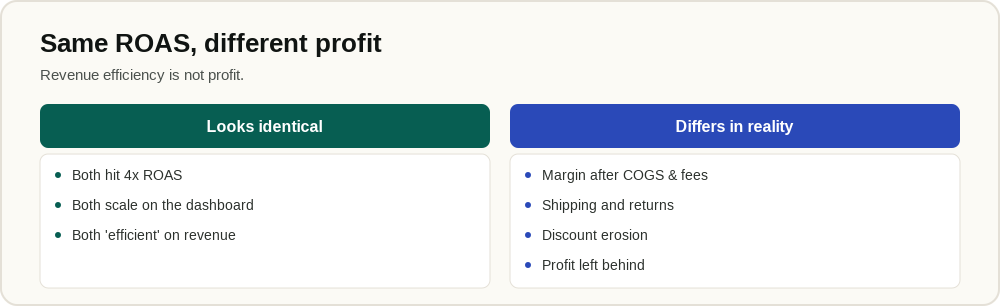
ROAS treats every pound of revenue as equal. It is not. The revenue from a product with a 60 percent margin is worth far more than the same revenue from a product with a 20 percent margin, because what matters at the end of the month is what is left after costs.
Consider two campaigns both hitting 4x ROAS. One sells your highest-margin range; the other sells a loss-leader you discount heavily and ship free. On a ROAS dashboard they look identical. In your accounts, one funds the business and the other drains it. If your bidding optimises both to the same ROAS target, it will cheerfully scale the one losing you money.
What contribution margin means here
Contribution margin is what a sale contributes after the variable costs of making and fulfilling it: cost of goods, payment fees, shipping, and expected returns. It is the money a sale actually leaves on the table before fixed overheads. Managing PPC to profit means managing it so that the contribution margin from sales comfortably exceeds the ad spend that drove them.
Work out your real margin by product
You cannot manage to margin you have not calculated. Start by establishing contribution margin for your products or product groups. This is accounting work, not marketing work, but it is the foundation. Without it, every efficiency target you set is guesswork dressed up as rigour.
Feed margin into bidding
The lever that makes this operational is conversion value. Most stores send the order total, the revenue, as the conversion value to Google and Meta. Smart Bidding and Advantage+ then optimise towards revenue.
If instead you send a margin-aware value, the profit contribution rather than the gross revenue, the algorithms optimise towards profit. This is often called value-based bidding or profit-based bidding. It means the system learns to chase the sales that actually make you money, not just the sales that are easiest to generate.
This is not trivial to implement cleanly, because it requires your margin data to flow into your conversion tracking. But even an approximation, grouping products into a few margin bands and sending a representative value, is far better than optimising on undifferentiated revenue.
Judge campaigns on profit left behind
Alongside bidding, change how you evaluate. Instead of asking which campaign had the best ROAS, ask which campaign left the most contribution margin after its ad spend. A campaign spending heavily at a modest ROAS on high-margin products can be your best performer by this measure, and a tidy-looking high-ROAS campaign on thin-margin clearance can be your worst.
This reframing changes decisions. You scale by profit contribution, you cut by profit drain, and you stop rewarding campaigns for the accident of selling cheap-to-advertise products at a flattering ratio.
Do not forget returns and discounts
Two costs quietly destroy PPC profitability and rarely show up in ROAS: returns and discounts. A category with a high return rate can turn a healthy ROAS into a loss once you account for the goods that come back. Heavy discount codes do the same by eroding the margin on every order. Fold both into your margin figures, or you will be optimising towards a profit that does not survive contact with reality.
FAQ
Frequently asked questions
ROAS is revenue divided by ad spend. Profit is what remains after all costs, including cost of goods, fees, shipping, returns and the ad spend itself. A high ROAS can still mean a loss if margins are thin, which is why profit-first management does not rely on ROAS alone.
Value-based bidding feeds a value representing each conversion's worth, ideally its profit contribution rather than its revenue, into the bidding algorithm, so the system optimises towards the most valuable sales. It requires margin data to flow into your conversion tracking but can meaningfully improve profitability.
No. Precise per-product margins are ideal, but grouping products into a few margin bands and sending a representative value is far better than optimising on undifferentiated revenue. Start approximate and refine.
Returns remove the revenue and often leave you with return shipping and handling costs, so a category with high returns can turn a profitable-looking ROAS into a real loss. Build an expected return rate into your contribution margin by product group.
Not necessarily. ROAS targets are still a convenient operational control, but set them with margin in mind so that different product groups carry different targets, and judge overall success on contribution margin rather than on the ROAS number itself.
Similar posts
Measurement
ROAS vs CAC vs MER: Which Metrics Actually Measure Marketing Performance?
Understand ROAS, customer acquisition cost and marketing efficiency ratio, when each metric helps, and how to use them together for better growth decisions.
11 min read
Measurement
Break-Even ROAS: How to Calculate the Minimum Return Your Ecommerce Ads Need
Learn how to calculate break-even ROAS using contribution margin, understand its limitations, and set practical advertising targets for ecommerce profitability.
11 min read
Performance Marketing
Diagnosing a declining ROAS before you cut the budget
When return on ad spend slips, the instinct is to cut spend. Usually the real problem is measurement, creative or funnel balance. Here is how to find it.
6 min read
Related services