AI Search & GEO
llms.txt Explained: Does It Help AI Search Visibility?

As AI assistants read the web, publishers have asked for a simple way to point them at the content that matters, much as robots.txt and sitemaps do for search crawlers. llms.txt is one answer: a human-readable file that lists and describes your key pages in markdown. It has generated a lot of discussion and some adoption, along with healthy scepticism. This article explains what llms.txt is, what it is not, and whether it is worth your time, without overselling an unproven convention.
Quick answer
llms.txt is a proposed plain-text file, placed at your domain root, that offers large language models a curated, markdown-formatted guide to your most important content. It is an emerging convention, not an official standard, and no major AI engine has confirmed it as a ranking or citation signal. It may help AI tools find and understand your key pages, so it is low-risk to add, but it is not a shortcut to being cited and should never replace clear, accessible content.
Key takeaways
- llms.txt is an emerging, unofficial convention, not a confirmed ranking signal.
- It offers AI tools a curated markdown map of your key content.
- It is low-risk and cheap to add, but has no proven visibility benefit yet.
- It never replaces accessible, clear, authoritative pages.
- Treat it as a minor optional tactic within a broader GEO programme.
What llms.txt actually is
Free tool: create both files with the llms.txt and robots.txt generator, including rules for AI crawlers.
llms.txt is a markdown file at yourdomain.com/llms.txt that summarises your site and links to your most important pages, optionally with short descriptions. The idea is to give a model a clean, curated map of your content rather than making it infer structure from navigation and HTML. Some implementations also offer expanded versions that inline the full text of key pages.
What it is not
It is not an official web standard, and no major AI provider has publicly confirmed that they read it or use it as a ranking or citation signal. It is not a replacement for accessible pages, sitemaps or structured data. And it is not a way to force inclusion in AI answers. Treat current claims about its impact as unproven.
The honest case for adding it
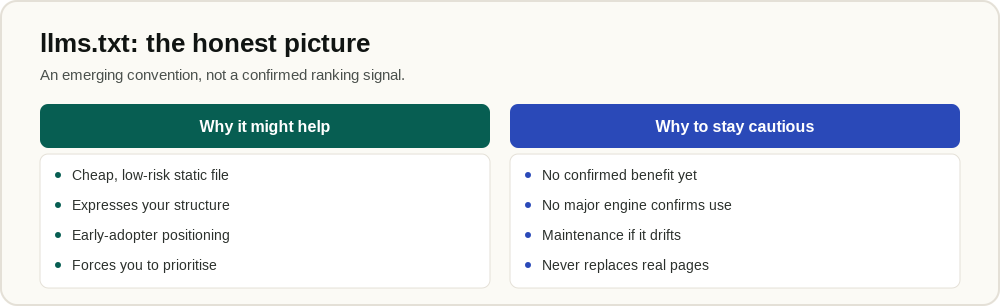
- It is cheap and low-risk: a single static file that cannot harm your normal SEO.
- It expresses your preferred structure clearly, which may help tools that choose to use it.
- Early adoption positions you well if the convention gains traction.
- It encourages a useful exercise: deciding which pages actually matter most.
The honest case for caution
- There is no confirmed benefit today, so do not expect visibility gains.
- It can create maintenance work if it drifts out of sync with your real content.
- It must never divert effort from the fundamentals that genuinely drive AI visibility: accessible, clear, authoritative pages.
How to implement it sensibly
- 01Keep it small and curated: your most important hubs and pages, not everything.
- 02Write a short, accurate description for each linked page.
- 03Place it at the domain root and keep it in sync when key pages change.
- 04Do not rely on it; make sure the same pages are crawlable and well-structured in the normal way.
- 05Monitor whether the convention gains official support, and adjust effort accordingly.
Where it fits in a GEO programme
llms.txt is a minor, optional tactic within generative engine optimization. The heavy lifting still comes from retrievable pages, answer-ready content, a strong brand entity and genuine authority. Add llms.txt as a tidy extra if you like, but spend your real effort where the evidence points.
FAQ
Frequently asked questions
No major provider has publicly confirmed that they read or act on llms.txt. Treat any claimed benefit as unproven for now.
No. It is a separate static file that does not affect normal crawling or ranking. The risk is wasted effort, not harm.
No. robots.txt controls crawler access; llms.txt is an optional guide to your key content for language models. They serve different purposes.
If it is quick and you keep it accurate, it is reasonable as a low-risk early bet. Do not prioritise it over accessible, clear content.
No. Keep your XML sitemap, which search engines actually use. llms.txt is an extra, not a substitute.
Similar posts
AI Search & GEO
Generative Engine Optimization (GEO): The Complete Playbook for Getting Cited by AI
A practitioner's guide to GEO: how to get your brand cited by ChatGPT, Google AI Overviews and Perplexity. What works, what you cannot control, and a 30-day plan.
6 min read
Technical SEO
Structured Data for AI Search: What Actually Helps
Which schema types matter for AI visibility, and which do not. How structured data supports AEO and GEO, the rules for using it well, and where people go wrong.
4 min read
AI Search & GEO
How to Write Answer-Ready Content That LLMs Quote
Answer-ready writing makes your content easy for AI to quote correctly. Lead with the answer, mirror the question, keep facts self-contained, and use lift-friendly formats.
3 min read
Related services