AI Search & GEO
How to Write Answer-Ready Content That LLMs Quote

AI answers are assembled by lifting and paraphrasing passages from sources. If your content is clear and self-contained, a model can quote you accurately. If it is rambling or context-dependent, the model will prefer a competitor or paraphrase without credit. Answer-ready writing is the craft of making your content the easiest correct source to use. This article gives the concrete techniques, which also improve readability and conventional SEO.
Quick answer
Answer-ready content is writing a language model can lift cleanly and correctly. To write it, lead with a direct, self-contained answer to each question, use headings that mirror how people ask, keep one idea per section, state facts in short declarative sentences, and add tables, step lists and FAQs. The goal is that a model can quote a sentence or two from you and be right, without stitching together scattered clues.
Key takeaways
- Answer-ready content is content a model can quote cleanly and correctly.
- Lead with a self-contained answer and mirror the question in headings.
- Keep facts short, declarative and free of back-references.
- Use tables, lists and FAQs that map to how answers are built.
- Precision and accuracy make you a preferred source; write for humans first.
Lead with the answer
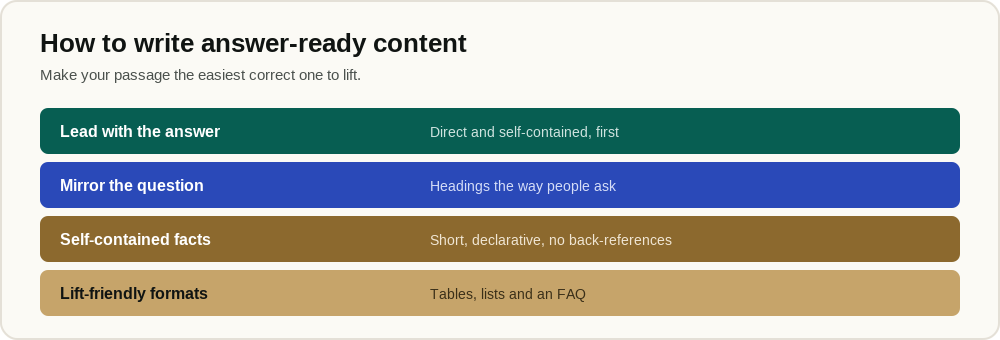
The highest-leverage habit is to answer the question in the first sentence or two of the relevant section, phrased so it stands alone. A reader, or a model, should get the answer without reading the surrounding paragraphs. Put the nuance and reasoning after the answer, not before it.
Mirror the question in your structure
Write headings the way people actually ask, and keep each section focused on a single question. When a model looks for the answer to a specific query, an unambiguous heading and a focused section make your passage the obvious match.
Keep facts self-contained
Avoid sentences that only make sense with the one before them. Replace "as mentioned above, this means..." with a complete statement. Short, declarative facts are easier to lift correctly than long, winding explanations full of pronouns and back-references.
Use formats models lift well
These structures map directly to how answers are reconstructed, and they reduce the chance of your point being mangled.
- Tables for comparisons and specifications.
- Numbered lists for processes and steps.
- Bulleted lists for criteria and options.
- An FAQ for common follow-up questions, marked up with schema.
Be precise and accurate
Models are cautious about sourcing claims that look shaky or contradict the wider web. State specifics plainly, avoid vague hedging where a clear fact exists, and keep everything accurate and current. A reputation for precision makes you a preferred source over time.
Write for humans first
Answer-ready does not mean robotic. The same qualities that help a model, clarity, structure, directness, help readers too. Write naturally, lead with value, and avoid padding. Content that bores a human will not be rescued by being machine-friendly.
A quick checklist
- 01Does each section answer one clear question?
- 02Is the answer stated first, and does it stand alone?
- 03Are the key facts short and declarative?
- 04Have you used a table or list where it fits?
- 05Is there an FAQ for follow-up questions?
- 06Is everything accurate and current?
FAQ
Frequently asked questions
No. The same clarity and structure that help models also help readers. Done well, it improves both.
State the direct answer at the start of the relevant section, and ideally summarise the page's main answer near the top. Put nuance afterwards.
Schema helps machines parse FAQs and processes, but clear writing is the foundation. Add schema to support good content, not to rescue unclear content.
It can, if the model answers on the spot. The trade-off is being the cited, trusted source; focus click effort on commercial and complex queries.
As long as it needs to fully answer the question and its follow-ups, and no longer. Padding for length weakens both clarity and trust.
Similar posts
AI Search & GEO
Generative Engine Optimization (GEO): The Complete Playbook for Getting Cited by AI
A practitioner's guide to GEO: how to get your brand cited by ChatGPT, Google AI Overviews and Perplexity. What works, what you cannot control, and a 30-day plan.
6 min read
AI Search & GEO
What Is Answer Engine Optimization (AEO)?
AEO structures your content so engines can extract a concise, correct answer. Learn the building blocks, why accuracy matters, and how AEO bridges SEO and GEO.
4 min read
AI Search & GEO
How to Get Your Brand Cited by ChatGPT
How to improve your odds of being cited by ChatGPT: retrievable pages, answer-ready content, consistent branding and real authority. Honest about what you cannot control.
4 min read
Related services