Technical SEO
Headless CMS and SEO for Ecommerce


Headless architecture is fashionable, and like most fashionable architecture it attracts both overclaiming and fear. Some present it as an SEO upgrade; others warn it will wreck your rankings. Both are wrong. Going headless changes how your site is built, not whether it can rank. This piece explains what headless actually is, why it is neutral for SEO in principle, and what genuinely determines the outcome in practice. The honest message is that headless is a tool that gives you control, and control cuts both ways: it lets a capable team build an excellent, fast, fully optimised site, and it lets a careless one ship something search engines struggle with. The architecture is not the story; the execution is.
Quick answer
A headless CMS separates the content layer from the front end, delivering content through APIs that a separate front end renders. It is neutral for SEO: it neither helps nor hurts by itself. What decides the SEO outcome is how the front end is built, whether pages are server-rendered so search engines reliably receive the content, whether URLs, metadata, structured data and internal links are all handled properly, and whether performance is good. Headless gives you the freedom to do all of that well, and equally the freedom to get it badly wrong.
Key takeaways
- A headless CMS delivers content through APIs that a separate front end renders; it is neutral for SEO by itself.
- Search engines judge the pages the front end renders, not how content is stored, so execution decides the outcome, not the architecture.
- The biggest risk is browser-only JavaScript rendering; server-side rendering so content is in the HTML is the most important fix.
- Headless does not provide SEO fundamentals automatically: URLs, metadata, structured data, internal links and sitemaps must be built deliberately.
- Performance can be excellent on headless, but that is a result of good engineering, not a gift of the architecture.
- Choose headless for flexibility and multi-channel needs, not for an SEO boost it does not inherently give; then build the fundamentals in from the start.
What headless means
In a traditional setup, the CMS both stores content and renders the pages visitors see. In a headless setup, the CMS stores and manages content but delivers it through APIs, and a separate front end consumes those APIs and renders the pages. The content layer has no "head", no fixed presentation, hence headless.
The appeal is flexibility: the same content can feed a website, an app, and other channels, and front-end teams can build with modern tools independent of the CMS. None of that is inherently about SEO. It is an architectural choice about how content and presentation are decoupled.
Why it is neutral for SEO
Search engines do not care how your content is stored or managed. They care about the pages they receive: whether they can access the content, understand it, and find it fast and well-structured. A headless CMS sits behind the scenes; what reaches search engines is whatever the front end renders.
So headless neither helps nor harms SEO by itself. A headless site with a well-built front end can rank superbly. A headless site with a poorly built front end can rank badly. The same is true of traditional sites. The architecture is not the deciding factor, which is why the overclaiming and the fear are both misplaced.
What actually decides the outcome
Because the front end is everything for SEO, that is where attention belongs. A few things matter most.
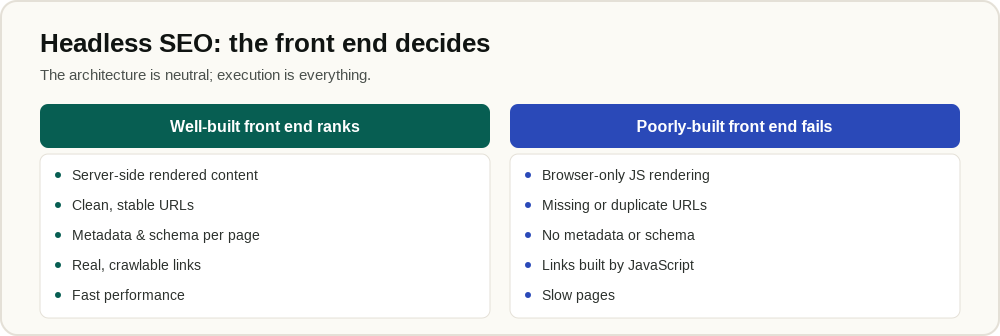
Rendering is the big one. Headless front ends are often built as JavaScript applications, and if content is rendered only in the browser, search engines may receive near-empty pages. The fix is the same as for any JavaScript site: server-side rendering or an equivalent, so the content search engines need is present in the HTML they first receive. This is the single most common way headless SEO goes wrong, and the single most important thing to get right.
Beyond rendering, the ordinary fundamentals must all be handled deliberately, because headless does not provide them automatically the way an integrated platform often does. URLs must be clean and stable. Metadata, titles and descriptions must be generated correctly per page. Structured data must be present. Internal linking must be real, crawlable links. Sitemaps, canonicals and the rest of the technical baseline must be implemented. On an integrated platform many of these come built in; on headless, your team builds them, which is both the freedom and the responsibility.
Performance is the final piece, and headless done well can be excellent here, modern front ends can be very fast, which helps both ranking and conversion. But speed is a result of good engineering, not a free gift of the architecture.
How to decide
Choose headless for the right reasons, the flexibility, the multi-channel content, the front-end freedom, not because you expect an SEO boost it does not inherently provide. If you do go headless, treat the SEO fundamentals as first-class requirements of the front-end build from the start, with server-side rendering at the top of the list. If you keep an integrated platform, you are not missing an SEO advantage. The right question is whether headless suits your wider needs; the SEO will be as good as the execution either way.
FAQ
Frequently asked questions
Neither by itself; it is neutral. Search engines judge the pages your front end renders, not how content is stored, so the SEO outcome depends entirely on how well the front end is built. A well-built headless site can rank superbly, and a poorly built one can rank badly, exactly as with traditional sites.
Not inherently. Headless is an architectural choice about decoupling content from presentation; it does not provide an SEO advantage on its own. Any ranking improvement comes from building a fast, well-optimised front end, which you can also do on a traditional platform. Choose headless for flexibility, not for an expected SEO boost.
Browser-only JavaScript rendering. Headless front ends are often JavaScript applications, and if content renders only in the browser, search engines may receive near-empty pages. The fix is server-side rendering or an equivalent so the content is present in the HTML search engines first receive. This is the most common and most important thing to get right.
Often, in the sense that integrated platforms provide many fundamentals automatically, metadata, sitemaps, clean URLs, while headless leaves them to your front-end build. That is the responsibility side of headless freedom. None of it is lost permanently; your team simply has to implement URLs, metadata, structured data, internal links and sitemaps deliberately.
Only if the flexibility, multi-channel content delivery and front-end freedom genuinely suit your needs, not for an SEO boost it does not inherently provide. If you do, treat the SEO fundamentals, especially server-side rendering, as first-class requirements from the start. If an integrated platform serves you well, you are not missing an SEO advantage by keeping it.
Similar posts
SEO
Ecommerce SEO: The Complete Guide to Growing Organic Revenue
Learn how to grow ecommerce organic revenue with category SEO, product pages, technical SEO, structured data, internal linking, content strategy and measurement.
24 min read

Technical SEO
JavaScript SEO for Ecommerce
Search engines render JavaScript, but imperfectly and with delay, so JS-only content and links are a risk. The pragmatic rule: put what matters for SEO in the HTML crawlers first receive.
5 min read

Technical SEO
Ecommerce Site Architecture for SEO
Good ecommerce architecture is shallow and logical, so authority and crawlers reach every product. How to structure categories, internal links and URLs, and tame large-catalogue problems.
5 min read
Related services