AI Search & GEO
A 30-Day GEO Action Plan

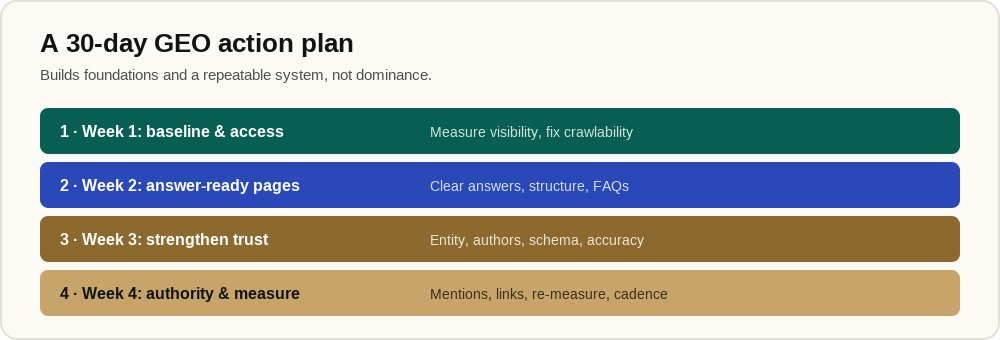
GEO can feel abstract, so here is a concrete month to get moving. This plan is realistic: 30 days is enough to build the foundations, fix the obvious gaps and set up measurement, not to win a competitive space outright. Treat it as the on-ramp to an ongoing programme. Each week has a clear focus and a short checklist you can actually complete.
Quick answer
A practical 30-day GEO plan runs in four weekly phases: week one, baseline your current AI visibility and audit technical accessibility; week two, make your most important pages answer-ready and well structured; week three, strengthen trust with entity, author and schema work; week four, build authority, re-measure and set an ongoing cadence. It will not make you dominant in a month, but it establishes the foundations and a repeatable system.
Key takeaways
- A 30-day GEO plan builds foundations and a repeatable system.
- Week one: baseline visibility and fix technical access.
- Week two: make priority pages answer-ready.
- Week three: strengthen entity, author and schema trust signals.
- Week four: build authority, re-measure and set an ongoing cadence.
Week 1: baseline and access
Establish where you stand and remove blockers.
- Build a fixed question set from real customer questions and run it through the main AI engines; record presence and competitors.
- Check that your key pages are crawlable, return valid status codes and expose their facts in the HTML.
- Confirm you are not inadvertently blocking the crawlers that power retrieval.
- Note your three biggest gaps to guide the weeks ahead.
Week 2: make pages answer-ready
Turn your priority pages into content an engine can quote.
- For your top pages, lead each section with a clear, self-contained answer.
- Rewrite headings to mirror how people actually ask.
- Add tables, step lists and an FAQ where they fit.
- Tighten facts into short, accurate, declarative sentences.
Week 3: strengthen trust
Give engines reasons to rely on you.
- Add or improve organisation and author information, with named, credentialled authors.
- Implement relevant structured data: organisation, author, FAQ and article where appropriate.
- Make your brand name, descriptions and key details consistent across the web.
- Ensure your most important claims are accurate and consistent with reputable sources.
What to expect
Thirty days builds foundations and a system, not dominance. Expect clearer, more quotable pages, stronger trust signals, a measured baseline and early signs of movement. Real competitive visibility comes from sustaining the work month after month.
FAQ
Frequently asked questions
No. A month builds foundations, fixes gaps and sets up measurement. Competitive visibility comes from sustaining the work over time.
No. You can baseline with a manual question set and standard analytics. Add tools later to scale measurement if useful.
Focus the 30 days on your most important pages and hubs. Establish the method, then roll it out across the rest over the following months.
No. GEO builds on SEO foundations. Most of this plan, accessibility, clarity, trust, authority, strengthens conventional search too.
Compare your week-four question-set results with week one, and watch supporting signals like AI referral traffic and branded search over the following cycles.
Similar posts
AI Search & GEO
Generative Engine Optimization (GEO): The Complete Playbook for Getting Cited by AI
A practitioner's guide to GEO: how to get your brand cited by ChatGPT, Google AI Overviews and Perplexity. What works, what you cannot control, and a 30-day plan.
6 min read
Measurement
How to Measure AI Search Visibility and Citation Share
Measure AI visibility with a fixed prompt set and citation share, plus referral traffic, branded search and sentiment. A practical method you can run without paid tools.
4 min read
AI Search & GEO
How to Write Answer-Ready Content That LLMs Quote
Answer-ready writing makes your content easy for AI to quote correctly. Lead with the answer, mirror the question, keep facts self-contained, and use lift-friendly formats.
3 min read
Related services