AI Search & GEO
How to Get Your Brand Cited by ChatGPT

ChatGPT answers many questions by drawing on its training and, when browsing is active, on live web sources it retrieves and cites. Brands increasingly want to be one of those cited sources, because a mention inside the answer carries trust and visibility that a buried link does not. There is no secret setting and no paid placement. What works is making your content the clearest, most credible answer to a real question, so the model has a reason to use you. This article explains the practical steps, and is honest about what is and is not in your control.
Quick answer
To get cited by ChatGPT, make your content easy to retrieve, easy to quote and safe to trust. That means crawlable pages with facts stated plainly in the HTML, a clear answer to each likely question near the top, consistent naming of your brand and products, and genuine authority signals across the web. You cannot guarantee a citation, because ChatGPT decides what to reference, but these steps measurably improve your chances.
Key takeaways
- ChatGPT cites sources that are retrievable, quotable and trustworthy.
- Put key facts in the HTML and lead with a clear, self-contained answer.
- Consistent naming and visible expertise build the entity the model recognises.
- Off-site authority and original assets raise your odds more than any on-page trick.
- You can improve your chances but never guarantee a citation.
Understand how ChatGPT finds sources
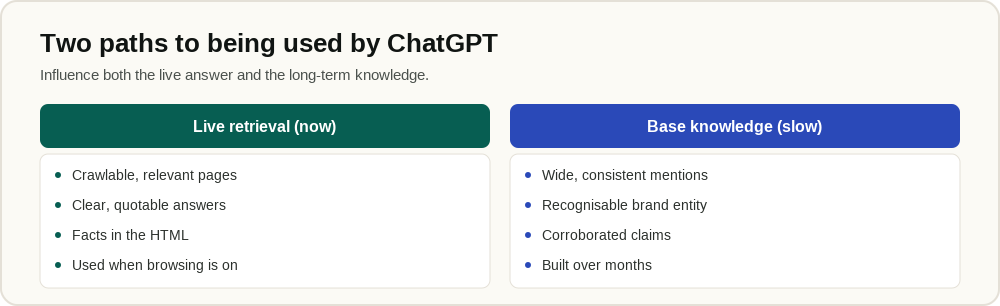
ChatGPT uses two broad paths. Its base knowledge comes from training data, which you influence slowly by being widely and consistently referenced over time. Its live answers, when it browses, come from retrieving pages in the moment, which you influence the same way you influence any search system: be accessible, relevant and clear. You are optimising mainly for the live-retrieval path and for the long-term reputation that shapes the base knowledge.
Make your pages retrievable
If a crawler cannot reach or render your page, it cannot be used. Keep important pages crawlable, use valid status codes and canonical URLs, and make sure your key facts exist in the HTML rather than appearing only after a click, hover or script. Avoid blocking the user agents that AI crawlers use unless you have a deliberate reason. Accessibility is the price of entry.
Write answer-ready content
Models prefer content they can lift cleanly.
The goal is that a model can quote a sentence or two from you and be correct, without needing to stitch together scattered clues.
- Put a direct, self-contained answer near the top of the page.
- Use question-style headings that match how people ask.
- Keep one idea per section and write short, factual sentences for the things that matter.
- Add an FAQ for the common follow-up questions, and mark it up with schema.
Build trust the model can verify
ChatGPT is cautious about sourcing claims it cannot corroborate. Strengthen the signals it can check.
- Name your authors and show real experience and credentials.
- Keep facts accurate and consistent with the wider web; contradictions make you a risky source.
- Use consistent names for your brand, products and key people so you form a recognisable entity.
- Earn mentions and links from places the model already trusts.
What you cannot control
You cannot force a citation, choose the exact wording, or guarantee you appear for a given prompt. Answers vary by user, phrasing, time and whether browsing is active. Treat GEO as improving odds across many prompts, not as a switch for a single result.
How to check if it is working
Define a set of real prompts a buyer might ask, run them periodically, and record whether and how your brand appears. Watch for referral traffic from ChatGPT where it is reported, and for lifts in branded search and direct visits. Keep the log simple and look for trends, not single results.
FAQ
Frequently asked questions
No. There is no legitimate paid placement inside organic answers. You earn citations through clarity, accuracy and authority.
If you block the crawlers an engine uses to retrieve live sources, you remove yourself from that path. Only block deliberately, understanding the trade-off.
Yes. The same foundations, crawlability, clear content and authority, underpin both ranking and citation. Weak SEO makes citation unlikely.
Ranking places a link in a list; citation places your brand inside a written answer. The inputs overlap, but the outcome and how you measure it differ.
A monthly check across a fixed prompt set is enough for most brands to spot trends without over-reacting to normal variation.
Similar posts
AI Search & GEO
Generative Engine Optimization (GEO): The Complete Playbook for Getting Cited by AI
A practitioner's guide to GEO: how to get your brand cited by ChatGPT, Google AI Overviews and Perplexity. What works, what you cannot control, and a 30-day plan.
6 min read
AI Search & GEO
How to Appear in Google AI Overviews
How to improve your chances of being cited in Google AI Overviews: rank for the query, answer it cleanly, and strengthen E-E-A-T. What you can and cannot control.
5 min read
AI Search & GEO
How to Get Cited by Perplexity
Perplexity retrieves and cites live sources. Learn how to be discoverable, relevant, quotable and credible so it chooses your page, and how to audit your citations.
3 min read
Related services